Dry Matter Basis Calculator
Convert feed and forage tests from as-fed to dry matter basis, compare wet and dry feeds fairly, and estimate how much dry matter each ration ingredient supplies.
Use lab results when you have them. Book values are useful for planning, but actual moisture and nutrient concentration can shift with harvest timing, storage, weather, and feed handling.
Dry matter feed report
Alfalfa hay converted from as-fed to dry matter basis.
| Feed class | Typical moisture | Typical dry matter | Planning note |
|---|---|---|---|
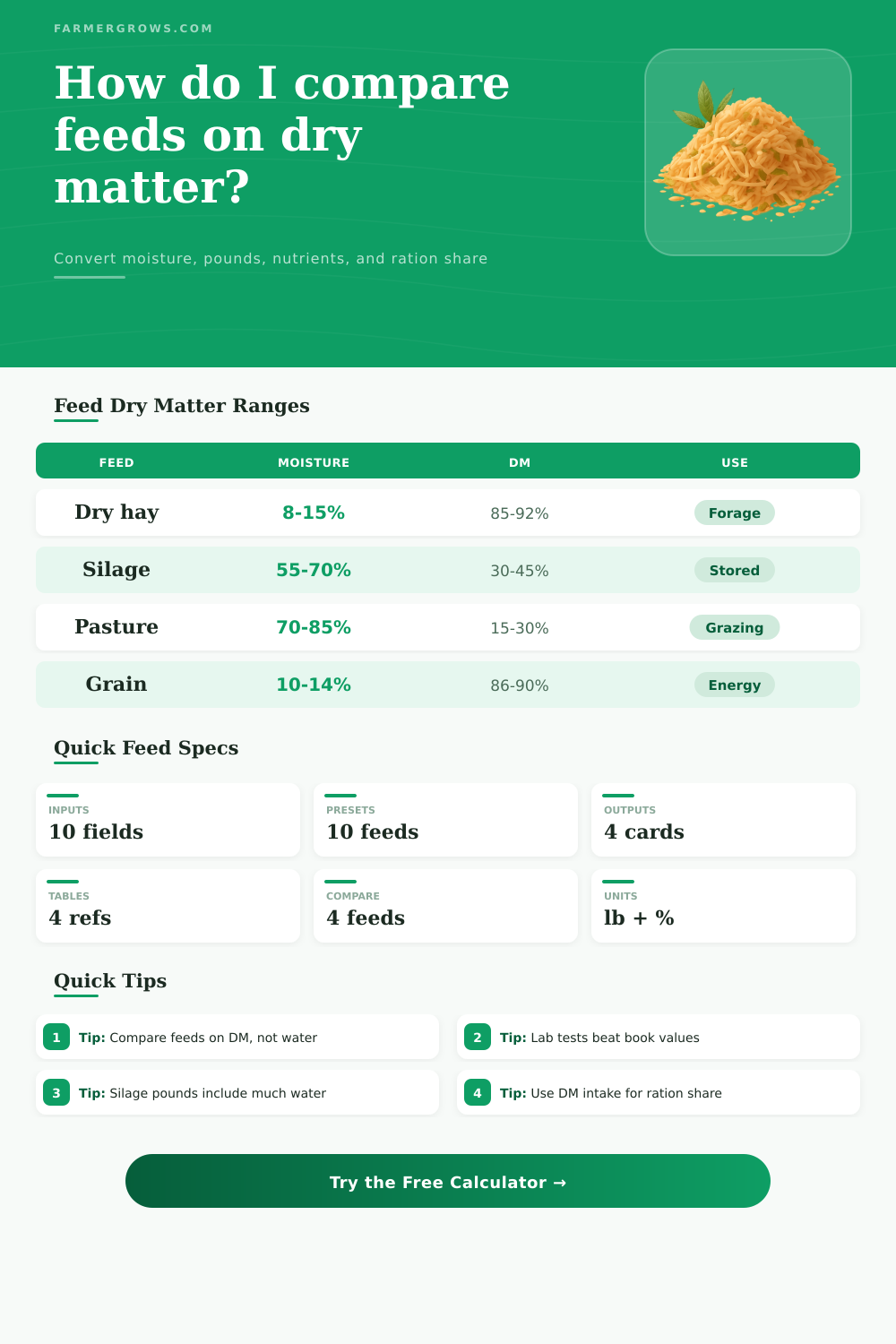
| Dry hay | 8% to 15% | 85% to 92% | Usually stable if cured and stored dry. |
| Haylage or baleage | 40% to 60% | 40% to 60% | Moisture varies widely by harvest and wrap timing. |
| Corn silage | 55% to 70% | 30% to 45% | Great example where as-fed pounds can mislead. |
| Fresh pasture | 70% to 85% | 15% to 30% | High water concentration reduces DM per bite. |
| Dry grain | 10% to 14% | 86% to 90% | Often traded on moisture-adjusted grain basis. |
| Wet byproducts | 55% to 80% | 20% to 45% | Compare delivered price and nutrients on DM basis. |
| As-fed nutrient | Feed DM | DM basis formula | DM basis result |
|---|---|---|---|
| 10% crude protein | 50% | 10 / 0.50 | 20.0% CP on DM |
| 16% crude protein | 88% | 16 / 0.88 | 18.2% CP on DM |
| 6% fat | 35% | 6 / 0.35 | 17.1% fat on DM |
| 24% NDF | 40% | 24 / 0.40 | 60.0% NDF on DM |
| 28% TDN | 35% | 28 / 0.35 | 80.0% TDN on DM |
| Animal or feed use | DM intake planning | Protein attention | Energy attention |
|---|---|---|---|
| Beef cow maintenance | About 2.0% of body weight | Forage CP often drives supplement need. | TDN drops fast in mature forage. |
| Lactating dairy cow | Often 3.0%+ of body weight | Balance amino acid and rumen needs. | Energy density limits milk response. |
| Growing cattle | About 2.3% to 2.8% of body weight | Protein and frame growth are linked. | Compare grain and forage on DM basis. |
| Sheep or goats | Often 2.5% to 4.0% of body weight | Late gestation raises nutrient density. | High moisture feed can cap intake. |
| Horses | Commonly 1.5% to 2.5% of body weight | Forage test prevents over-supplementing. | Keep forage intake and starch in view. |
| Ingredient class | Common DM inclusion | Watch item | Practical check |
|---|---|---|---|
| Forage hay | 40% to 100% | Protein, fiber, dust, mold | Weigh bales and test lots. |
| Silage or haylage | 20% to 70% | Fermentation, spoilage, moisture | Recheck DM after rain or face changes. |
| Pasture | Variable | Daily intake uncertainty | Use residual height and condition score. |
| Grain | 0% to 60% | Starch load and acidosis risk | Step up gradually and balance fiber. |
| Mineral mix | Usually under 5% | Salt, copper, selenium, magnesium | Follow tag directions and species limits. |
Tip: When comparing hay, silage, pasture, grain, or byproducts, first convert every feed to dry matter pounds and dry matter nutrient percentages. Water changes the scale weight, not the nutrient concentration in the dry feed.
Tip: Ration inclusion should be checked on dry matter. A wet feed can look like a large share of the bunk by weight while contributing a much smaller share of actual dry matter.
When you purchase animal feeds by the bale or by a ton, you are paying for water. The feed that is in the bale can vary by twenty pound of dry matter per load. The silage that are loaded into the truck can also vary by many pounds of dry matter between each loads.
The nutrients that is required by the animal are contained within the dry matter of the feed. Since the dry matter is the source of the nutrients, the water must be strip from the equation. The only way to compare the different types of feed is by comparing the dry matter contents of each type of feed.
How to Compare Animal Feeds by Dry Matter
The calculator will provide you with the conversions of your entered numbers. You enter the number of pounds of feed, the moisture test results of the feed, and the protein level of the feed into the calculator. From this data, the calculator will provide the dry matter pounds of the feed, the dry matter nutrient level of the feed, and the amount of the ration that the feed fulfills for you.
These values will allow you to determine whether the feed in your barn is worth the price that you paid for it, or whether you need to adjust the amount of feed that you need to provide to the next cutting of the feed. The moisture content of the feed is rarely stable. Moisture content can vary between a field that is cut at dawn and the same field at noon.
The same is true of a bunker face that is exposed to rainfall. You can enter the moisture content into the calculator to allow for the same flexibility that farmer have in the field. Should a new core sample be taken of the feed, the updated value of the moisture content can be entered into the calculator so that the other calculations will be updated automaticly.
When feed is tested in the laboratory, the results of the nutrient test can be provided on a dry matter basis or an as-fed basis. Some test results may be provide on a dry basis because the dry matter values of the feed are what is important. Other test results will show the nutrients in they as-fed (as-fed means that moisture is included in the weight of the feed) form.
The values of the nutrients will be divided by the dry matter fraction to account for the dry matter to arrive at the same value as the nutritionist who perform the calculations by hand. If the value of the nutrients in the feed is visible on the calculator, the farmer can determine if the animals are receiving the amount of forage that they require to fulfill the targets for the animals ration. Because feed contains water, any inclusion in the ration will be expensive.
Wet byproduct are often purchased because they are relatively cheap per ton. However, the wet byproduct will only include a quarter of the weight of the byproduct as dry matter. Using the calculator will allow you to determine the number of dry pounds of each ingredient.
Furthermore, the calculator will factor in the shrink and the refusal of the feed. Should the dry pounds of each ingredient be less than the ration that is targeted for the animal, the farmer will be aware that the animal will run short of feed before the next delivery of feed. Many farms do not use only one type of feed for there animals.
Most farms will use at least three different type of feed, and each of the feeds can vary in moisture content by thirty point or more. The calculator is designed to accept any combination of feed. Thus, it is possible to change the percentage of each type of feed and determine the impact that it will have upon the ration.
The outputs of the calculator are of the same units as the inputs of the calculator. Thus, the differences between the types of feed can be seen due to the same unit. The book value of the feed is convenient, but it does not reveal the way in which the feed can vary between each load.
The book value of alfalfa hay may be twelve percent moisture. However, the hay in the barn may be eight or eighteen percent moisture. The only way to determine the moisture content of the alfalfa hay is to measure the amount of moisture in the hay.
The calculator will allow the value of the moisture to be made useful for the farmers by converting the moisture measurement to pounds and percentages that can be use that day. The most important piece of information for the farmer is the simple habit of the inclusion of each type of feed as dry matter first. Once this step is perform, the other element of the ration will fall into place for the farmers.