Drainage Gravel Calculator
Estimate clean stone, bag counts, and total weight for French drains, trench fills, and low-spot repairs before you order material.
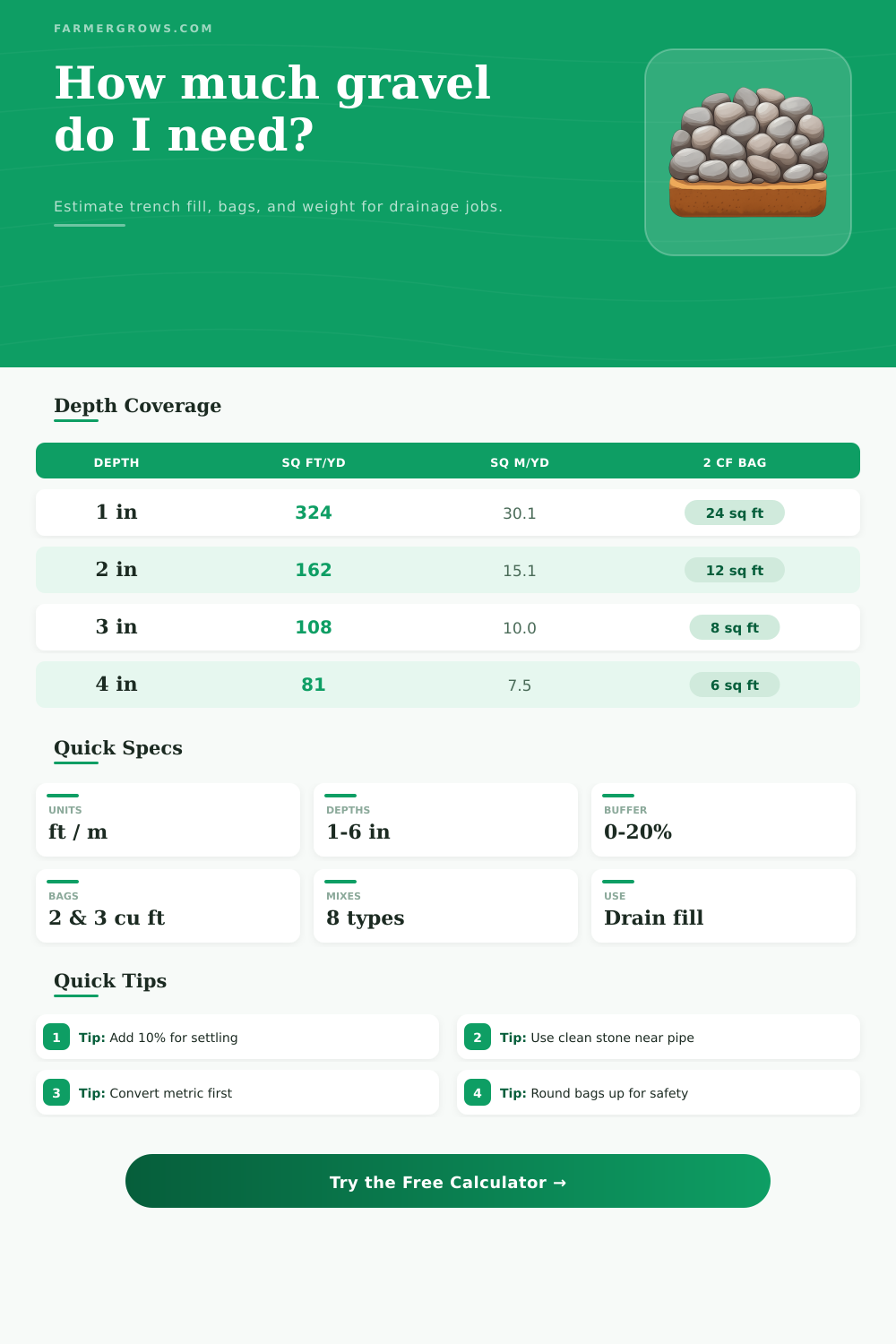
| Depth | Sq ft / yd3 | Sq m / yd3 | 2 cf bag |
|---|---|---|---|
| 1 in | 324 | 30.1 | 24 sq ft |
| 2 in | 162 | 15.1 | 12 sq ft |
| 3 in | 108 | 10.0 | 8 sq ft |
| 4 in | 81 | 7.5 | 6 sq ft |
| 6 in | 54 | 5.0 | 4 sq ft |
| 8 in | 40.5 | 3.8 | 3 sq ft |
| Bag / bulk | Volume | Per yd3 | 3 in cover |
|---|---|---|---|
| 2 cu ft bag | 0.074 yd3 | 13.5 bags | 8 sq ft |
| 3 cu ft bag | 0.111 yd3 | 9.0 bags | 12 sq ft |
| 1 cubic yard | 27 cu ft | 1.0 yd3 | 108 sq ft |
| 1 cubic meter | 35.3 cu ft | 1.31 yd3 | 141 sq ft |
| Project | Area | Yards @ 3 in | 2 cf bags |
|---|---|---|---|
| Backyard French drain | 40 sq ft | 0.37 yd3 | 5 bags |
| Driveway edge trench | 150 sq ft | 1.39 yd3 | 21 bags |
| Window well ring | 50 sq ft | 0.46 yd3 | 7 bags |
| Downspout strip | 36 sq ft | 0.33 yd3 | 5 bags |
| Orchard low spot | 600 sq ft | 5.56 yd3 | 84 bags |
Use the 10% buffer for most jobs. It helps cover settling, wheelbarrow loss, and the extra stone you usually want around pipe and bends.
If the trench is shallow, a clean 3/4 in or #57 stone usually drains better than rounded river rock because it packs less tightly around the voids.
Drainage gravel are a material that can be used to manage water that is present within the soil. Often, water that sits upon surface of the soil in a yard is unable to infiltrate into the soil due to the soil being either compacted or containing high amount of clay. Drainage gravel can help to resolve this issue in that the drainage gravel naturaly allow for water to flow through its voids rather than permitting the water to remain upon the surface.
Drainage gravel can be used to build a structure known as a French drain, which utilizes both drainage gravel and a perforated pipe to allow water to flow away from a particular area. When building a French drain, you should utilize the correct type of drainage gravel. Drainage gravel of 3/4-inch washed gravel or #57 crushed stone is often recommended.
How to Build a French Drain Using Gravel
Crushed stone gravel that contain angular pieces is preferred to rounded stones like pea gravel. Because the angular pieces of crushed stone tend to interlock with one another, the gravel is less likely to shift within the trench compared to rounded stones. Additionally, because people often use pea gravel as a decorative gravel in landscaping projects, the rounded nature of the gravel can shift within the drain and may slow the drainage of water from that area.
In order to ensure that there is enough drainage gravel to perform the construction of the French drain, it is first necessary to calculate the numbers of cubic yards of drainage gravel that will be required for the project. To calculate the number of cubic yards, it is first necessary to calculate the area of the trench that will be dug. If the trench is of rectangular dimension, the length of the trench multiplied by the width of the trench will provide the area.
If the area is of a circular shape, the area can be calculated with the equation: area = pi times the radius of the circle to the power of two. Once you have determined the area, you can multiply the area by the depth of the drainage gravel. The result will be the number of cubic feet of drainage gravel that will be required.
Dividing that number by 27 will reveal the number of cubic yards of drainage gravel that will be required. A 10% surplus of drainage gravel is typically recommended for these projects, since drainage gravel can settle during the building process. Drainage gravel can be purchased either in bags or in bulk.
Drainage gravel that you purchase in bags is useful for small projects, but bulk purchases is the more efficient option for those with large projects that require the drainage gravel. If you are to purchase drainage gravel in bags, the bag will contain a listed volume of drainage gravel, such as 2 or 3 cubic feet of gravel. The number of bags of drainage gravel will be calculated from the total volume of drainage gravel that will be needed.
Additionally, drainage gravel is heavy. You should consider the weight of drainage gravel when purchasing drainage gravel in bags. The truck or trailer that you will utilize for transporting drainage gravel should be able to support the weight of the drainage gravel.
There are some common mistakes that may be made when building a French drain. One common mistake is utilizing dirty drainage gravel. Dirty drainage gravel often contains fines, which are small particles of clay or sand.
These fine particles can clog the voids within the drainage gravel, preventing water from flowing through the drainage system. Another common mistake is not using enough depth for the drainage gravel. A minimum depth of 3 inches of drainage gravel should be used; if the soil to be drained contains high amounts of clay, the depth should be 4 inches.
Finally, you should place a geotextile fabric into the trench prior to placing the drainage gravel; the geotextile will prevent soil from entering the drainage gravel. In order to ensure that a drainage gravel system remains efficient and effective over time, some maintenance of the system is necessary. One type of maintenance is flushing sediment out of the French drain each year.
Especially if the French drain is located near a roof, leaves may fall into the drain and clog the drainage system. Additionally, you may test the soil for it’s percolation rate; if the rate at which water percolates through the soil is high, the drainage gravel may not be sufficient; in this case, sand may need to be added to the drainage system. By performing these maintenance steps, the drainage gravel will remain effective at the draining of water from an area.