💧 Drainage Coefficient Calculator
Estimate the drawdown rate, flow, and fill volume for fields, swales, drainage strips, and wet spots.
Choose a shape, target drawdown depth, and removal time. The calculator converts metric or imperial inputs, then estimates the coefficient, flow, and drainage media needed.
💧 Drainage Coefficient Results
Estimate the coefficient, flow, and material demand for your drainage layout.
Coefficient Breakdown
| Depth | Sq ft per yd3 | M2 per m3 | Best use |
|---|---|---|---|
| 1 in | 324 | 39.0 | Thin top layer |
| 2 in | 162 | 19.5 | Shallow fill |
| 3 in | 108 | 13.0 | Common trench top |
| 4 in | 81 | 9.8 | Deeper bedding |
| 6 in | 54 | 6.5 | Heavy drainage bed |
| Package | Volume | Per yard | Coverage at 3 in |
|---|---|---|---|
| 2 cu ft bag | 2 cu ft | 13.5 bags | 24 sq ft |
| 3 cu ft bag | 3 cu ft | 9 bags | 36 sq ft |
| 1 cu ft bag | 1 cu ft | 27 bags | 12 sq ft |
| Bulk yard | 27 cu ft | 1 yard | 324 sq ft |
| Project | Area | Cubic yards | 2 cu ft bags |
|---|---|---|---|
| Backyard swale | 120 sq ft | 0.37 yd3 | 6 bags |
| Shed drain bed | 60 sq ft | 0.19 yd3 | 3 bags |
| Driveway edge | 180 sq ft | 0.56 yd3 | 9 bags |
| Barn runoff line | 240 sq ft | 0.74 yd3 | 10 bags |
The drainage coefficient measure the speed at which water drains out of the soil. The drainage coefficient is expressed in inches per day and tells you how many water must be removed from the soil within the required timeframe. If a person calculates the drainage coefficient correctly, a drainage system will effectively remove the standing water from the soil.
However, if the drainage coefficient are calculated incorrectly, then the drainage system will not effectively remove the water from the soil. The type of soil will impact the functioning of the drainage coefficient. For example, clay soil retain water very well and, therefore, has a low drainage coefficient.
How Drainage Coefficient Affects Soil Drainage
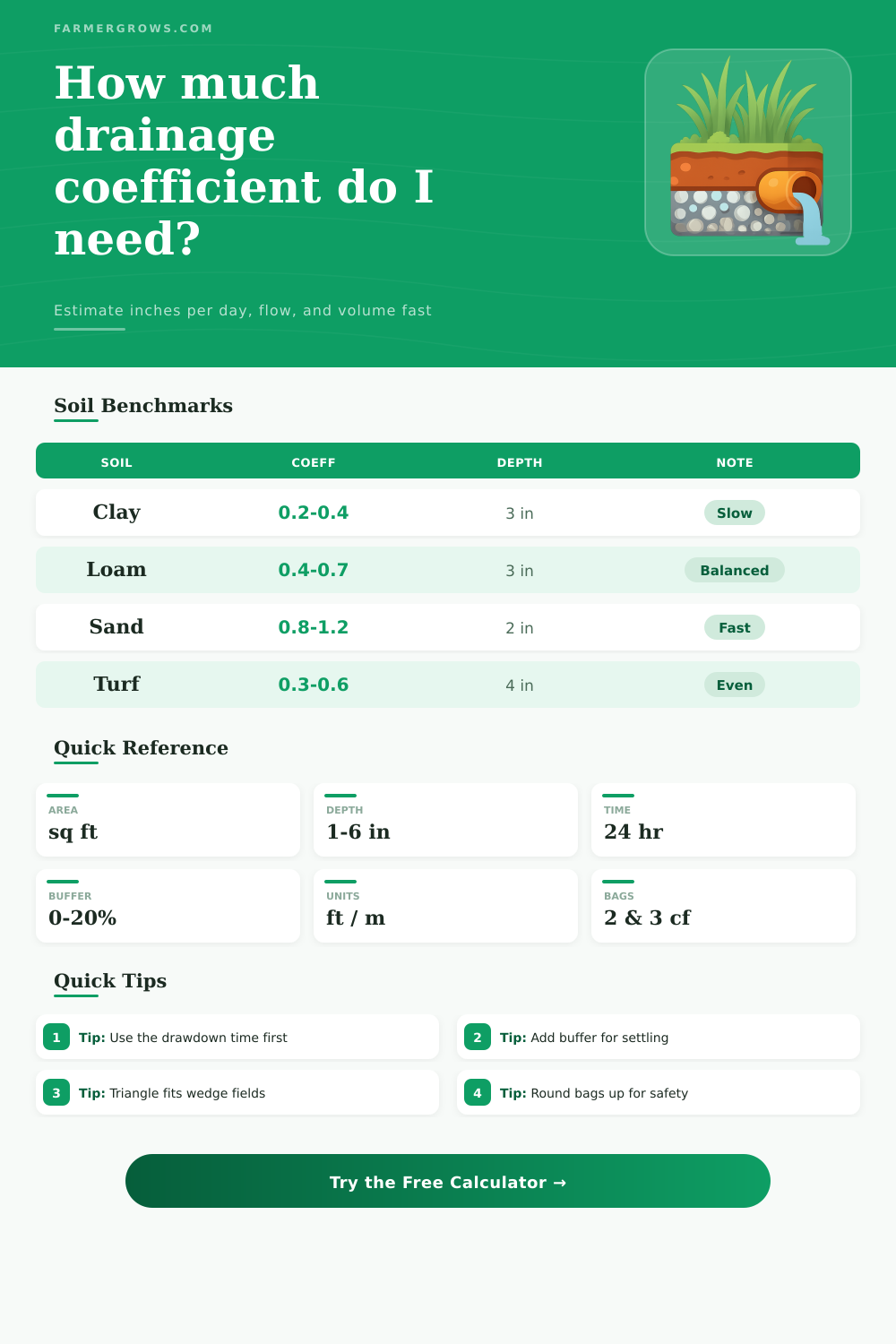
Drainage coefficients for clay soil ranges from 0.2 inches per day to 0.4 inches per day. Sand soil allows water to pass through the soil very quickly. For this reason, sand soil has a high drainage coefficient for sand soil range from 0.8 inches per day to 1.2 inches per day.
Loam soil sits in the middle of sand and clay soil, and drainage coefficients for loam soil range from 0.4 inches per day to 0.7 inches per day. Additionally, turf grass will impact the drainage coefficient of the soil. Turf grass establish a mat of roots that hold the soil together and prevent it from washing away.
As a result, turf grass has a drainage coefficient that range from 0.3 inches per day to 0.6 inches per day. Another consideration in the creation of a drainage system is the contributing area. The contributing area is the size of the land that contribute to the amount of water that enters the low spot in the land or forms a puddle.
Many individuals will make the mistake of only measuring the size of the puddle that forms in the area with the drainage system. However, the size of the puddle is not the same than the contributing area. The contributing area must be calculated to determine how much total water will flow into the drainage system.
For instance, the water that runs off the roof lines or aprons of barns will flow into the contributing area and increase the amount of water that the drainage system must be able to move. Depending on the drainage coefficient, there are different drainage materials that can be used for the drainage system. For instance, one material that can be used is washed rock.
Washed rock contain gaps between stones that remain open so that water can flow through the stones. Crushed rock does not have gaps between the rocks as it does with washed rock, and the crushed rock may pack together very closely. Therefore, crushed rock will reduce the amount of water that drains through the drainage system.
Another consideration for drainage systems is the inclusion of a buffer. A buffer is an excess amount of drainage that is calculated into the drainage system. Using a buffer of 10 to 15 percent in the drainage system for accounts for the compaction of soil and the settling of silt in the drainage area.
Another consideration when creating a drainage system is the drawdown time for the project. Drawdown time is the amount of time that you want the water to remain on the surface before it is completely drained from the soil. For instance, if the drawdown time is to be 24 hours, then the drainage system must be constructed to remove all standing water within a 24-hour time frame.
Other projects may require the standing water to be drained in a shorter time frame, such as a catch basin that drains in six hours. However, other projects, such as drainage basins for orchards, may allow for a longer drawdown time. When calculating the drainage system, you also must calculate the volume of stone that is required.
The volume of stone that is required for the drainage system will depend on the depth of the layer of stone and the total square footage of the area that will be treated with the drainage system. For example, if the stone is to be spread one inch deep, then one cubic yard of stone will cover 324 square feet. However, if the stone is spread three inches deep, one cubic yard of stone will only cover 108 square feet.
Similarly, if the stone is spread six inches deep, one cubic yard of stone will only cover 54 square feet. Bags of stone may be used for small drainage projects. However, for larger drainage projects, bulk stone must be used as it is more efficient in moving large volume of stone.
Therefore, the volume of stone that is used in the drainage system must be calculated based off the drainage coefficient for the site, the soil type at the site, and the contributing area that will feed the drainage system.