Dog Food Dry Matter Calculator
Convert dog food labels from as-fed guaranteed analysis to dry matter, compare wet and dry foods fairly, estimate carbs by difference, and check calorie-normalized servings.
Dry matter removes moisture from the comparison so a canned food and a kibble can be judged on the same nutrient basis. Use label values as a planning estimate, because guaranteed analysis minimums and maximums are not the same as a full lab analysis.
Dry Matter Results
Results convert the label to a moisture-free basis, estimate carbs by difference when selected, and normalize calories for serving and food-to-food comparison.
| Food type | Common moisture | Dry matter range | Best calorie basis | Comparison note |
|---|---|---|---|---|
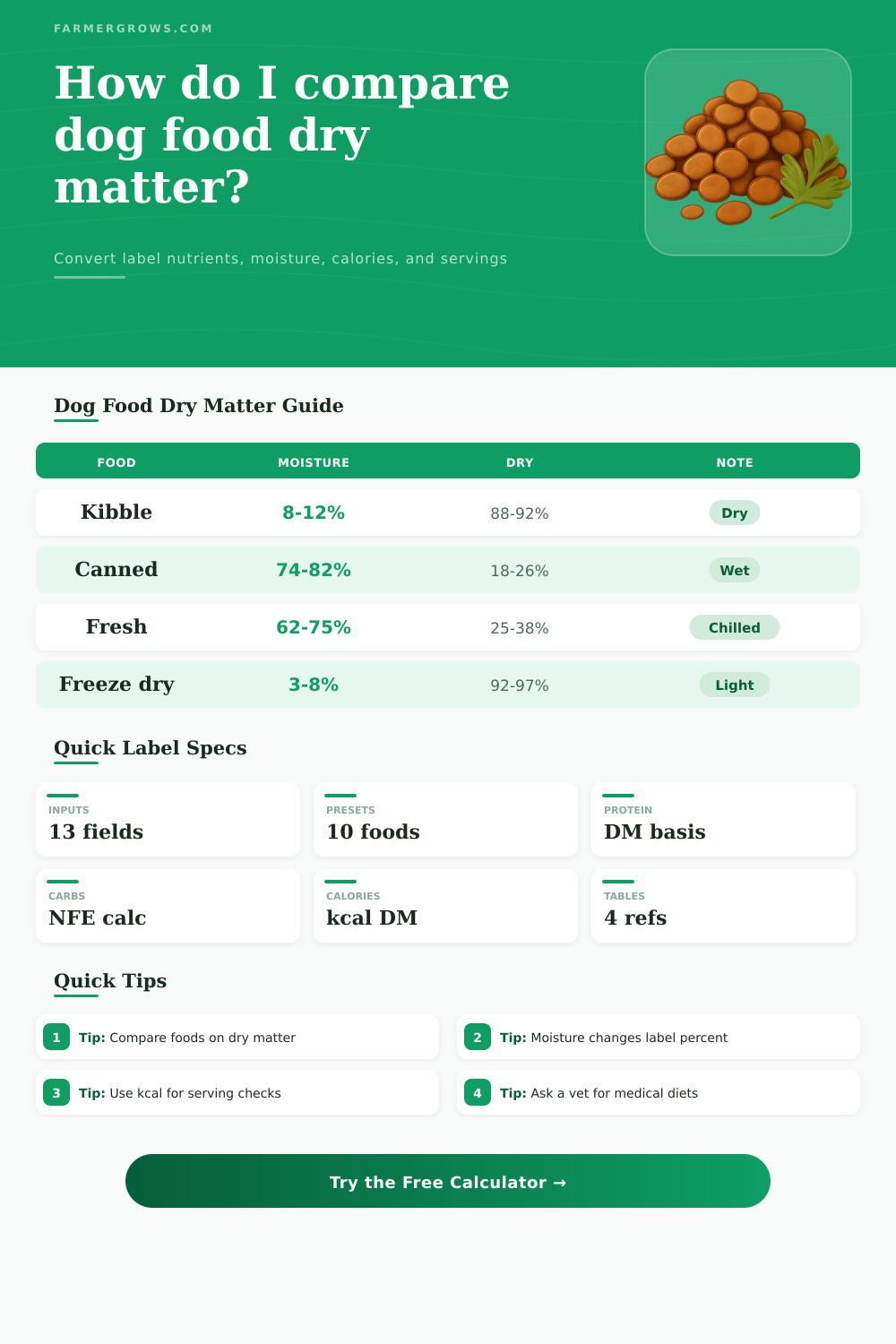
| Dry kibble | 8% to 12% | 88% to 92% | kcal/kg plus kcal/cup | Cup weights vary, so grams give the cleanest portion check. |
| Canned or pouch | 74% to 82% | 18% to 26% | kcal/kg plus kcal/can | Low as-fed protein can become moderate or high on dry matter. |
| Fresh cooked | 62% to 75% | 25% to 38% | kcal/kg or kcal/100 g | Moisture and fat shifts can strongly change calories per gram. |
| Freeze-dried | 3% to 8% | 92% to 97% | kcal/kg as-fed | Dry matter and as-fed percentages are usually close together. |
| Dehydrated mixer | 6% to 12% | 88% to 94% | kcal/kg before water | Compare before rehydration, then feed by prepared directions. |
| Label value | Moisture | Dry matter divisor | Dry matter result | Formula |
|---|---|---|---|---|
| 26% protein kibble | 10% | 90% | 28.9% protein DM | 26 divided by 90, then multiplied by 100 |
| 8% protein canned | 78% | 22% | 36.4% protein DM | 8 divided by 22, then multiplied by 100 |
| 15% fat kibble | 10% | 90% | 16.7% fat DM | 15 divided by 90, then multiplied by 100 |
| 5% fat canned | 78% | 22% | 22.7% fat DM | 5 divided by 22, then multiplied by 100 |
| 40% carbs kibble | 10% | 90% | 44.4% carbs DM | Carbs by difference, then converted to dry matter |
| Calorie basis | How to enter it | Internal conversion | Serving use | Watch-out |
|---|---|---|---|---|
| kcal per kg | Select kcal per kg | Divide by 1000 for kcal/g | Most direct for gram servings | Confirm it is metabolizable energy, not lab gross energy. |
| kcal per cup | Enter calories and cup grams | Calories divided by cup grams | Converts cups to grams and calories | Measuring cups can be loose or packed. |
| kcal per can | Use cup/can basis | Calories divided by can grams | Finds cans per day from kcal target | Can sizes differ by brand and recipe. |
| kcal per gram | Select kcal per gram | No conversion needed | Useful for fresh recipes | Small rounding changes affect daily grams. |
| kcal per ounce | Select kcal per ounce | Divide by 28.3495 | Works for treats and toppers | Use grams for better scale accuracy. |
| Nutrient | Guaranteed analysis role | Dry matter use | Carb effect | Practical note |
|---|---|---|---|---|
| Moisture | Usually a maximum | Sets the dry matter divisor | Higher moisture lowers as-fed carbs | Needed for every dry matter conversion. |
| Crude protein | Usually a minimum | Compares protein density | Subtracted in NFE calculation | Minimum may understate actual protein. |
| Crude fat | Usually a minimum | Compares fat density | Subtracted in NFE calculation | Fat drives many calorie differences. |
| Crude fiber | Usually a maximum | Shows fiber density | Subtracted in NFE calculation | Crude fiber can understate total dietary fiber. |
| Ash | Sometimes listed | Improves carb estimate | Subtracted in NFE calculation | If omitted, use the best estimate available. |
Comparison tip: Use dry matter for nutrients and kcal/kg for energy before deciding whether one food is truly higher in protein, fat, fiber, or carbs.
Health caution: Dogs with kidney disease, pancreatitis, diabetes, allergies, growth needs, or prescription diets should have food changes reviewed by a veterinarian.
When comparing the percentages listed on dog food labels, you will often find that the percentages does not allow for a complete comparison of the foods due to the effect of the moisture content of the foods. For example, one brand of dog food may contain 26% protein while an other contains only 8% protein. However, the food with the lower protein percentage may actualy contain more protein then the food with the higher percentage if the moisture content of the food is removed from the equation.
The percentage of protein listed on most dog food labels is based upon the weight of the water content in the food, as well. In order to make a true comparison between dog foods, you must utilize dry matter analysis. Dry matter analysis is the process of removing the water content from the food in order to view the percentage of nutrient contained within the food itself.
How to Compare Wet and Dry Dog Food
Such an analysis is necessary to make an even comparison between dry kibble foods and canned foods. The dry kibble foods will contain alot of the dry matter and little water content, while the canned foods will contain a lot of water content. Thus, the foods with a high amount of water will have lower percentages of protein, fat, and carbohydrates when viewed on the food labels.
The amount of moisture content within the food will vary according to the type of food. For instance, kibble will contain approximately ten percent moisture, while canned food will contain around seventy-eight percent moisture. Fresh cooked diet will contain a different amount of moisture than kibble foods, though freeze-dried foods will contain very little moisture content.
The food will calculate the percentage of each nutrient listed according to the total weight of the food. Thus, any amount of water content will decrease the amount of protein, fat, and carbohydrate contents of the food. The amount of each nutrient listed in the food can be divided by the percentage of dry matter in the food to determine the true content of that nutrient in the food.
When comparing different types of food, such as kibble and canned foods, it is important to compare the foods on a dry matter basis. While the kibble may appear to contain a moderate percentage of protein, it may have a similar amount of protein to the canned food when you compare the percentages on a dry matter basis. The same rule applies to fats and carbohydrates in the food.
Additionally, because dogs must consume a certain amount of calorie each day, the calorie content of the food can also be expressed on a dry matter basis. The amount of carbohydrates in dog food isnt often listed on the food label. Therefore, you must calculate the amount of carbohydrate content by difference.
To calculate the carbohydrate content, the moisture, protein, fat, fiber, and ash content of the food can be subtracted from 100%. The result is the carbohydrate content of the food. A calculator that can automatically subtract these listed value can perform such a calculation.
In order to determine the amount of food to be fed to the dog each day, you must know the calorie density of the food. Once the calories per gram of the food is known, the number of grams of the food to be fed to the dog each day can be calculated. Each type of food can be compared to another type of food to determine whether one food contains more protein or energy than the other food.
Such comparisons can be made between foods if they are being rotated each day, or if a food topper is to be added to the dog’s main food. The values indicated as the “guaranteed analysis” within each bag of dog food indicates the minimum and maximum percentages of each nutrient of the food. Thus, the calculations of the percentages of nutrients of the food will be estimate only.
Actual analyses of the food may find different results due to the different ways in which the foods is manufactured. Thus, the percentages listed on the bag of food are merely a guide to how much of each nutrient the food contains, rather than an indication of the precise amount of that nutrient in the food. In the case that the dog has any health condition, the owner should of consult a veterinarian regarding the diet of the dog.
When making a decision between wet dog food and kibble, the price per serving of each type of food can be compared. Although the price per unit of wet food may be higher than dry kibble food, the amount of protein and fat content of the canned food may be similar to the kibble food when expressed on a dry matter basis. Such comparisons can be made with the use of a calculator for dog food analysis.
Through understanding how the moisture content within the food can change the percentage of nutrients listed on the label, individuals will be able to look past the numbers listed on the food to the true nutritional value of the food.