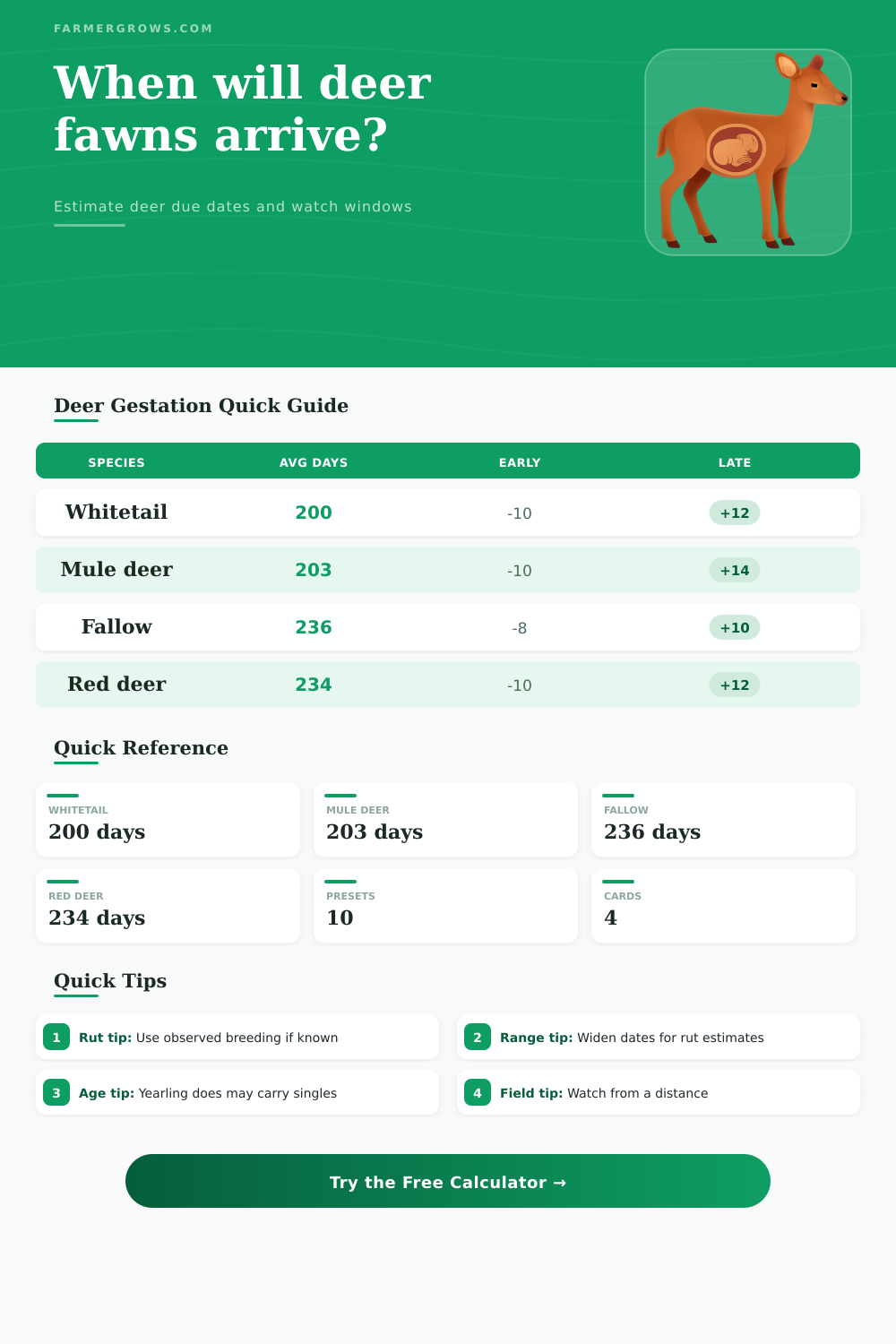
Deer Gestation Period Calculator
Estimate fawn or calf dates from a breeding date, peak rut observation, species, doe age, region, prep lead time, and the early-to-late watch range you want to use.
This planner is for farm records, wildlife observation, and habitat timing. Deer vary by herd, nutrition, latitude, and individual animal. Avoid disturbing does near fawning cover and follow local wildlife rules.
●Deer breeding presets
▣Species comparison grid
Common North American baseline for estimating late spring and early summer fawning from fall rut dates.
Similar to whitetail, with fawning often spread over several weeks in western habitats.
Longer gestation than whitetail and mule deer, useful for deer parks and farmed herds.
Hinds generally calve after a longer autumn-to-spring schedule than North American deer.
⚙Breeding, rut, and observation inputs
The center date adds the species gestation average to the breeding or rut date. The range expands for rut estimates, very young does, senior does, and unknown ages.
Your Deer Gestation Plan
Enter a rut or breeding date to calculate the expected fawning window.
■Gestation length cards
▲Species gestation reference
| Species | Average gestation | Typical range used here | Best use |
|---|---|---|---|
| White-tailed deer | 200 days | 190 to 212 days | Rut-to-fawn timing for farms, land managers, and wildlife observers. |
| Mule deer | 203 days | 193 to 217 days | Western fawning plans where elevation and habitat spread births. |
| Fallow deer | 236 days | 228 to 246 days | Managed parks, deer farms, and breeding paddock records. |
| Red deer | 234 days | 224 to 246 days | Hind calving windows for farmed or estate deer herds. |
▶Regional rut timing notes
| Region or herd | Common rut clue | Fawning implication | Calculator setting |
|---|---|---|---|
| Northern range | Strong November breeding pulse | Fawns often concentrate in late spring or early summer. | Use peak rut if no observed breeding date exists. |
| Midwest / central | Late October through November activity | Most fawning windows cluster, but late breeding can add June dates. | Keep the late range at 12 to 16 days. |
| Southern range | Rut can be late, split, or local | Fawning may be later and more spread out than northern herds. | Use wider observation follow-up. |
| Farmed or deer park | Known paddock exposure or hand breeding | Exact records narrow the useful prep and observation window. | Choose observed or farmed herd record. |
◆Observation and prep timeline
| Milestone | When to plan | What to watch | Low-disturbance note |
|---|---|---|---|
| Prep start | Set by your prep lead | Farm pens, cover, handling supplies, and quiet zones. | Prepare before does begin isolating. |
| Observation start | Before the early range | Udder change, isolation, bedding areas, and reduced movement. | Use distance, optics, or cameras. |
| Expected fawning | Species average date | Newborn hiding behavior, doe return patterns, and fawn cover use. | Avoid repeated close checks. |
| Late follow-up | After the late range | Late-bred does, uncertain rut dates, or still-pregnant farmed hinds. | Contact a veterinarian for farm herd concerns. |
◉Doe age and fawn planning table
| Age class | Range effect | Common fawn note | Planning use |
|---|---|---|---|
| Fawn-bred doe | Wider range | More likely to have one fawn and uncertain timing. | Add observation days and avoid assuming twins. |
| Yearling | Slightly wider | Often first fawning season, with single or smaller twins. | Start checks early without crowding cover. |
| Prime adult | Standard range | Most reliable class for average herd timing. | Use the species default range. |
| Senior or unknown | Wider range | Condition, tooth wear, and health can affect confidence. | Use a broader watch window and farm records. |
ℹField calculation tips
Observed breeding or a farmed herd record gives a tighter estimate than a general rut date. If only trail-camera activity is known, keep the early and late range wider.
For wild deer, the best observation plan is low disturbance. Watch from a distance, limit walking through bedding cover, and follow local wildlife guidance.
Gestation values are planning averages. Weather, nutrition, genetics, herd condition, and exact conception timing can shift real-world fawning dates.
When you see a scrape or a trail camera full of does and bucks in late October, you must figure out when the fawns will arrive. This information is crucial to determine when to check the bedding cover of does or when the deer farm might need to prepare its pens for the fawns. Based off the information regarding breeding and pregnancy lengths of deer, you can use the fawn-bred deer pregnancy calculator to determine when the fawns will arrive so that you can plan your management efforts around this important date.
Not all does have the same breeding calendar; each species of deer has different length of pregnancy. For instance, whitetail, mule, fallow, and red deer all have different lengths of pregnancy. Furthermore, the length of pregnancy for each species can vary based on the age of the does and the nutrition they receives while pregnant.
When Will the Fawns Be Born?
Does that are in the prime of their reproductive years will exhibit the same length of pregnancy as other does in their age group; however, yearling or senile does may not follow this schedule. However, the calculator will do the math for you once you input the species of deer and the best date that you have seen for their breeding. The breeding or rut date that you input will start the calculation for the tool.
The quality of the breeding or rut date that you input will determine the width of the fawning period. For instance, if you use the date of the observed breeding, the fawning period will be the narrowest window. If you use the rut peak as the starting date, the fawning period will be wider since the does may have bred earlier or later in this period.
The same is true for the dates of the first and last rut activities; the calculator adds these days to either the early or late date based on the rut activity that you choose. These extra days are added because does do not conceive all of their fawns on the same date. Furthermore, the species of deer will determine the length of pregnancy for the does.
For instance, whitetail and mule deer have similar lengths of pregnancy. However, fallow and red deer have longer pregnancies. The calculator will account for this when you choose the species; furthermore, the fawn-bred pregnancy calculator will apply the normal variations in pregnancy lengths within herds to the average length of pregnancy of that species.
These variations are due to the nutrition and health of each doe. You can adjust these dates using the sliders for early and late fawns. Age class of does also play a role in the fawning period.
Fawn-bred does, yearlings, and senile does tends to have more variation in their length of pregnancy than do prime-aged does. When you choose the fawn-bred, yearling, or senior options, the calculator will widen the fawn-bred pregnancy period. This is done to account for the age variations in pregnancy lengths among these does.
Does that are within the prime of their reproductive years will remain within the standard pregnancy length; however, their pregnancies may be more variable. The region in which the does are found and the herds that they belong to will not impact the length of pregnancy; however, they may impact the breeding dates of does. For instance, does that live in the northern herds will experience a breeding period within November that is more condensed than does that live in the southern herds or in desert areas.
Furthermore, herds that are farmed or found in parks may have more known breeding periods than does that live in the wild. Thus, the fawn-bred pregnancy calculator allows for these different settings to be adjusted for those who manage deer on farms or in parks. Finally, the tool allows managers to set the lead time for preparing for the fawning does and to observe the does after their fawning period.
The preparation lead time will tell you when to start preparing for the does fawning period. The observation lead and follow-up windows will help managers to establish the window that they will use to observe the does; however, since does do not give birth to all of their fawns on the same day, observation must occur before and after the fawning period. This information is important to provide managers with an idea of how long to prepare for and observe the does fawning period.
However, the center date is not the date on which does will give birth; births can happen several days early or late from this calculated date. Furthermore, if you use a vague date for the rutting period, the other settings will not become as precise; the calculator cannot create certainty out of an uncertain date for the rutting period. Thus, you should match the width of the pregnancy period to the quality of the date that you have for the breeding does.
Weather and nutrition will not be accounted for in this pregnancy length calculator. However, the nutrition and health of the does will impact their pregnancies. For instance, if the does experienced a harsh winter and poor health during their pregnant period, the births of their fawns may be delayed by a few days.
Conversely, if there is an abundance of forage during spring, the fawns may be born earlier and will be stronger during their first few weeks of life. However, these factors will not invalidate the pregnancy length that is calculated by the tool. Rather, these factors will help remind its managers of the nature of the tool and its intended use.
Regardless of whether you are managing does in one area or many does in a variety of locations, you can use the fawn-bred pregnancy calculator to calculate the length of pregnancy for each doe. Furthermore, the tool allows for the scenarios to be run separately to determine the pregnancies of does in each location. This could of been helpful for managers to determine how many fawn-bred quiet zones should exist in an area.
The main use of the fawn-bred pregnancy length calculator is so that those who manage deer can avoid unnecessary disturbance during the fawning period. When the first fawns of the season are spotted, the planning that was created with this tool will have ensured that human activity is low and that the does have there cover intact. Thus, the quiet period that is established for does in the fawning period is the result that is to be protected by these dates.