Cure Salt Calculator
Calculate Cure #1 or Cure #2 by gram weight, nitrite ppm, curing method, brine pickup, salt percentage, sugar percentage, and safety-oriented reference limits.
●Named curing presets
Start with a real project, then adjust every field to match your recipe, meat weight, and process.
●Batch and cure inputs
The method changes the ppm limit and whether water or pickup is part of the formula.
Use 0 for dry cure. Use actual brine water, or sausage ice/water, for wet methods.
For pump/immersion formulas, this is retained pickle as percent of meat weight.
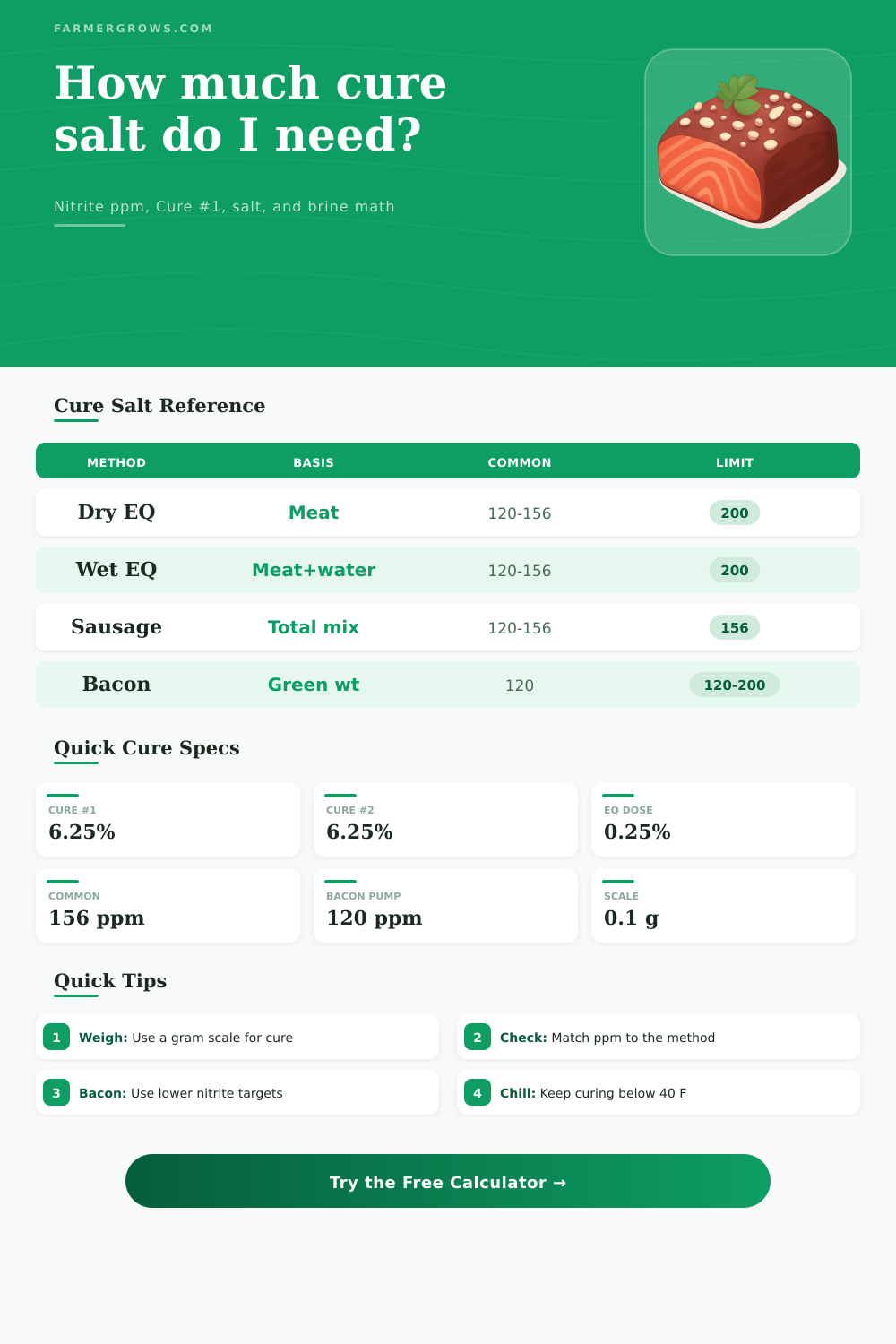
Common home equilibrium targets are often 120 to 156 ppm; bacon is lower.
Cure #1 and many Cure #2 blends use 6.25% sodium nitrite.
Used only for Cure #2 style long dry cures; many blends vary by maker.
Calculator subtracts the salt already carried by pink curing salt.
Commercial pumped bacon requires an accelerator; this field sizes pure sodium ascorbate or erythorbate.
Teaspoons are approximate; weigh cure salt in grams whenever possible.
●Cure product reference
●Method comparison grid
Dry equilibrium
Cure, salt, and sugar are calculated from meat weight only. Best for bacon, loin, small ham pieces, and whole muscle cures.
Wet equilibrium
Cure is calculated from meat plus water so the final brine cannot overshoot the chosen ppm when fully equalized.
Pumped pickle
Brine is mixed stronger because only a selected pickup percentage remains in the meat after pumping or tumbling.
Comminuted mix
Ground sausage math uses the full meat, fat, and added water weight. FSIS references a 156 ppm sodium nitrite maximum.
Bacon
Bacon has special lower limits because fried bacon can form nitrosamines; pumped or immersion bacon uses a 120 ppm cap.
Cure #2
Cure #2 is for long dry cures where nitrate conversion is part of the process. It is not a substitute for Cure #1 in quick cures.
●Reference limits by curing method
| Product or method | Calculation basis | Common target | Reference ceiling | Safety note |
|---|---|---|---|---|
| Equilibrium dry whole muscle | Meat weight | 120 to 156 ppm | 200 ppm home-style cap | Use weighed cure only; teaspoons are too variable for small batches. |
| Wet equilibrium brine | Meat plus water | 120 to 156 ppm | 200 ppm home-style cap | All water included in the system reduces the cure salt needed. |
| Pumped, massaged, or immersion cured meat | Green meat weight and pickup | 120 to 180 ppm | 200 ppm sodium nitrite | Pickup must be measured or conservatively estimated. |
| Comminuted sausage or chopped meat | Total formulation weight | 120 to 156 ppm | 156 ppm sodium nitrite | Include fat, trim, and added water in the batch weight. |
| Bacon, pumped or immersion | Green belly weight and pickup | 100 to 120 ppm | 120 ppm sodium nitrite | Commercial pumped bacon also requires 550 ppm sodium ascorbate or erythorbate. |
| Bacon, dry cured | Skin-free green belly weight | 120 to 156 ppm | 200 ppm sodium nitrite | Keep the full premeasured cure on the belly surfaces. |
| Traditional long dry cure | Meat weight | 120 to 156 ppm nitrite | Specialized process only | Cure #2 and nitrate use require validated drying, temperature, and water activity control. |
Reference basis: USDA-FSIS restricted ingredient calculation guidance and U.S. curing-agent regulations; bacon has separate lower nitrite limits.
●Cure salt types and conversions
| Cure product | Typical nitrite | Typical nitrate | Primary use | Calculator setting |
|---|---|---|---|---|
| Cure #1 / Prague Powder #1 | 6.25% sodium nitrite | 0% | Cooked cured meats, bacon, ham, corned beef, poultry | Use 6.25 nitrite, 0 nitrate |
| Cure #2 / Prague Powder #2 | Often 6.25% sodium nitrite | Often about 1% sodium nitrate | Long dry-cured meats only | Confirm label; blends vary |
| Morton Tender Quick style | About 0.5% sodium nitrite | About 0.5% sodium nitrate | Use only by label directions | Preset included for ppm checking |
| Custom curing salt | Enter label value | Enter label value | Regional or butcher-shop blends | Use exact percentage from package |
| Pure sodium nitrite | 100% | 0% | Commercial formulation only | Not recommended for home use |
●Typical ppm and salt targets
| Project | Typical nitrite ppm | Total salt target | Sugar target | Method note |
|---|---|---|---|---|
| Belly bacon, dry equilibrium | 120 to 156 ppm | 2.0% to 2.5% | 0.5% to 1.5% | Use dry-cured bacon limit if labeling as bacon. |
| Canadian bacon loin | 120 to 156 ppm | 1.8% to 2.25% | 0.5% to 1.5% | Dry or wet equilibrium both work with weighed cure. |
| Corned beef or pastrami | 120 to 156 ppm | 2.0% to 2.8% | 0.5% to 2.0% | Wet equilibrium uses meat plus water as basis. |
| Cooked ham or shoulder | 120 to 180 ppm | 1.8% to 2.5% | 0.5% to 2.0% | Pumped ham depends on true retained pickup. |
| Cured sausage mix | 120 to 156 ppm | 1.6% to 2.2% | 0% to 1.0% | Do not exceed the comminuted limit. |
| Poultry wet cure | 100 to 120 ppm | 1.5% to 2.0% | 0.5% to 1.5% | Use lower salt for lean poultry and keep cold. |
●Formula reference table
| Formula item | Equation used | When it applies | Important detail |
|---|---|---|---|
| Equilibrium cure salt | ppm x system grams / nitrite fraction / 1,000,000 | Dry EQ, wet EQ, sausage | System grams means meat only, or meat plus water, by method. |
| Pumped brine cure salt | ppm x brine grams / pickup fraction / nitrite fraction / 1,000,000 | Pumped, injected, immersion by pickup | Lower pickup requires stronger brine for the same ingoing ppm. |
| Rounded ppm check | rounded cure x nitrite fraction x 1,000,000 / basis grams | All methods | Rounding to a coarse scale can move small batches over target. |
| Plain salt adjustment | total salt target minus salt contained in cure salt | All methods | Pink curing salt is mostly regular salt and counts toward saltiness. |
| Ascorbate or erythorbate | ppm x basis grams / 1,000,000 | Bacon accelerator or optional cure accelerator | Commercial pumped bacon uses 550 ppm sodium ascorbate or erythorbate. |
●Practical safety notes
Calculating the correct amount of cure salts is a necessary step in the curing of meat because calculating the correct amount of cure salt will ensure that the meat contain the proper amount of nitrite for safety and flavor. While many peoples may try to use volume measurements for the amount of cure salt that should be used, volume measurements are not precise enough. A calculator, however, will allow people to more accurate calculate the weight of the cure salt that should be used in a project.
The amount of sodium nitrite that are required for a project will depend upon the type of curing process that the cook will use for the meat. For dry equilibrium curing processes, the weight of the meat will be the only variable. For wet equilibrium curing processes, however, the weight of the water that the cook will use in the brine will have to be accounted for in the calculation.
Use a Calculator to Measure Cure Salt
For products that are pumped or immersed into brine, pumping liquids into the meat, the percentage of the brine that the meat picks up will have to be accounted for in the calculation. Calculators can account for these variable, allowing for the proper amount of sodium nitrite to be calculate for any type of curing process. Another critical variable that must be accounted for in the calculation of the amount of cure salt to be used is the concentration of sodium nitrite within the pink curing salt.
Both cure number one and cure number two contains 6.25% sodium nitrite, though other brands of pink curing salt may contain a different percentage of sodium nitrite. In order to ensure that the calculated amount of pink curing salt is accurate, the user must enter the exact percentage of sodium nitrite that is contained in the brand of pink curing salt that the user will use into the calculator. Because pink curing salt also contains regular salt, the amount of regular salt that is contained in the pink curing salt will also have to be accounted for in the calculation; otherwise, the amount of salt that is added to the meat will be too much.
The safety limits for nitrite are different for different types of cured meats. For instance, bacon has different limits for nitrite than other types of cured meat, due to the frying of bacon. Comminuted sausages, too, have different limits for nitrite than other types of cured meat.
Thus, another benefit of utilizing a calculator for curing meat is that the calculator may alert the user to the amount of sodium nitrite that will be introduced to the meat, which can prevent the user from adding to much nitrite to the meat. The temperature and time of the curing process are two variables that a calculator cannot account for, though they are essential variables to the curing process. Pink curing salt only works if the meat is cured at cold temperatures; otherwise, the bacterial growth in the meat may lead to food safety issue.
Therefore, the person must control the temperature and timing of the curing process; while a calculator may provide the weight and amounts of ingredients for the cure, the calculator cannot ensure that the user will utilize the correct temperature and time to accomplish the cure. Because the amount of pink curing salt that is added to the meat can have a significant impact upon the nitrite content of the cured meat, precision in the measurement of that cure salt is required. Using a scale to measure the cure salt in whole gram may lead to error in the nitrite content of the cured meat.
However, using a scale that measures to the tenth of a gram will ensure that the amount of cure salt that the user adds to the meat will be accurate. Additionally, cure number one and cure number two may appear to be the same product, but they are not interchangable. Cure number two contains nitrate, which will convert to nitrite over a long period of time; cure number one, which contains sodium nitrite, is the compound that should of be used for curing meat.
The calculator will provide the weight in grams of the cure salt, regular salt and sugar that should be used for the curing of meat. Once these weights are obtained with the calculator, the curing process can begin. In addition to inputting these weights into the recipe, the user should check the nitrite content of the meat against the safety limits for that type of cured meat.
By utilizing the calculator, the curing process can be made repeatable; the calculator accounts for the math that is required for the process, removing the guesswork involved in calculating each ingredient for curing meat.