Crop Rotation Calculator
Plan how many beds or fields you need, how long to keep a crop family out of the same ground, and where cover crops fit between harvest and the next planting.
✦Named Rotation Presets
Choose a realistic starting point, then adjust the disease interval, season length, nitrogen demand, and cover crop window to match your field notes.
🌱Rotation Inputs
Rotation Plan Results
🌿Crop-Family Comparison Grid
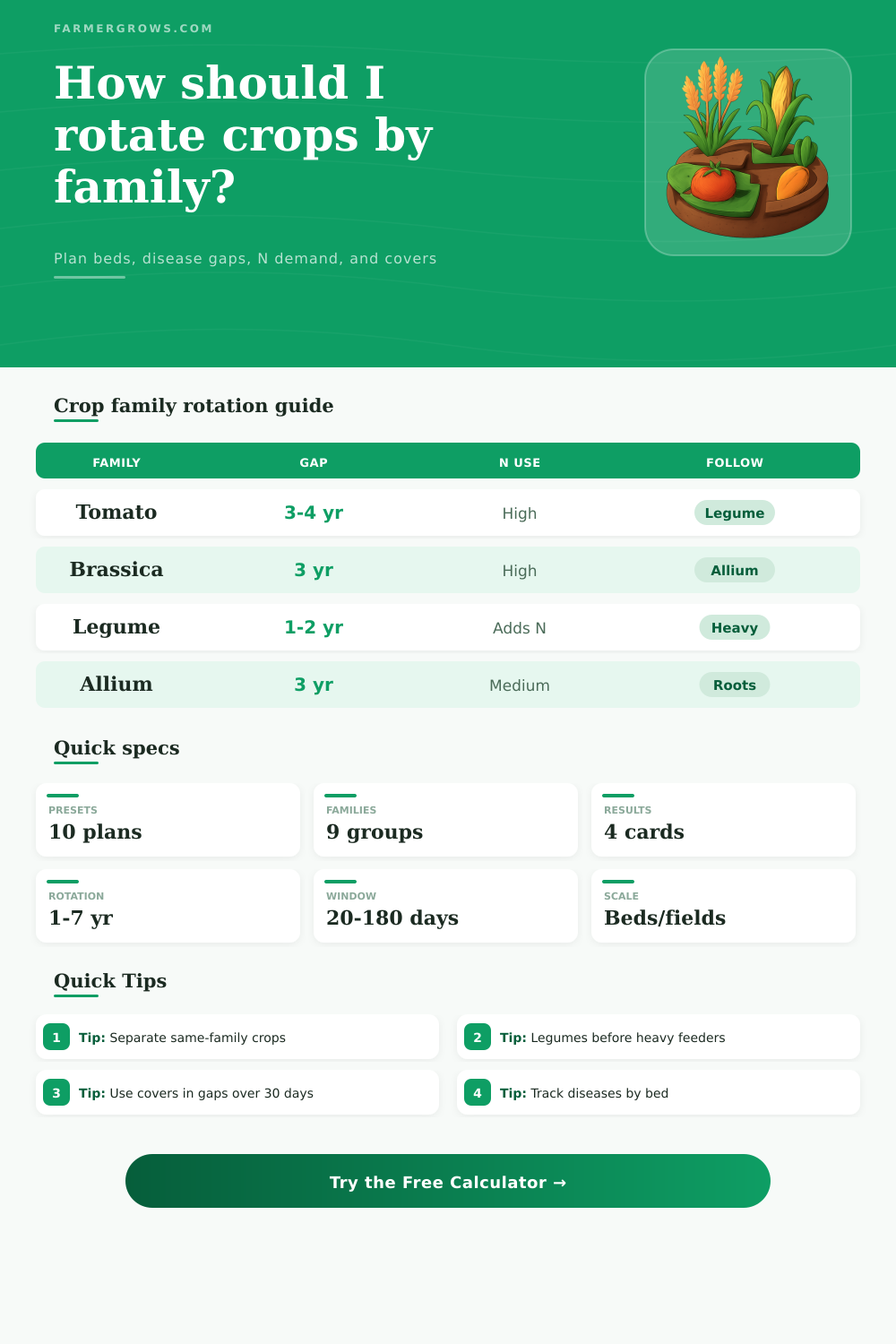
Use the grid to compare families by typical return interval, nutrient behavior, and common rotation partners. Local disease history should override any general rule.
Solanaceae
Tomato, pepper, eggplant, potato. Keep away from the same bed 3 to 4 years when blight, verticillium, nematodes, or potato beetle pressure appears.
Cucurbitaceae
Cucumber, squash, pumpkin, melon. Rotate 3 years; follow with grasses or legumes to break powdery mildew residue and vine borer habitat.
Brassicaceae
Cabbage, kale, broccoli, radish, turnip. Use a 3 to 4 year gap where clubroot, black rot, or flea beetles are recurring.
Alliaceae
Onion, garlic, leek, shallot. Avoid following alliums with alliums; use 3 years for white rot risk and keep residue breakdown clean.
Fabaceae
Pea, bean, clover, vetch. Adds nitrogen when inoculated and healthy; good before heavy feeders, but still rotate for root rot control.
Apiaceae
Carrot, celery, fennel, parsley. Moderate feeders with slow seedlings; avoid repeating where carrot rust fly or root disease builds.
Amaranth/Chenopod
Beet, spinach, chard, amaranth. Medium demand; rotate to prevent leaf spot, damping-off, and spinach crown issues.
Poaceae
Sweet corn, rye, oats, grain sorghum. Useful disease break for many vegetables; corn is a heavy feeder, while small grains scavenge nitrogen.
Asteraceae
Lettuce, endive, chicory, sunflower. Short-season salads work well between heavier families but need clean beds to reduce drop and aphids.
⚙Rotation Capacity Snapshot
These quick indicators update after calculation and help show whether the current bed count is enough for the selected disease interval.
📋Family Rotation Reference
| Crop family | Common crops | Typical return gap | Best previous family | Watch for |
|---|---|---|---|---|
| Solanaceae | Tomato, pepper, potato, eggplant | 3 to 4 years | Legume or allium | Early blight, verticillium, nematodes |
| Cucurbitaceae | Squash, cucumber, melon, pumpkin | 3 years | Legume, poaceae, allium | Powdery mildew, wilt, vine borers |
| Brassicaceae | Cabbage, broccoli, kale, radish | 3 to 4 years | Allium, legume, lettuce | Clubroot, black rot, flea beetles |
| Alliaceae | Onion, garlic, leek, shallot | 3 years | Roots, brassica, lettuce | White rot, onion maggot, thrips |
| Fabaceae | Pea, bean, fava, clover, vetch | 1 to 2 years | Poaceae or light feeders | Root rots, bean beetles, nematodes |
| Apiaceae | Carrot, celery, parsley, parsnip | 3 years | Allium, lettuce, legume | Rust fly, cavity spot, damping-off |
| Amaranth/Chenopod | Beet, spinach, chard, amaranth | 2 to 3 years | Legume or allium | Leaf spot, boron stress, crown disease |
| Poaceae | Sweet corn, oats, rye, sorghum | 1 to 2 years | Legume for corn; vegetables before grain | N drawdown, residue tie-up, armyworm |
| Asteraceae | Lettuce, chicory, endive, sunflower | 2 to 3 years | Allium, roots, light legumes | Lettuce drop, aphids, downy mildew |
🌾Nitrogen Demand and Follower Table
| Nitrogen class | Typical crops | Good previous crop | Cover crop fit | Rotation note |
|---|---|---|---|---|
| Low | Carrot, garlic, herbs, mature dry beans | Light feeder or grain | Buckwheat, oats, rye mulch | Avoid excess N that causes leafy tops or storage issues. |
| Medium | Beet, onion, lettuce, cucumber | Legume mix or composted cover | Oats, pea, crimson clover | Keep fertility even for steady growth and quality. |
| High | Tomato, brassica, squash, sweet corn | Legume, legume-grass mix | Vetch, clover, winter pea plus grain | Place after nitrogen building crops when possible. |
| Very high | Long-season corn, heavy brassica blocks | Strong legume stand plus soil test | Hairy vetch, clover, pea-rye | Use rotation plus measured fertility, not rotation alone. |
⏱Cover Crop Window Guide
| Open window | Best use | Common covers | N effect | Management note |
|---|---|---|---|---|
| 0 to 20 days | Mulch or stale bed | Residue mulch, composted leaf mold | Neutral | Use this for fast replanting when establishment time is too short. |
| 21 to 45 days | Fast smother crop | Buckwheat, oats, mustard where suitable | Low to medium | Great for weed suppression before fall greens or garlic. |
| 46 to 75 days | Short soil builder | Oats and pea, cowpea, sorghum-sudangrass | Medium | Enough time for biomass if moisture and heat are present. |
| 76 to 120 days | Full cover crop | Rye-vetch, clover, winter pea, oats | Medium to high | Plan termination early enough for the next planting date. |
| 120+ days | Soil recovery phase | Perennial clover, ryegrass, multi-species mix | High if legume-rich | Useful after disease pressure or compacted field blocks. |
🗓Example Bed Sequences
| Rotation style | Year 1 | Year 2 | Year 3 | Year 4 | Why it works |
|---|---|---|---|---|---|
| Four family market bed | Solanaceae | Legume or cover | Brassica | Allium or roots | Separates heavy feeders and gives tomato ground a real break. |
| Brassica recovery | Brassica | Allium | Legume cover | Solanaceae | Moves away from clubroot hosts while rebuilding nitrogen. |
| Root-focused bed | Allium | Apiaceae | Legume cover | Cucurbit | Keeps fresh organic matter ahead of roots but not directly under carrots. |
| Sweet corn strip | Poaceae | Legume | Brassica | Cucurbit | Uses legumes after corn to rebuild nitrogen before heavy vegetables. |
| Salad succession | Asteraceae | Allium | Chenopod | Legume cover | Works for quick beds when records prevent repeating lettuce too often. |
💡Rotation Tips
Crop rotation is an process of moving different type of crops to different location within a garden or farm. Crop rotation is used after planting the same type of plants in the same soil for several years because planting the same plants in the same soil for several years can produce multiple problem for those plant crops and soils. If a person plant the same type of plant in the same soil each year, the pests and disease that target that type of plant will build up in that soil.
Since those pests and diseases will build up in that soil, they will attack the following plant of that same type. Therefore, a person must use crop rotation in order to move the plant families to different locations in the soil to avoid the building up of those pests and diseases. A person should group the plants into different families because all of the plants within the same family require similar care and experience similar problems with there growth.
How to Do Crop Rotation in Your Garden
For instance, plants like tomatoes, peppers, and potatoes is all members of the same plant family. Therefore, a person should plant those three type of plants in a crop rotation plan. The same is true for cabbage, kale, and radishes, which are all member of the same plant family.
If a person plants any of the plants of those same families into the same soil that contained those plants in the past, the pests and diseases will still be a problem in that soil. A person can use a three-year gap to rotate any plant family, but if the soil contained diseases like verticillium or white rot, a person should use a four year gap between planting any of that plant family. A person should utilize a three or four year gap to allow the soil to clear of pests and diseases.
Plants require the nutrient nitrogen in order to growing. Not all plants require the same amount of nitrogen from the soil. For instance, heavy feeders like tomatoes or sweet corn will deplete the nitrogen from the soil quick.
However, legumes are considered nitrogen-building crops, meaning that these plants will leave nitrogen in the soil for the next plants to utilize. A person should plant nitrogen-building crops prior to planting nitrogen-demanding crops to ensure that the soil contains enough nitrogen to allow the nitrogen-demanding plants to grow. A person will benefit from utilizing nitrogen-building plants because these plants will reduce the amount of outside fertilizers that the soil will need.
Cover crops are plants that are grown within a garden to protect the soil while the main crops are resting. Cover crops can be planted during a 20 day time frame between plant harvests, but not many different type of cover crops can grow within that time frame. During a 45 day or more time frame between harvests, a person can plant cover crops like buckwheat and oats.
During very long time frames between harvesting of the main crops, a person can allow rye-vetch mixes to grow within the garden. Many gardeners make the mistake of not providing enough time for the cover crops to establish themselves within the soil, and that mistake will ensure that the cover crops will not fulfill there role within the garden. The number of garden beds that a person grows within their garden is another important aspect of crop rotation.
The number of beds that a person has will impact whether or not a person can implement the crop rotation plan that they have created for their crops. For instance, if a person has six gardening beds and they wish to implement a four-year crop rotation cycle for their tomatoes, a person will need enough garden beds to follow the rotation plan. A person may have more gardening beds than the number of different types of crops that they will grow within a season to allow for resting periods for those crop plants.
If a person does not have enough gardening beds for this type of crop rotation plan, then that person will experience the failure of that crop rotation plan. A person should keep a record of the types of crops that have grown within each garden bed. Within the garden, the weather can change for the crops and new pests can appear within the crops within the garden.
Therefore, a person will need to adjust their crop rotation and planting plan according to the changes that occur within the garden. By keeping a record of which plants have grown within each bed and whether those plants had any disease problems, a person will be able to create an effective crop rotation and planting plan. A person can implement an easy habit to aid them in their efforts with implementing a crop rotation plan.
For example, a person can tag each gardening bed with the name of the plant family that grew within that bed. Using the plant family name rather than the name of each individual crop will help prevent a person from unintentionally planting another crop of that same family. For instance, if a person only grows lettuce within their garden, a person will remember to not plant any other crops that contain the same family of plants as lettuce.
By using the names of each plant family within each bed, a person will be more successful in following the crop rotation rules that was created for them. Additionally, after growing gardens for several years, a person will begin to understand the behavior of their soil, and how to best utilize each gardening bed based on the other crops that have been planted within that bed.