Compost Calculator for Lawn
Estimate screened compost for lawn topdressing, core aeration holes, moisture-adjusted delivery weight, spreader passes, pile staging, settling allowance, overage, and nutrient credits.
Pick a lawn scenario, then tune the depth, aeration pattern, compost moisture, delivery rounding, and spreader width to match the actual job.
Lawn Compost Estimate
Your lawn compost estimate will appear here.
Use these tables to sanity-check coverage, aeration-hole volume, compost density, and spreader delivery assumptions before ordering.
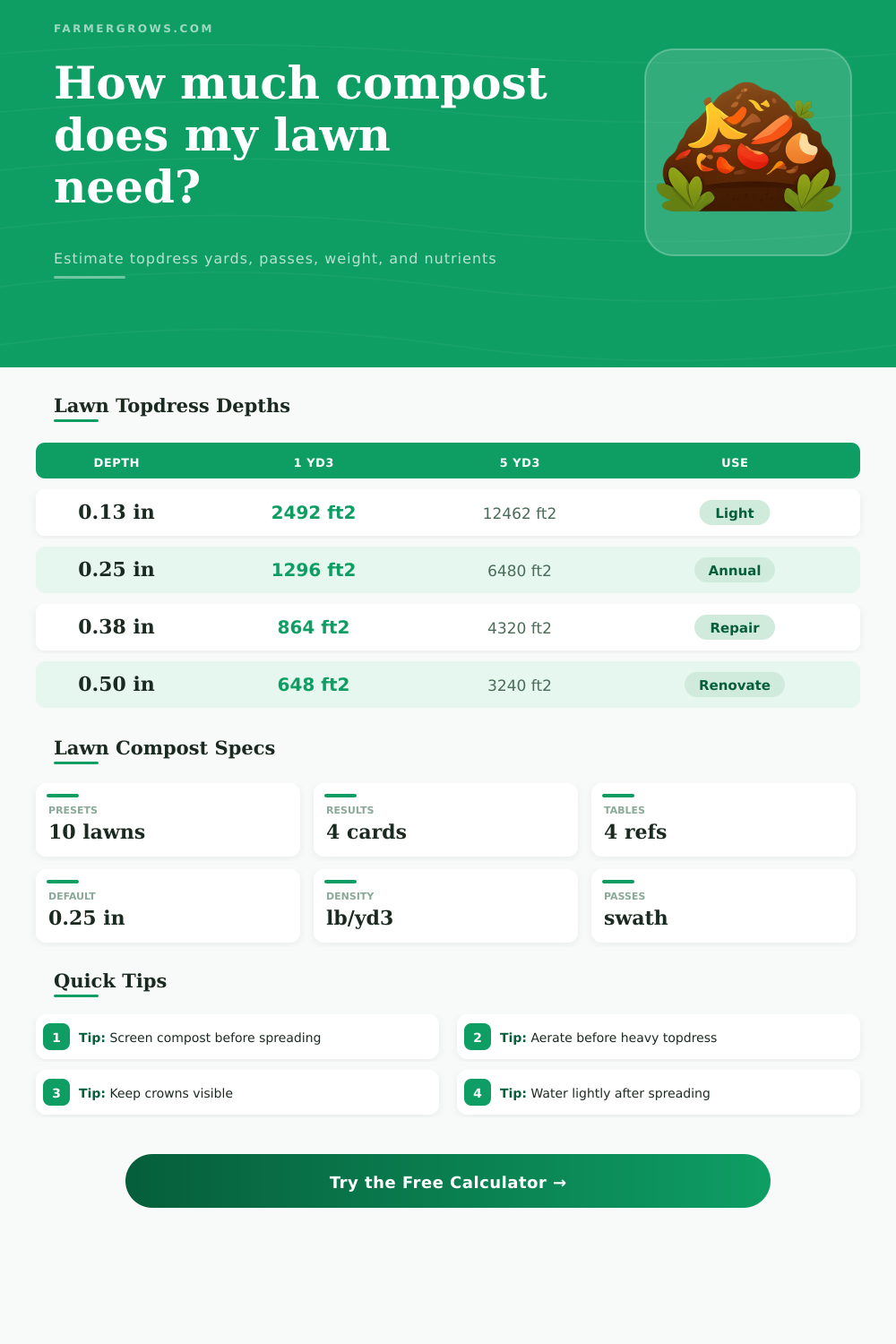
| Finished depth | Coverage per yd3 | Cu ft per 1,000 sq ft | Best lawn use |
|---|---|---|---|
| 0.125 in | 2,592 sq ft | 10.4 cu ft | Light annual feeding without burying turf crowns |
| 0.25 in | 1,296 sq ft | 20.8 cu ft | Routine topdressing after mowing low |
| 0.375 in | 864 sq ft | 31.3 cu ft | Overseeding and minor leveling |
| 0.5 in | 648 sq ft | 41.7 cu ft | Renovation work where grass is open or thin |
| Aeration setup | Hole count | Hole volume | Compost added |
|---|---|---|---|
| 4 in spacing, 0.5 in x 2 in | 9 per sq ft | 0.020 cu ft per sq ft | Small fill allowance after light aeration |
| 3 in spacing, 0.5 in x 2.5 in | 16 per sq ft | 0.045 cu ft per sq ft | Typical core-aerated lawn topdress |
| 2.5 in spacing, 0.625 in x 3 in | 23 per sq ft | 0.100 cu ft per sq ft | Compacted turf with aggressive passes |
| No aeration | 0 per sq ft | 0.000 cu ft per sq ft | Surface-only compost layer |
| Compost type | Wet density | Moisture | Topdressing note |
|---|---|---|---|
| Fine turf topdress compost | 850-950 lb/yd3 | 35-40% | Best for thin layers and drag mats |
| Screened yard compost | 950-1,150 lb/yd3 | 38-48% | General lawn organic matter source |
| Aged manure compost | 1,150-1,350 lb/yd3 | 45-55% | Higher nutrient credit, watch salts |
| Mushroom compost | 1,000-1,250 lb/yd3 | 45-55% | Use lightly unless soil test supports it |
| Spreading method | Useful swath | Practical rate | Planning note |
|---|---|---|---|
| Manual shovel and rake | 2-3 ft | Small repairs | Good control around edges and slopes |
| Peat moss style roller | 2-3 ft | Light layers | Needs dry, finely screened compost |
| Compost drop spreader | 3-5 ft | Consistent lawn pass | Set overlap before the first full load |
| Topdresser machine | 4-6 ft | Large lawns | Useful when ordering several cubic yards |
Compost improves water holding, but split heavy corrections into repeat light layers.
Annual light topdressing usually maintains organic matter without smothering growth.
Core aerate first so compost enters holes instead of only sealing the surface.
Use tighter hole spacing and keep enough dry compost for hole fill after dragging.
Keep seed visible through the compost and avoid thick mats over seedlings.
Use screened, mature compost for lawns. Large chips bridge in spreaders, sit on leaf blades, and make thin topdressing harder to drag evenly.
When topdressing after core aeration, drag the lawn in two directions and water lightly so compost settles into holes without burying turf crowns.
Compost will change the way your lawn behave in periods of heat, traffic, and drought. However, compost will only change your lawn if the compost reach the soil. Applying too little compost will leave your grass thin.
Applying too much compost, though, will cause your grass crowns to getting buried under compost and the water that pool on the composts surface. If the crowns of your grass gets buried under too much compost, your lawn will struggle to breathe. Knowing the correct volume of compost to apply to your lawn is essential to having effectively grass growth.
How Much Compost Your Lawn Needs
Calculating the correct volume will allow you to avoid guessing at how much compost to order for your yard. The first measurement that you need to make is the area of your lawn. This is the measurement that will form the basis for your calculation.
To determine the area of your lawn, measure the rectangular or circular area of your lawn and any odd strips or corners of your lawn that require compost. A calculator can make the mathematical computation for you. Many people will often forget to include patches of lawn that require composting.
Patches like dog runs or strips of lawn that wear down along sidewalks may require an additional 10% in compost volume for effective coverage. The next factor to consider is the depth of the compost that you will use on your lawn. One eighth of an inch of compost is a light feeding of compost to your soil.
This depth is typically used for lawns that do not experience much traffic or heavy growth of grass. One quarter inch is the depth used for providing compost to lawn once a year. However, for lawns that may need composting for renovation or leveling, the depth of compost will be greater than one quarter inch.
Using a reference table will allow you to determine how many square foot a cubic yard of compost will cover at the depths that you select for your lawn. Core aeration will change the amount of compost that you order for your lawn. When aeration occur in your lawn, you can place the compost directly into the core holes in your lawn.
This will allow the compost to reach the root zone of your grass quickly. Furthermore, the compost will not wash away from the root zone. Aeration can be performed in light, standard, or aggressive spacing.
You must decide the amount of compost according to the amount of soil the aerator will remove from your lawn. If you do not aerate the lawn, the compost will take longer to move into the soil. Compost is not a uniform material.
For example, yard waste compost that has been screened for turf will weigh around 1,050 pounds per cubic yard of compost when it is 42% moist. Leaf compost will be lighter and contain less water than yard waste compost. Manure composts will be the heaviest composts and contain the most nutrient.
Using a calculator will allow you to adjust the weight of the compost that you order. The weight of the compost is important to consider if you pay for compost by the ton or if you have a weight limit for the truck that will deliver the compost. Furthermore, if your compost is too moist, it may clog the hopper for your compost spreader.
If the compost is bone dry, it may blow away in the wind. The width of your spreader and the number of overlap that you use when applying compost will determine how many passes your spreader will have to make over your lawn. For instance, a drop spreader that spreads in three-foot swaths and has a 20% overlap is commonly used on residential lawn.
A wider spreader will cover more of your lawn quickly. However, it will require more space to turn the machine once it is done spreading compost on a swath. Job planning card will allow you to calculate how far you will have to walk and how many loads of compost you will recieve to spread over your lawn.
This will allow you to decide whether or not you will use a spreader or hand tools like a shovel and rake. Beyond settling and overage, there are a few more variable to consider in calculating the amount of compost for your lawn. The compost that you order will expand after you load it into your spreader.
After you drag the compost onto your lawn, it will settle and compress. You should of ordered compost with a 10% allowance for settling. Furthermore, you should allow extra compost to trim the lawn edge.
However, your supplier may round the order to the nearest half-yard increment of compost. This may require you to order more compost than your calculations require. The nutrient credit that compost will provide to your lawn are not a replacement for a fertilizer program for your lawn.
The nitrogen that compost will contain is not alot. However, it will help your soil over time. The calculator will show you the amount of nitrogen credit that your compost will provide.
This will allow you to adjust your feeding schedule for your grass. By running these calculations before the delivery truck arrives with the compost, you will gain the most value from your composting purchase. By calculating the order of compost for your lawn, you can determine the depth of compost needed according to the area of your lawn.
You can determine if aeration will change the amount of compost you order. Furthermore, the weight of the compost will fit into the weight limit for your driveway or trailer. By calculating the order of compost for your lawn, you will save yourself from ordering too little or to much compost.
Once you have set the number for the compost for your lawn, you can begin to move the compost in two directions. This will keep the crowns of your grass visible. Finally, water the compost lightly to allow the particle of compost to settle into the soil.