Chicken Brine Calculator
Measure a poultry brine by weight, choose the chicken cut, salt style, salinity, sugar level, ice dilution, and holding time, then get a chilled brine plan.
①Named chicken brine presets
Use a preset as a starting point, then adjust salinity, sugar, and brine volume for the exact bird on your farm table.
②Choose the brining method
③Chicken brine inputs
Your chicken brine plan
Measured by liquid weight so the salinity stays accurate even when ice is used to chill the brine.
④Formula breakdown used by the calculator
kg = lb × 0.453592, or lb = kg × 2.20462quarts = chicken lb × coverage ratio; liters = quarts × 0.946353salt grams = final liquid grams × salinity percent / 100ice grams = final liquid grams × ice percent; hot water = final liquid - icesugar grams = final liquid grams × sugar percent / 100tablespoons = salt grams / grams per tablespoon for selected salt⑤Salt conversion reference
Spoon weights vary with crystal shape and packing. Weighing salt is more reliable than cups or tablespoons for poultry brine.
⑥Chicken cut timing table
| Chicken cut | Typical weight | Suggested salinity | Brine time range | Notes |
|---|---|---|---|---|
| Tenders or thin cutlets | 1 to 2 lb | 4% to 5% | 15 to 45 minutes | Small pieces season quickly; avoid overnight wet brines. |
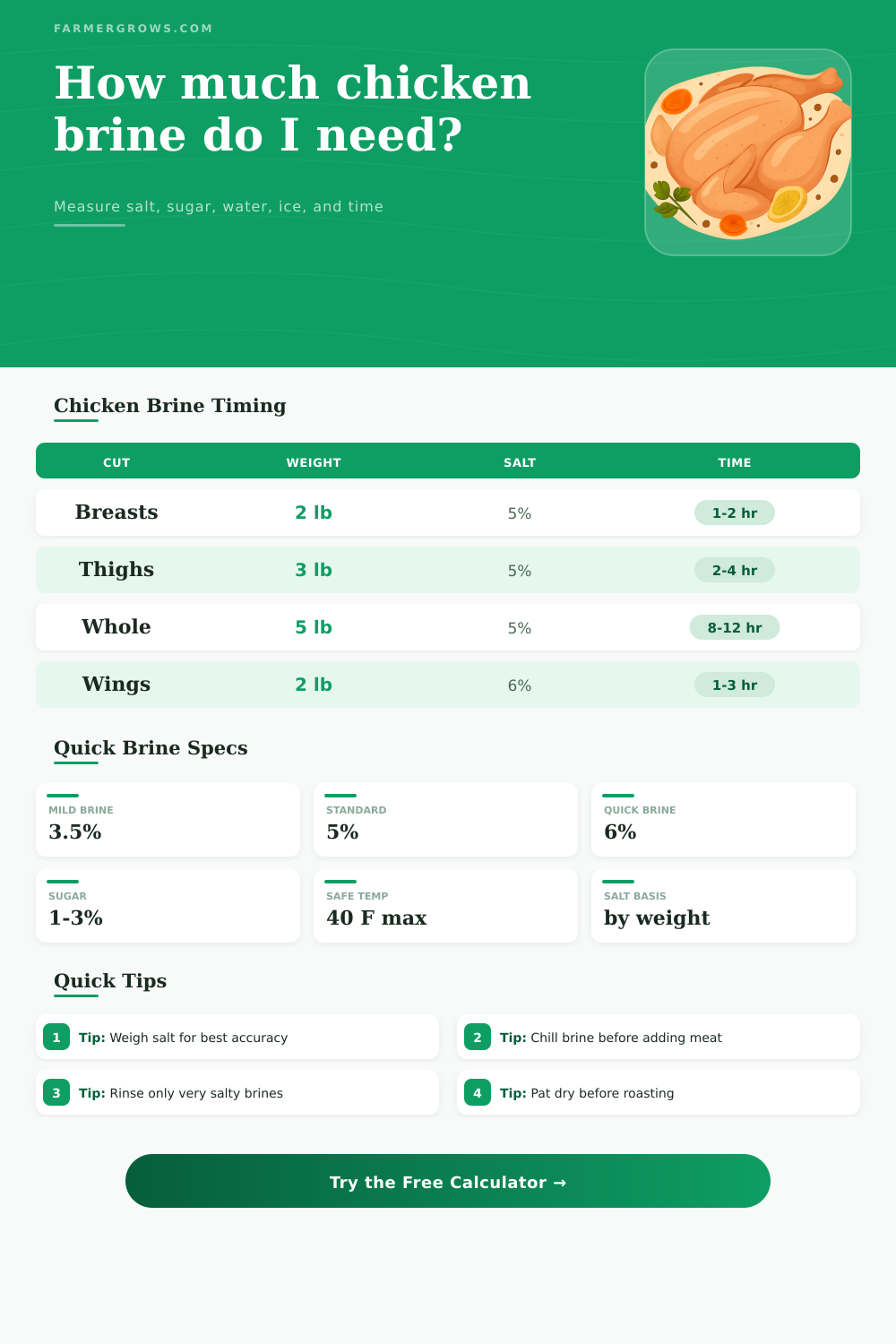
| Boneless breasts | 1.5 to 3 lb | 4% to 5% | 45 minutes to 2 hours | Good for lean meat, especially grilling or pan roasting. |
| Bone-in breasts | 2 to 4 lb | 5% | 2 to 4 hours | Bone and skin slow seasoning compared with boneless pieces. |
| Wings | 1.5 to 4 lb | 5% to 6% | 1 to 3 hours | Dry very well before roasting, smoking, or air frying. |
| Drumsticks | 2 to 5 lb | 5% | 2 to 5 hours | Works well with 1% to 2% sugar for browning. |
| Bone-in thighs | 2 to 5 lb | 5% | 2 to 6 hours | Darker meat tolerates longer brining than breast meat. |
| Spatchcock chicken | 3 to 6 lb | 4.5% to 5% | 4 to 8 hours | Flatter shape needs less time than an intact whole bird. |
| Whole chicken | 3.5 to 7 lb | 4.5% to 5.5% | 8 to 12 hours | Use a tight container so less brine is needed. |
⑦Salinity and sugar reference
| Brine style | Salt % by liquid | Sugar % by liquid | Best use | Watch point |
|---|---|---|---|---|
| Light equilibrium wet brine | 3% to 3.5% | 0% to 1% | Longer soak, mild salt finish | Needs more time than a standard brine. |
| All-purpose chicken brine | 4.5% to 5% | 1% to 2% | Whole birds and mixed pieces | Keep poultry fully submerged. |
| Quick piece brine | 5.5% to 6% | 0% to 2% | Wings, tenders, small parts | Do not exceed the timing range. |
| Sweet roast brine | 4% to 5% | 2% to 3% | Roasting and smoking | Can brown faster over direct heat. |
| No-sugar savory brine | 4.5% to 5.5% | 0% | Grilling or low-carb cooking | Flavor will taste more directly salty. |
⑧Brine volume and ice table
| Chicken weight | Tight container | Normal cover | Loose bucket | 25% ice amount |
|---|---|---|---|---|
| 2 lb chicken pieces | 1.1 qt / 1.0 L | 1.4 qt / 1.3 L | 1.8 qt / 1.7 L | 0.35 qt / 0.33 L |
| 4 lb small whole bird | 2.2 qt / 2.1 L | 2.8 qt / 2.6 L | 3.6 qt / 3.4 L | 0.70 qt / 0.66 L |
| 5 lb roaster | 2.75 qt / 2.6 L | 3.5 qt / 3.3 L | 4.5 qt / 4.3 L | 0.88 qt / 0.83 L |
| 7 lb large chicken | 3.85 qt / 3.6 L | 4.9 qt / 4.6 L | 6.3 qt / 6.0 L | 1.23 qt / 1.16 L |
⑨Common chicken brine batches
| Batch | Chicken | Final brine | Salt at 5% | Typical time |
|---|---|---|---|---|
| Weeknight breasts | 2 lb boneless breasts | 1.4 qt / 1.3 L | 66 g | 1 to 2 hours |
| Roast chicken dinner | 5 lb whole chicken | 3.5 qt / 3.3 L | 166 g | 8 to 12 hours |
| Wing tray | 3 lb wings | 2.1 qt / 2.0 L | 99 g | 1 to 3 hours |
| Thigh and drum mix | 4 lb dark meat | 2.8 qt / 2.6 L | 133 g | 3 to 5 hours |
| Spatchcock grill bird | 4.5 lb chicken | 3.15 qt / 3.0 L | 149 g | 4 to 8 hours |
⑩Practical brining notes
Brining chicken are a method of ensuring that chicken remains juicy during the cooking process. If you dont brine your chicken correctly, the chicken can either become dry or it can become too salty. To prepare your chicken correctly, ensure that you use the correct balances of salt, sugar, water, and time.
By treating the brining of your chicken like a recipe, you can ensure that the outcome will be as expected. If you take a more rough approach to preparing your brine, the outcome can be accidental. Wet brine allows for salt to diffuse into the chicken tendons and chicken meats.
Brine Chicken the Right Way
This process ensure that the salt diffuses into the meat and prevents the chickens surface from drying out during the cooking process. Too little salt in the brine will result in the internal portion of the chicken not being flavored enough. Conversely, using too much salt in the brine will result in the salt extracting the water from the chickens myocytes instead of soaking it in.
A salt calculator will tell you exactly how much salt to use by weight. Measuring the salt by weight is more accurate than using volume measurements as some salts are heavier than others. The coverage ratio will allow you to determine how much brine to prepare for your container.
If the container is tight, less brine are needed. If the container is more open and loose, more brine will be required. The brine calculator will scale the volume of brine to ensure you can fit it in a small refrigerator.
Another variable that you can change is the ice percentage. By adding ice to your brine, it will remain colder than the room temperature. However, the weight of the ice will impact the total weight of the brine, so you must account for this in the brines total weight.
Different parts of chicken requires different times in the brine. Thin chicken tenders will reach equilibrium with the brine faster than a whole chicken. A whole chicken has a cavity and thick chicken breasts that require more time in the brine.
The brine calculator will provide you with a time range depending on the cut of chicken you will use. The time range will ensure that small portions of chicken are not left in the brine for too long or the chicken will be too salty. Bone-in chicken thighs and chicken drumsticks can sit in the brine longer as the dark meat contains more moisture.
Additionally, the bone will limit the movement of salt into the chicken meat. Sugar is an ingredient in the brine that is not required but useful if you will roast or grill the chicken after brining. The sugar will allow the chicken to brown when exposed to high heat.
Additionally, the sugar will round out the salt flavor in the chicken meat. If you use a small amount of sugar, the chicken will not taste sweetly. The sugar percentage can be set separately from the salt level in the brine.
This allows you to prepare the chicken to have a savory flavor or add sugar to develop a deeper browning effect on the chicken. Aromatics like garlic and citrus peel will add scent to the brine but will not impact the percentage of salt that enters the chickens myocytes. You must maintain the chicken at or below forty degrees Fahrenheit when using the brine.
The brine calculator will give you a field to note the temperature the chicken must remain at. If the chicken reaches above this temperature, the brine enters the food safety danger zone where bacteria can grows. By calculating the brine by weight, the percentages will work for any amount of chicken that you use.
Regardless of the amount of chicken that you have, the ratio will be the same for brining two pounds of chicken wings to a six-pound chicken. The ratios will remain the same, but the amount of brine and the time in the brine will change depending on the amount and the cut of the chicken. Common mistakes includes skipping the scale for measuring salt and not paying attention to the time for specific cuts of chicken.
If you use the salt by volume instead of by weight, the salt level will not be correct in the brine. If you leave the small pieces of chicken in the brine for the same length of time as the whole chicken, the small pieces will end up being too salty. The brine calculator will tell you the correct weight of the salt and time for specific cuts of chicken.
Another optional step is rinsing the chicken after it is done with the brine. A five percent brine will not usually require rinsing of the chicken. The surface of the chicken will not be too salty after you pat it dry.
However, if the brine is strong or if the chicken is soaked in the brine for a long time, there may be a salt crust on the chicken. In case the chicken has this crust, rinse and dry the chicken. The salinity level will tell you whether the chicken need to be rinsed.
Using the brine as precisely as the instructions tell you will make the chicken brining process faster and with more predictable results. Once you understand how the different cuts of chicken will react to the brining process, you can adjust the brine for the cooking method that you will use. For example, you can adjust the brine to cook the chicken for a quick grill or to cook a large roast of chicken.