💧 Center Pivot Nozzle Calculator
Size irrigation flow, water depth, and nozzle zone output for full circles, partial pivots, and end gun layouts.
Center Pivot Sizing Results
Water volume, flow, and zone output are updated from the current inputs.
Calculation Breakdown
| Zone | Radius band | Area share | Nozzle flow |
|---|
Center drop nozzles
Match flow to the area band served by each radius segment.
Pressure regulators
Keep pressure steady so nozzle output stays predictable.
End gun assembly
Add extra reach on the outer edge when the layout needs it.
Flow meter
Compare total system flow against the calculated requirement.
| Depth | Gallons/ac | Liters/ac | Note |
|---|---|---|---|
| 0.25 in | 6,789 | 25,698 | Light set |
| 0.50 in | 13,577 | 51,395 | Short pass |
| 1.00 in | 27,154 | 102,790 | One acre-inch |
| 1.50 in | 40,731 | 154,185 | Moderate refill |
| 2.00 in | 54,308 | 205,580 | Heavy refill |
| Radius | Area | Hectares | Typical use |
|---|---|---|---|
| 240 ft | 4.2 ac | 1.7 ha | Small pivot |
| 320 ft | 7.4 ac | 3.0 ha | Compact block |
| 400 ft | 11.6 ac | 4.7 ha | Mid-size set |
| 480 ft | 16.7 ac | 6.8 ha | Common field |
| 640 ft | 29.6 ac | 12.0 ha | Large full circle |
| 800 ft | 46.3 ac | 18.7 ha | Long radius |
| Nozzle family | Pressure | Pattern | Use |
|---|---|---|---|
| LEPA bubble | 4-8 psi | Low spray | Very high efficiency |
| LESA spray | 8-15 psi | Low lift | Shallow placement |
| Mid spray | 15-25 psi | Balanced | General pivot use |
| Standard spray | 20-35 psi | Wide pattern | Common nozzle set |
| High pressure | 35-50 psi | Tighter throw | Windy conditions |
| End gun | 45-70 psi | Long throw | Outer edge reach |
| Radius | Circumference | 12 hr rev | 24 hr rev |
|---|---|---|---|
| 320 ft | 2,011 ft | 2.8 ft/min | 1.4 ft/min |
| 480 ft | 3,016 ft | 4.2 ft/min | 2.1 ft/min |
| 640 ft | 4,021 ft | 5.6 ft/min | 2.8 ft/min |
| 800 ft | 5,027 ft | 7.0 ft/min | 3.5 ft/min |
Center pivot irrigation systems uses nozzles to release the water onto the crops. The sizing of these nozzles will impact how much water that reaches the ground. The wrong size of nozzle could result in under-watering of the crops, or the wells may pump to much water.
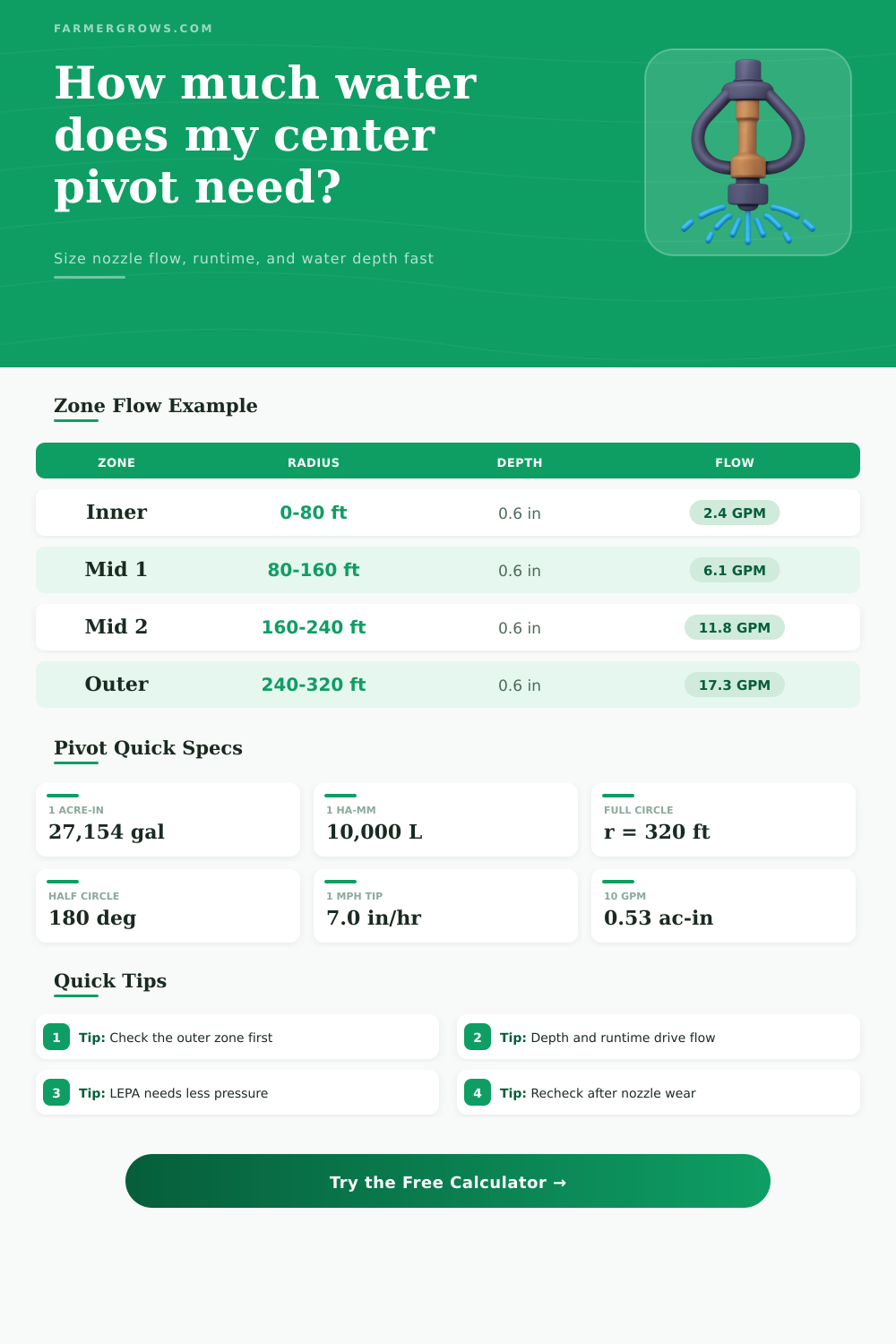
The farther the pivot is from the center of the pivot, the more water the nozzles must release. The section of the pivot between 240 and 320 feet from the center may require seven times more water than the innermost section of the pivot. When planning the irrigation system for the field, the shape of the field should be consider.
Sizing Nozzles and Using a Center Pivot to Water Crops
Fields that are square in shape can use full circles of center pivots. Fields with odd corners, however, will require half circle or quarter circles of center pivots. An end gun can be used on the pivot system to extend the reach of the water 50 feet out from the pivot system.
The downside to using an end gun, though, is that it increases the amount of water that must come out of the outer zone of the pivot system to accomplish this goal, which may overwhelm the pivot system’s water pump. It may also be necesary to leave a dry radius of the field around the center point of the pivot system to prevent the pivot system’s equipment from damaging the crops. These determinations will impact the entire pivot system, and will dictate whether the water from the pivot system reaches the target depth.
The target depth for the water that the pivot system applies, as well as the runtime of the pivot system, are two factors in the irrigation planning process. Three-quarters of an inch of water may be required to be applied to the field over a 12-hour period, for instance. In this case, the irrigation system will have to be sized appropriately to provide that volume of water.
The target depth and runtime will effect the number of irrigation passes that are required to provide the crops with the amount of water that they need. In addition, some losses of the water that the pivot system distributes may occur due to the wind, or due to the evenness of the spray patterns of the nozzles. Some nozzles may have different rates of water distribution efficiency than others.
For example, standard sprays have an efficiency of approximately 85 percent, while low-pressure LEPA nozzles have an efficiency of approximately 95 percent. The spacing between the nozzles impacts how much water is distributed to the crops. For instance, 24 feet spacing between the nozzles may be used for orchards, but 40 feet may be used for larger fields.
The radius of the pivot system can be divided into sections, each with their own amount of water requirements. For instance, the innermost zones of a pivot system may require only 5 percent of the total water output of the pivot system, while the outer zones may require up to 25 percent of the total water output. The runtime of the pivot system will impact the number of passes that the pivot system takes over the field.
For instance, a 640-foot radius pivot system that moves at a speed of 5 feet per minute will take 12 hours to complete a single pass around the field. Therefore, if the radius of the pivot system increase, the time to complete a single pass will increase. If the pivot system moves at a faster speed, the pivot system will require larger nozzles to distribute the same amount of water to the field.
The opposite is true if the pivot system moves at a slower speed. The nozzles of the pivot system may degrade over time. The causes of nozzle degradation may be erosion of the nozzles caused by movement of the pivot system, or the nozzles may become clogged due to sediment in the water.
If the nozzles of the pivot system degrade, the amount of water that emerges from the nozzles may increase by 10 to 20 percent. Therefore, the nozzles should be inspected each year. The nozzles on the outer edges of the pivot system should be inspected more often than the remaining nozzles.
Another common error that occurs in the irrigation of crops with center pivot systems is placing the nozzles of the pivot system to provide a flat flow of water to each span of the pivot system. Such a placement of nozzles will cause the center of the field to become too wet, and the edges of the field will become too dry. Using a zone table for the pivot system will ensure that each zone of the pivot system appropriately match the hardware to the crops within those zones.
Another factor that will impact the effectiveness of the pivot system is the environment in which the pivot system is to be established. For instance, wind may carry some of the water droplets of the pivot system away from the crops. The use of LESA or LEPA systems may allow for lowering the elevation of the water to reduce the amount of water that is lost to drift due to wind.
The type of soil in which the pivot system is to be established will also impact the pivot system. For instance, sandy soil absorbs water at a faster rate than clay soil. Therefore, irrigation passes with sandy soil will be shorter and deeper than those made on clay soil.
The use of low-pressure setups for the pivot system may reduce the energy costs of the pivot system. However, ensuring that the pump for the pivot system is able to handle the pressure requirements of the system is essential. The output of the well can be tested at the operating psi for the pivot system to ensure that the pump will appropriately supply the water that the pivot system requires.
Another strategy for the pivot system is to utilize presets to determine the amount of water that is required to water the field of various sizes. For instance, a preset can be established for a 160-acre field that has a full circle of center pivots. The preset will ask for the radius of the field, the target depth for the field, and how much water is required for various types of crops, such as corn or alfalfa.
These presets may also be programmed to calculate the requirements of the pivot system for other measurement systems, such as hectares and millimeters. Observing the field while the pivot system is in operation will allow the pivot system to be calibrated to the area that is to be irrigated. For instance, walking near the pivot while it is in operation will reveal which areas are too wet or too dry.
Soil cores can be inspected after placing water into the soil to determine how deeply the water entered the soil. Crops will lose some of the water that was placed into the soil through processes such as transpiration. Therefore, calculating how much water is lost each day, and providing that amount of water to the crops each day with the pivot system will ensure that the crops receive enough water.
For instance, using a strategy that waters the field to a depth of 0.5 inches every eight hours will be more effective than watering the field to a depth of 2 inches once each day. Additionally, various types of equipment can be purchased to increase the precision of the pivot system. For instance, pressure regulators will maintain the water output of the pivot system, despite the changes in the elevation of the pivot system.
Flow meters will ensure that the pivot system is providing the amount of water that is calculated for that field. Low-drift nozzles will reduce the amount of water that evaporates from the pivot system by 15 percent in areas with strong winds. When establishing the pivot system, the outer zones will be established first.
These outer zones will dictate the amount of water that emerges from each nozzle of the pivot system. If the nozzles are appropriately sized, if the zones are appropriately balanced with each other, and if the depth of water provided to each zone is matched to the size of the roots of the crops in that zone, the pivot system will function in an effective manner.