Nozzle K Factor Calculator
Find flow, pressure, or K factor for sprinkler and spray nozzles in imperial or metric units.
Calculated Output
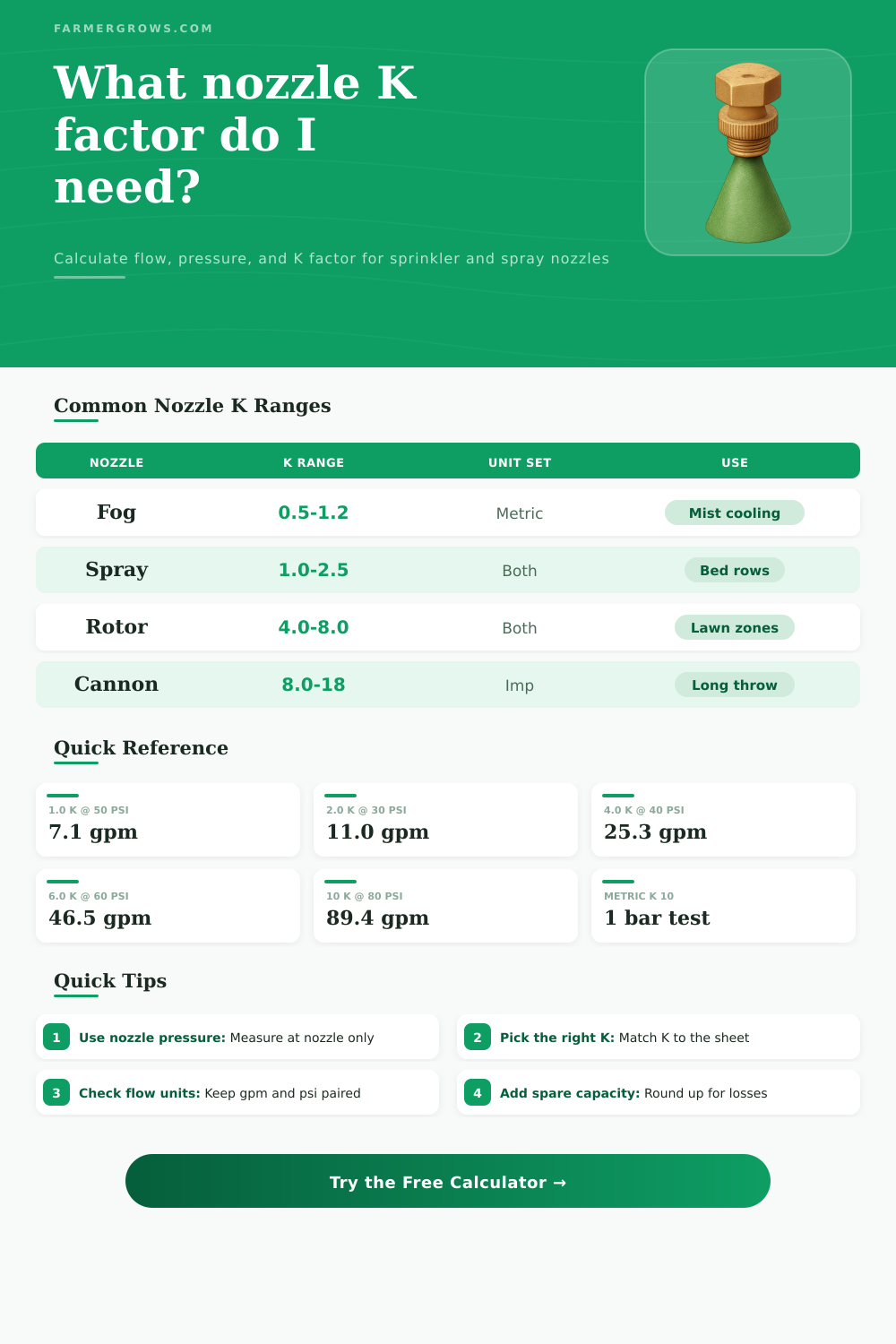
| Nozzle | K Range | Unit Set | Notes |
|---|---|---|---|
| Fog | 0.5-1.2 | Metric | Fine mist |
| Spray | 1.0-2.5 | Both | Beds rows |
| Rotor | 4.0-8.0 | Both | Lawn zones |
| Cannon | 8.0-18 | Imperial | Long throw |
| K Value | 30 psi | 50 psi | 80 psi |
|---|---|---|---|
| 1.0 | 5.5 | 7.1 | 8.9 |
| 2.0 | 11.0 | 14.1 | 17.9 |
| 4.0 | 21.9 | 28.3 | 35.8 |
| 8.0 | 43.8 | 56.6 | 71.6 |
| Measure | Imperial | Metric | Formula |
|---|---|---|---|
| Flow | gpm | L/min | x 3.7854 |
| Pressure | psi | bar | x 0.06895 |
| K factor | gpm/sqrt(psi) | L/min/sqrt(bar) | calc both |
| Count | Nozzles | Nozzles | same input |
| Example | K | Pressure | Flow |
|---|---|---|---|
| Fine mist | 0.5 | 30 psi | 2.7 gpm |
| Spray bed | 1.0 | 50 psi | 7.1 gpm |
| Rotor zone | 4.0 | 40 psi | 25.3 gpm |
| Big cannon | 10.0 | 80 psi | 89.4 gpm |
The K factor is a mathematical value that relate the flow of water to the pressure of water within an irrigation system. People use the K factor to determine the amount of water that will emerge from a nozzle at a given pressure. This value is used in the equation that relates the flow of water to the K factor of the nozzle and the square root of the pressure.
The flow of water do not increase linearly in relation to the pressure of the water within the nozzle. Instead, the flow of water will increase at a slower rate as the pressure increase. For instance, if the pressure is doubled, the flow of water will increase to only 40% of the initial flow.
K Factor in Irrigation: What It Is and How to Use It
Using the correct K factor will help to avoid wasting water within the irrigation system. Furthermore, using the correct K factor will help to prevent over pressurizing the system. Different types of nozzle has different K factors.
This is because each type of nozzle will disperse the water in a different manner. For instance, fog nozzles will emit droplets of water that evaporate quick. Spray nozzles will emit water over a broader area than fog nozzles but has a different K factor.
Rotors will dispense water on lawns using gear driven rotation systems and have a higher K factor than spray nozzles. Large cannons will water sports fields and orchards and will have very high K factors. Using the wrong K factor for a given type of nozzle will create patchy areas that are watered versus areas that are not watered.
Furthermore, this can waste money on water bills. In order to calculate the K factor for a nozzle correctly, you must measure the pressure and flow of water correct. The pressure should not be taken at the pump as the water will lose some of its pressure as it passes through the irrigation system pipes.
Instead, you should place a pressure gauge directly at the nozzle to measure the pressure of the water at the nozzle. The flow of water can be measured with a bucket or flow meter. It is also necessary to calculate the total number of nozzles within the system.
Each nozzle will increase the demand for water. Finally, it is a good idea to include a reserve of 10 or 15% in the calculations to account for water that might be lost to elevation changes in the system or clogged filter within the nozzles. The correct nozzle size for an irrigation system will depend on the K factor of the nozzles and the needs of the zone to be irrigated.
If the K factor of the nozzles is high, then each will dispense more water. This will allow for fewer nozzles to water an area but will require the pump to work harder to push the water out of the nozzles. If the K factor is low for the nozzles, then each will emit less water.
This will require that the nozzles be placed closer together to provide adequate water to the zone but will allow for the pump to work less. Soil type can also play a role in the determination of nozzle size. Sandy soil will require higher rates of water than clay soil because it absorb the water at a faster rate.
Another factor is the wind. If the wind is strong in the area to be irrigated, then misting nozzles will move the water away from the area to be watered. Therefore, you will have to adjust the placement of these nozzles accordingly.
Common mistakes in calculating the K factor include only relying on the charts that the manufacturer of the nozzle provides. Additionally, people might not account for the fact that over time the K factor of the nozzles change due to the wear on the nozzles. Another mistake is using different units of measurement for different variables.
For instance, the metric system K factors do not necessarily equal the imperial system K factors. Therefore, it is essential to convert these units to ensure that the irrigation systems calculations is correct. Another mistake is not accounting for the elevation of the water within the irrigation system.
Changes in elevation will impact the pressure of the water within the pipes, which will change the flow rate of the water that comes out of the nozzles. When faced with problems with an irrigation system, there are steps that can be followed to use the K factor to solve those problems. If the water from the irrigation system is not traveling as far as desired, then you can check the pressure at the nozzle and inspect the K factor of the nozzles.
If the nozzles are flooding the area that is to be watered, you can use a nozzle with a lower K factor or there can be more nozzles placed within the area to be irrigated. Furthermore, if the flow rate of water within the system is too low, the pipes can be of a larger size or the pump can be of a larger size. By measuring the flow of water from the system and measuring the pressure at a specific nozzle, it is possible to solve for the K factor.
Once you obtain this number, it can be used to establish a baseline for the irrigation system.