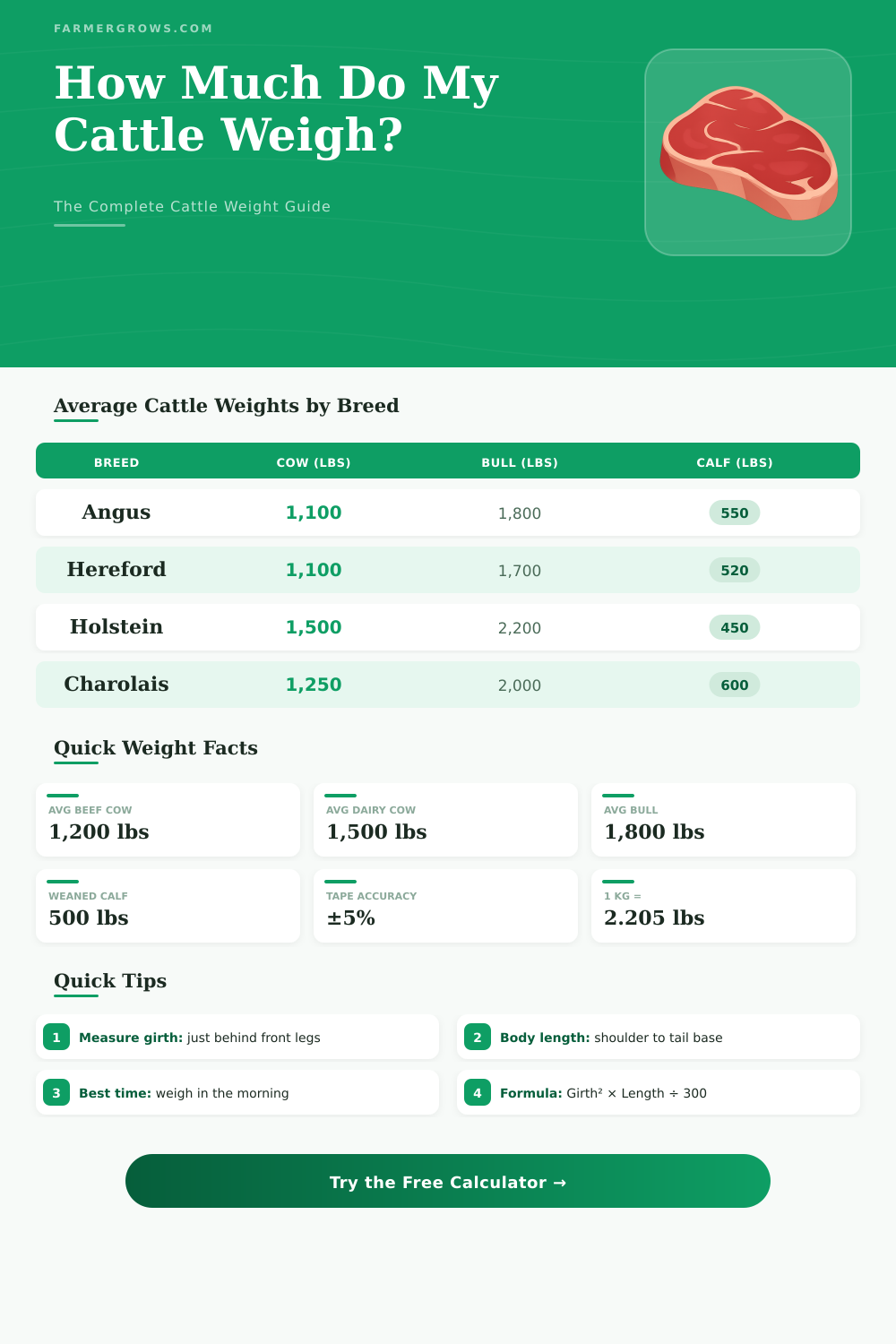
🐄 Cattle Weight Calculator
Estimate live weight by body measurements, breed, age & sex — Imperial & Metric
| Heart Girth (in) | Heart Girth (cm) | Est. Weight (lbs) | Est. Weight (kg) |
|---|---|---|---|
| 40 | 102 | 200 | 91 |
| 48 | 122 | 400 | 181 |
| 56 | 142 | 650 | 295 |
| 64 | 163 | 950 | 431 |
| 70 | 178 | 1,150 | 522 |
| 74 | 188 | 1,300 | 590 |
| 78 | 198 | 1,500 | 680 |
| 82 | 208 | 1,700 | 771 |
| 86 | 218 | 1,900 | 862 |
| Age | Heifer (lbs) | Steer (lbs) | Bull (lbs) |
|---|---|---|---|
| Birth | 60–70 | 65–75 | 65–80 |
| 3 months | 200–250 | 220–270 | 230–280 |
| 6 months (weaning) | 400–500 | 450–550 | 460–560 |
| 12 months | 650–800 | 700–850 | 750–900 |
| 18 months | 850–1,000 | 900–1,100 | 1,000–1,200 |
| 24 months | 950–1,100 | 1,000–1,200 | 1,200–1,500 |
| Mature | 1,000–1,200 | 1,100–1,300 | 1,600–2,000 |
| Method | Formula | Best For | Accuracy |
|---|---|---|---|
| Beef Tape (Girth only) | Girth² × 0.0635 | Beef cattle, mature | ±5–10% |
| Dairy (Girth + Length) | (Girth² × Length) ÷ 300 | Dairy breeds | ±3–7% |
| Sheep/Calf Tape | Girth² × Length ÷ 660 | Calves <6 months | ±5–8% |
| Visual / BCS | Breed avg × BCS factor | Quick field estimate | ±10–15% |
The weight of livestock ranges according to the breed, age and other factors. In one group, animals can differ by 300 kg. Small breeds reach only 350 kg or less, while big breeds pass 700 kg The Chianina is the tallest and heaviest breed, a mature bull weighs around 1,280 kg.
Dairy cows usually have between 600 and 700 kg. For context, that is around 1,200 to 1,500 pounds. Beef cows on the other hand commonly pass 2,500 pounds.
Cattle Weights and How to Measure Them
The weight of cow depends on her breed, pregnancy and quality of food.
Average beef cow weighs around 550 kg or more, although the range goes from 408 to 800 kg according to age and breed. Precise weigth of your livestock is important, especially for producers that need records. Feed is the main cost for beef ranchers, so exact knowledge about weight of animals helps to control nutrition, stocking and other signs without guessing.
Calves grow very quickly. From birth to market weight of 1,200 to 1,400 pounds they reach that in 14 to 18 months under good conditions. Since the 1970s, the values changed a lot.
For Angus yearlings weights grew by 96 pounds, average steers jumped by 239 pounds, and heifers even more, to 300 pounds.
Weights matter in farming, because they help to control growth and feed needs daily. Breeders commonly measure at 200, 400 and 600 days. Moreover, that is key for doses of medicines and drenches, that must match with the animal.
You not always need scales for estimate weight of cow. One simple method is heart girth, measure around the chest. Take that number, square it, multiply by body length, divide by 300, and you have approximate weight in pounds.
Girth is the most used mode. Also hip height is usefull. For beef livestock sent to slaughter, measure hip height and compare with a chart for find target weight.
In 1,000 pound alive steer you receive around 610 pounds of body. From that, 70 percent becomes take-home meat, so around 43 percent of alive weight. Fat forms 20 to 22 percent of carcass weight, bones around 15 percent.
In 1,200 pounds the body reaches 750 pounds, giving 485 to 490 pounds of retail cuts. Boneless cuts lower those numbers. Recently average dressed weight was 960 pounds, 33 pounds more than same week before.
Angus is the most common beef breed through United States. Its popularity comes from meat quality, soft and delicious thanks to natural marbling. Angus cows easily calve because of strong maternal instincts.
Ultimately, livestock that does not gain, does not gain value, so efficient fatteningdecide everything.