🐄 Cattle Ration Calculator
Balance a cattle ration from body weight, cattle class, target gain or milk, forage dry matter, concentrate, crude protein, TDN, mineral, and total dry matter intake.
Pick a preset to load a practical starting ration, then adjust the as-fed forage, concentrate, feed-test numbers, mineral amount, and target gain or milk to match your herd.
Ration Balance Results
Your cattle ration estimate will appear here after calculation.
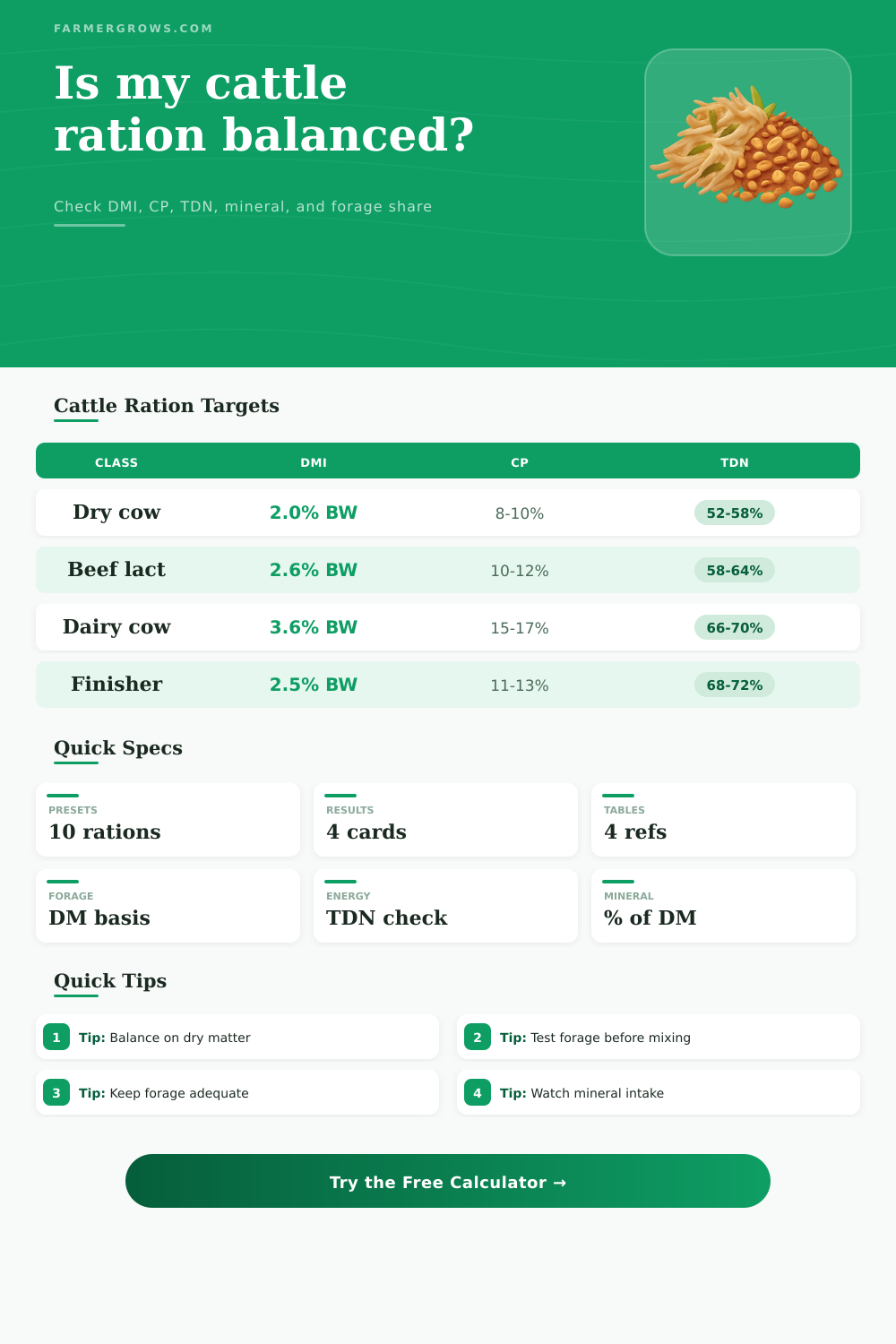
| Cattle class | DMI target | Crude protein target | TDN target |
|---|---|---|---|
| Dry beef cow, mid gestation | 1.8 to 2.1% of body weight | 8 to 10% | 52 to 56% |
| Late gestation beef cow | 2.0 to 2.3% of body weight | 9 to 11% | 56 to 60% |
| Lactating beef cow | 2.4 to 2.8% of body weight | 10 to 12% | 58 to 64% |
| Lactating dairy cow | 3.2 to 4.0% of body weight | 15 to 17% | 66 to 70% |
| Replacement heifer | 2.2 to 2.6% of body weight | 11 to 13% | 60 to 65% |
| Stocker or backgrounder | 2.3 to 2.8% of body weight | 12 to 14% | 63 to 68% |
| Finishing steer | 2.2 to 2.6% of body weight | 11 to 13% | 68 to 72% |
| Feedstuff | Dry matter | Crude protein | TDN |
|---|---|---|---|
| Grass hay | 88 to 92% | 7 to 11% | 48 to 56% |
| Alfalfa hay | 88 to 92% | 16 to 22% | 55 to 62% |
| Warm-season hay | 88 to 92% | 8 to 12% | 50 to 58% |
| Corn silage | 32 to 38% | 7 to 9% | 65 to 70% |
| Small grain silage | 30 to 40% | 9 to 13% | 58 to 64% |
| Lush pasture | 18 to 30% | 14 to 22% | 60 to 70% |
| Corn grain | 88 to 90% | 8 to 10% | 86 to 90% |
| Distillers grains | 88 to 92% | 26 to 32% | 82 to 90% |
| Ration style | Forage share of DM | Concentrate share of DM | Use case |
|---|---|---|---|
| Maintenance cow ration | 85 to 100% | 0 to 15% | Dry cows with adequate hay or pasture |
| Late gestation support | 75 to 90% | 10 to 25% | When forage quality is short before calving |
| Lactating beef cow | 65 to 85% | 15 to 35% | Milk production, thin cows, or limited pasture |
| Growing calf ration | 45 to 70% | 30 to 55% | Stocker and backgrounding gain targets |
| Finishing ration | 8 to 25% | 75 to 92% | High energy finish with careful adaptation |
| Dairy lactation TMR | 40 to 60% | 40 to 60% | Milk production with fiber and energy balance |
| Check | Low signal | High signal | Planning response |
|---|---|---|---|
| Dry matter intake | More than 10% below target | More than 15% above target | Review feed availability, refusals, moisture, and bunk space |
| Crude protein | Below class target | More than 3 points above target | Adjust hay quality, protein supplement, or feed class |
| TDN energy | Below class target | Very high for cow ration | Increase energy or protect effective fiber as needed |
| Mineral share | Below 0.5% of DM | Above 3% of DM | Check label intake, salt level, and delivery method |
| Forage share | Too low for non-finishing cattle | Too high for fast gain | Match forage share to class, adaptation, and fiber need |
Hay, pasture, silage, grain, and supplement only balance correctly after moisture is removed, so update dry matter when feed changes or storage conditions shift.
Crude protein and TDN vary widely by maturity, harvest, and storage; a forage test can change whether cattle need protein, energy, both, or neither.
This calculator is a planning tool for ration estimates. Work with a qualified nutritionist, veterinarian, or extension specialist for mineral programs, transition diets, feed additives, and health concerns.
Cattle feeding require a balance between the nutrients that the cattle require and the nutrients that the feed supplies to those cattle. The nutrients in hay change with the quality of hay with every cutting. The nutrients in pasture change with the weather.
Each of these feeds can have a single missing nutrient that limit the weight gain of cattle that eat those feeds or limits the milk production of lactating cows. Producers check for these nutrients to ensure that the feed that is provided to the cattle meets the nutritional requirements of those cattle. Different classes of cattle have different nutritional requirements of the cattle, and the requirements of the cattle change with the life stage of those animals.
Use a Ration Calculator to Balance Cattle Feed
For example, dry cows have different requirements than cows that are lactating. Additionally, replacement heifers have different requirements than growing steers. The farmer need to compare the requirements of each of these different groups to the feed that is provided to each category of cattle, or the feeding into each group of cattle could result in either underfeeding of those cattle or overfeed of those groups.
A practical ration tool allows the farmer to input a variety of known numbers for the cattle and their feeding situation, and the ration tool calculates the nutritional values of the ration for that farm. For example, the farmer can enter body weight, cattle class, forage amounts, concentrate amounts, and feed test values into the tool. Based off these entries, the tool calculates dry matter intake, crude protein, TDN, and forage share.
Additionally, these feeds perform conversions from feeds as-fed values to dry matter values, allowing those feeds to be compared to one another. Through the completion of these calculations, the farmer can determine whether the ration that will be used for feeding the cattle will meet the target requirements for that class of cattle, or whether adjustments will need to be made in the creation of the next load of hay. Forage is often the largest portion of the rationing of cattle, yet can be difficult to judge as to the quality of the forage.
For example, hay may appear good when loaded into the barn, yet test poorly in relation to the protein and energy content of the hay. Additionally, silage and pasture contains moisture level that can affect how much dry matter that the cattle will consume each day. Each of these parameters can be entered individually into the ration tool, allowing the cattle manager to determine whether the forage portion of the ration is fulfilling its role within the ration, or whether the concentrate portion of the ration is performing more of the role of the forage than it is supposed to.
The concentrate portion of the ration can include feeds such as corn grain, distillers grains, or soybean meal. Each of these feeds contributes to the nutrition level of the ration provided to the cattle. Additionally, because the amount of concentrate that is fed to the cattle is less than the amount of forage that is fed to the cows, any change in the amount of concentrate that is fed to the cattle will have an impact upon the protein and TDN levels of the ration.
Such a change can be viewed on the ration calculator in real time, allowing the cattle manager to make decisions regarding the amount of supplement that should be added to the ration to increase either the protein levels or the energy levels of the ration to those amounts that are required of the cattle. Another area in which producers can become interested in the ration calculator is in regard to the mineral share of the ration. Small mistake in the providing of minerals to the cattle can lead to significant problems in the health of the cows.
For example, if the free-choice minerals are provided in amounts of ounces of mineral per head of cow, those ounces of mineral contribute to the total dry matter intake of the cows. If the amount of minerals that are provided is too high relative to the amount of dry matter that is provided to the cows, it is possible for those minerals to crowd out the amount of forage or concentrate ration that is provided to the cows. Additionally, if there is insufficient amounts of minerals provided to the cows, the cows may not ingest the trace elements that the cows require.
Another use of the reference tables that are provided within the tool is to provide context for the decisions regarding hay, supplement, and mineral rationing for the cattle. For example, the reference tables allow for the viewing of typical dry matter intake by different classes of cattle, typical nutrient levels within feeds, and typical forage to concentrate ratio. By viewing the reference tables and the cattle rationing requirements for the individual category of cows and bulls, it is possible to determine whether the rationing of hay, supplement, and minerals is resulting in any problems for the cattle farm, and to address any of those problems.
Many of the individuals who are in charge for feeding the cattle may make mistakes with the rationing. For example, they may not provide enough dry matter to the cows, they may not account for the moisture content of silage, or they may not ensure that the minerals that are provided to the cows are balanced appropriately. By reviewing the ration calculator that is described in this article, an individual can make decisions regarding hay, supplement, and mineral rationing to the cows, and avoid those potential mistakes.
Even with such a detailed and comprehensive calculator, not all variables for feeding the cattle can be accounted for. For example, the amount of dry matter that is actually consumed by the cattle will change with the size of the feeding bunk, the weather, the behavior of the cattle in relation to feeding, and the refusal of certain types of feed by the cows. The dry matter intake that is calculated will be different than the dry matter that is consumed by the cows.
Additionally, the tests of the forage can change between loads of hay, and the quality of the pasture can change every day. Thus, the calculator will allow a farmer to have a starting point in feeding the cattle, but still require the judgement of the farmer to ensure that the rationing of hay, supplement, and minerals to the cows is actualy matching the amount of feed that is being consumed by those animals. The goal of the creation of the calculator is not to provide the most precise measurement to the farmers of the amount of hay, supplement, and minerals that should be provided to the cows.
Rather, the calculator allows the producers to make decisions regarding hay, supplement, and mineral rationing for the cattle. If the rationing of hay, supplement, and minerals to the cows allows for each category to meet the requirements of its category of cattle, then the cows will exhibit the best possible performance, and the cost of the feed will be within the budget of the cattle farmer. Thus, the most practical use of the calculator is in making decisions regarding the balance of the rationing of hay, supplement, and minerals to the cows.