🐄 Cattle Fence Calculator
Estimate fence length, line posts, braces, and wire or rail needs for cattle paddocks
🧰Fence Setup
📊Fence Style Comparison
4-Strand Barbed
Best for: mature cows and long boundary runs.
Shape: simple, durable, and common on open pasture.
Containment: solid when cattle are trained.
5-Strand Smooth
Best for: rotational cells and visible boundary lines.
Shape: fewer points, cleaner appearance, easy to inspect.
Containment: works well with trained cattle.
Woven Wire
Best for: calves, heifers, and tight paddocks.
Shape: closer posts, tighter mesh, more stability.
Containment: strong on small livestock pressure.
Pipe / Board
Best for: pens, working alleys, and high-visibility edges.
Shape: rigid rail layout with strong corner support.
Containment: ideal near handling areas.
🔧Reference Tables
| Fence style | Runs | Typical spacing | Primary use |
|---|---|---|---|
| 4-strand barbed | 4 | 16 ft | General cattle |
| 5-strand barbed | 5 | 16 ft | Heavier pressure |
| 5-strand smooth | 5 | 18 ft | Rotational cells |
| Woven wire + top | 1 + 1 | 12 ft | Young stock |
| High-tensile electric | 4 | 30 ft | Training fence |
| No-climb woven | 1 | 10 ft | Calf control |
| Board and wire | 3 | 8 ft | Visible pens |
| Pipe rail | 4 | 10 ft | Working lots |
| Terrain | Spacing factor | Effective spacing | Planning note |
|---|---|---|---|
| Flat ground | 1.10 | Wider | Steady line, fewer dips |
| Normal ground | 1.00 | Base spacing | Standard build condition |
| Rolling ground | 0.90 | Closer | Add a few more posts |
| Rough ground | 0.80 | Closest | Use extra bracing |
| Gate width | Gate posts | Brace assemblies | Notes |
|---|---|---|---|
| 10 ft | 2 | 1 | Utility lane |
| 12 ft | 2 | 1 | Common pasture gate |
| 14 ft | 2 | 1 | Small equipment entry |
| 16 ft | 2 | 1 | Tractor or trailer access |
| Scenario | Typical size | Perimeter | Use case |
|---|---|---|---|
| Calving pen | 100 x 120 ft | 440 ft | Short, visible boundary |
| Heifer cell | 330 x 330 ft | 1,320 ft | Rotational stocking |
| Bull lot | 200 x 240 ft | 880 ft | Heavy-duty enclosure |
| Round pen | 120 ft dia. | 377 ft | Training or holding |
🧰How the Build Breaks Out
When planning a cattle fence, calculating the amount of materials that is needed to build the fence will ensure that you dont run out of materials, nor will you have to purchase too many extra material for the job. In planning a cattle fence, you must consider such things as the shape of the paddock, the way that you construct the fence, and the tension that may act upon the fence if it isnt planned and built correctly. If the cattle are not manage within the paddock or if the cattle fence fail, it is due to an incorrect planning of that fence.
The shape of the paddock will play a critical role in determining the length of the perimeters of the paddock, which will help to determine the amount of wire and posts that is required to build that fence. For instance, a square paddock will allow for even distribution of the grounds pressure upon the corner of the paddock. For paddocks that is triangular or circular in shape, more heavier braces will be required for the fence to distribute the weight of the cattle upon those angle of the paddock.
How to Calculate Materials for a Cattle Fence
For rectangular paddocks, the perimeter of the paddock can be calculate by multiplying the length and the width of the paddock by two. For paddocks that are circular in shape, the perimeter (the circumference) of the paddock can be calculated by multiplying the diameter of the paddock by the value of pi (3.14). These measurement are essential in determining the total length of the fence.
The terrain in which you construct the fence will also influence the spacing of the fence posts. For instance, on flat pastures, the spacing between fence posts can be between 16 and 18 feet. However, if the terrain are hills or slopes, the posts should be placed at intervals of 12 feet.
If the fence is constructed on hills without adjusting the spacing of the posts, the fence will sag. If the fence sag, the cattle may be able to pass through the gaps within the fence. Within the fence, a number of gate will be required to provide individuals with access to the paddock.
However, each gate will require extra reinforcement in the form of two heavy fence posts to allow for the gate to remain secure against the weight of the cattle. Each gate will also require an even number of feet in width based off the needs of the individuals who will use those gates. For instance, gates that are 12 feet in width will allow for tractors to pass through the paddocks gates.
Gates that are 16 feet in width will allow trailers to pass through the paddock. The width of each gate should be subtracted from the total length of the fence. Additionally, brace assembly will be required for each corner and each gate within the fence.
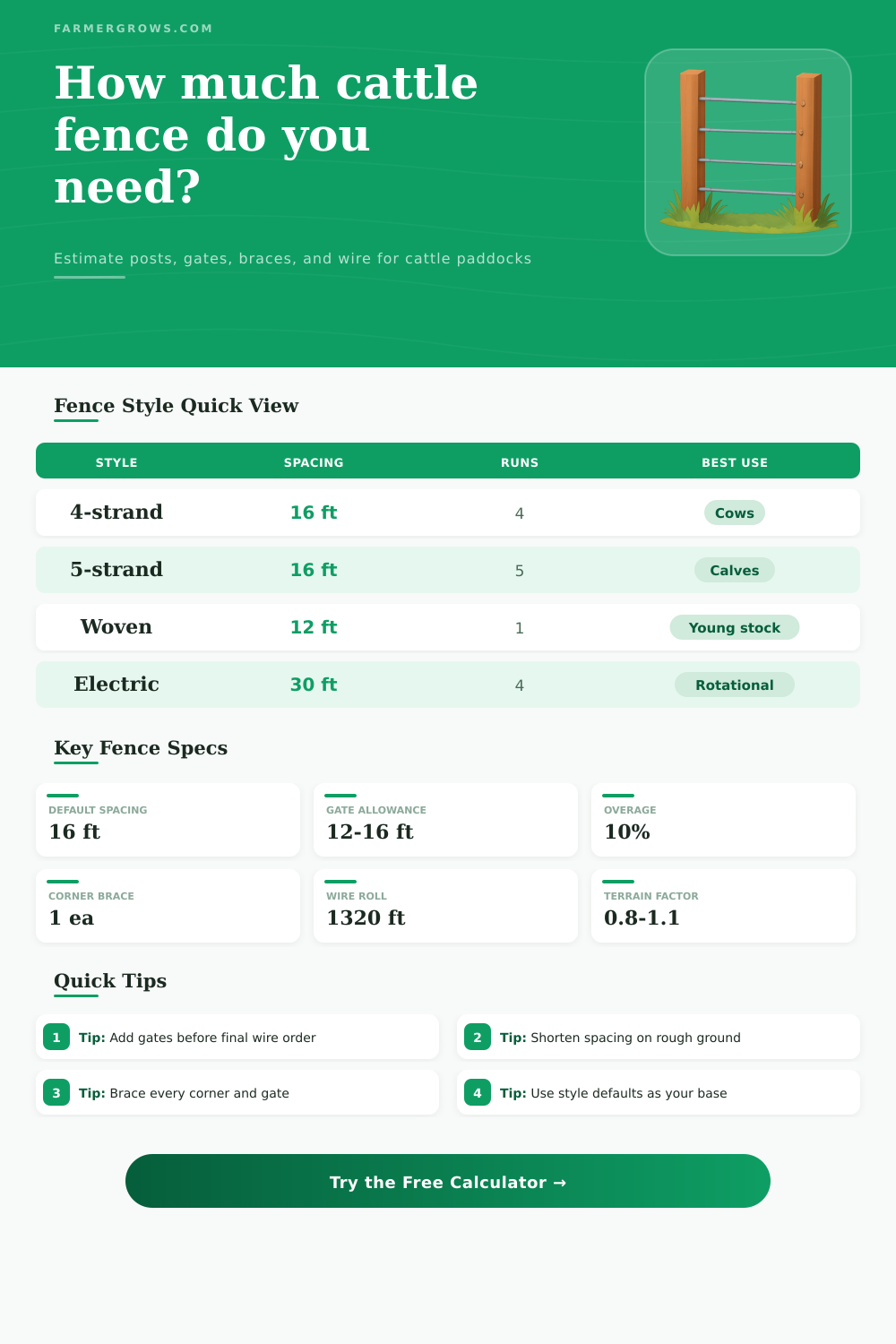
The style of the fence will determine the number of wire that are required for the fence. For instance, people often use four-strand barbed wire to surround paddocks containing mature cows. Four-strand barbed wire can be installed between posts that are 16 feet in spacing.
Woven wire is used to contain calves because woven wire has tighter gaps that prevent the calves from pushing there heads through the openings in the wire fence. Finally, electric high-tensile wire is used for long boundaries. With electric wire, the posts can be up to 30 feet in spacing.
Additionally, insulators and a charger will be required for installing electric wire. Each of these fence style will influence the total count of wire roll and the count of fence posts required for construction of the fence. When calculating the amount of materials required to build a cattle fence, it is important to include an overage in that initial calculation.
An overage of 10 percent to the total count of posts and wire is recommended. If the paddock to be enclosed by the fence has any particular feature, or if it is of a custom shape, it may be better to add 15 percent to the total count of posts and wire for that fence. By not including an overage percentage for posts and wire, it is possible that there will not be enough post or wire to build the cattle fence.
When building the fence, the corner brace should be set first. The corner braces will provide stability for the fence when the wire is stretch. Following placement of the corner braces, the line posts can be installed into the ground.
The gates should be installed last. Finally, when installing the wire, those cool morning hour should be utilized to ensure that the fence remains at an even tension throughout the day. By following these steps, the cattle fence will be built correct and will remain functional for the herd of cattle for many years.