🌾 Bushel to Acre Converter
Calculate application rates, total bushels needed, and metric equivalents for any field size
| Crop | Min Rate (bu/ac) | Max Rate (bu/ac) | Min Rate (kg/ha) | Max Rate (kg/ha) |
|---|---|---|---|---|
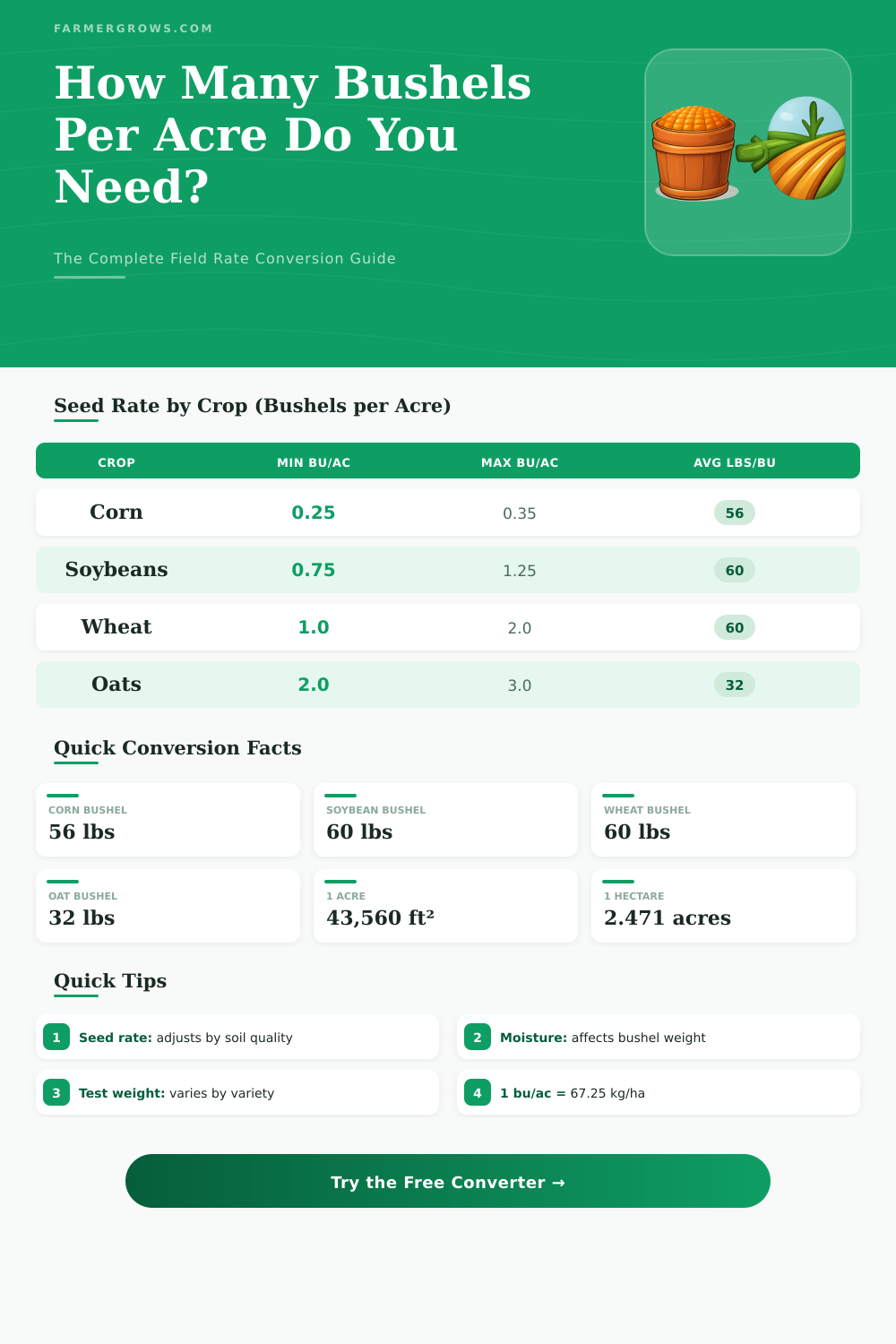
| Corn | 0.25 | 0.35 | 14.2 | 19.8 |
| Soybeans | 0.75 | 1.25 | 50.5 | 84.1 |
| Wheat | 1.0 | 2.0 | 67.3 | 134.5 |
| Oats | 2.0 | 3.0 | 36.0 | 54.1 |
| Barley | 1.5 | 2.5 | 80.6 | 134.5 |
| Rye | 1.0 | 2.0 | 62.6 | 125.2 |
| Sorghum | 0.5 | 1.0 | 31.3 | 62.6 |
| Sunflower | 0.2 | 0.4 | 2.8 | 5.6 |
| Acres | Sq Feet | Hectares | Sq Meters |
|---|---|---|---|
| 0.5 ac | 21,780 ft² | 0.202 ha | 2,023 m² |
| 1 ac | 43,560 ft² | 0.405 ha | 4,047 m² |
| 5 ac | 217,800 ft² | 2.023 ha | 20,234 m² |
| 10 ac | 435,600 ft² | 4.047 ha | 40,469 m² |
| 40 ac | 1,742,400 ft² | 16.19 ha | 161,875 m² |
| 80 ac | 3,484,800 ft² | 32.37 ha | 323,749 m² |
| 160 ac | 6,969,600 ft² | 64.75 ha | 647,497 m² |
| 640 ac | 27,878,400 ft² | 259.0 ha | 2,589,988 m² |
| Field Size | Corn @ 0.3 bu/ac | Soybeans @ 1.0 bu/ac | Wheat @ 1.5 bu/ac |
|---|---|---|---|
| 1 Acre | 0.3 bu | 1.0 bu | 1.5 bu |
| 5 Acres | 1.5 bu | 5 bu | 7.5 bu |
| 10 Acres | 3.0 bu | 10 bu | 15 bu |
| 40 Acres | 12 bu | 40 bu | 60 bu |
| 80 Acres | 24 bu | 80 bu | 120 bu |
| 160 Acres | 48 bu | 160 bu | 240 bu |
| 320 Acres | 96 bu | 320 bu | 480 bu |
| 640 Acres | 192 bu | 640 bu | 960 bu |
| Rate (bu/acre) | Corn (kg/ha) | Soybeans (kg/ha) | Wheat (kg/ha) |
|---|---|---|---|
| 0.25 bu/ac | 15.7 | 16.8 | 16.8 |
| 0.5 bu/ac | 31.4 | 33.6 | 33.6 |
| 1.0 bu/ac | 62.8 | 67.3 | 67.3 |
| 1.5 bu/ac | 94.1 | 100.8 | 100.8 |
| 2.0 bu/ac | 125.5 | 134.5 | 134.5 |
| 3.0 bu/ac | 188.3 | 201.7 | 201.7 |
To calculate the amount of seed that is needed for a field, a person must determine the amount of bushel of seed that are needed per acre. If a person plants too few bushels of seed per acre, then some portions of the field will be missing some of the crops that will grow. However, if a person plants too many bushel of seed per acre, then the person will waste money on the planted seed.
Therefore, a person must calculate the total number of bushels of seed that will be planted per acre to ensure that the crop grows correct. The amount of bushels of seed that is planted per acre will depend upon the type of crop that will grow in the field. For instance, crops like corn may require only.25 bushel per acre if the soil is high-quality.
How to Calculate Seed Needed for a Field
However, crops like soybeans require more seed to be planted because soybeans will branch out and not like to be crowd. Wheat may require one to two bushels of wheat per acre because it needs to grow thick to survive the winter. Finally, crops like oats may require two to three bushel of oats to be planted per acre.
Each type of crop has its own requirements for how much seed to plant per acre. The type of soil in which the crops will be planted will also impact the amount of seed that should be planted per acre. Soils that drains water quickly, like sandy soil, may require fewer seeds to be planted per acre than soils that retain their water for long periods of time, like clay soil.
Thus, a person must adjust the amount of bushel of seed per acre according to soil type. The test weight of the grain that will be planted also has an impact upon the amount of bushel per acre that should be planted. For instance, corn weigh 56 pounds per bushel, soybeans and wheat weigh 60 pounds per bushel, but oats only weigh 32 pounds per bushel.
Thus, the amount of seed that is planted will have to account for the weight of the seed that will be planted into the field. The total acreage that must be planted will determine the total amount of seed that will be planted into the field. The total acreage of a field can be calculated by dividing the total square footage of that field by 43,560.
Rectangles are the easiest to calculate the area of, but circles and triangles will require different math to determine the total area of the field. Once the total acres of the field is calculate, it can be multiplied by the rate of bushels of seed per acre to determine the total bushels of seed that will be required. An application buffer must also be added to the total bushels that are calculated for a field.
A buffer of 10% or 15% should be added to the total bushels of seed that will be planted into the field. This is to ensure that if the planter plants some areas of the field better than others, there will still be enough seed to cover those acre. If the buffer is not added to the total bushels of seed that are calculate, then it is possible that a person will run out of seed prior to planting all of the acres that were calculate for.
Knowing the total bushels of seed that will be planted will allow a person to calculate the number of bag of seed that will have to be hauled to the field. Bags of seed come in many different size, including bags that contain only one bushel of seed, two-bushel bags, five-bushel bags, ten-bushel bags, or even bags that contain 50-bushel quantities of seed. Thus, if a person knows the total number of bushels of seed that is required to be planted into the field, that person can calculate how many bag of seed will be required.
Furthermore, if a person knows the number of bushels of seed that will be planted into the field, that person can calculate the total weight of that seed by multiplying the total bushels of seed by the number of pounds of that type of seed per bushel. Metrics are another measurement system that must be considered in relation to the amount of seed to be planted into a field. Fields can be measured in both imperial measurements and metric measurements.
One hectare is equal to 2.47 acre. Thus, if the field that is to be planted with seed is measured in hectares, the amount of bushel of seed per acre will have to be adjusted accordingly. If a person incorrectly calculates the number of acres in a hectare or vice versa, the person will end up planting the wrong amount of seed into the field.
The germination rate of the seed can also impact the amount of seed that is planted into a field. If a person performs tests on the seed prior to planting, and discovers, for instance, that the batch of seed has a germination rate of 90%, then that person can adjust the rate of bushels of seed per acre by 10% to account for the fact that 10% of the seed will not germinate and grow. Finally, maps of the soil in which the seed will be planted may reveal area in the field where more seed should be planted than other areas of the field.
For instance, low areas in a field, known as “draws”, may have different soil makeup than high areas in the field, known as “knolls”. Thus, a person can use these maps to adjust the amount of seed that is planted in different area of the field. If a person commits any type of error in calculating the amount of seed to be planted into a field, issues may arise in that field.
For instance, if the size of the field is guessed rather than measured, the person will plant the wrong amount of seed into the field. Furthermore, if the weight of corn is used to calculate the weight of soybeans, the calculation will be incorrect due to the fact that corn and soybeans has different weights per bushel. Thus, to avoid these errors, a person can print the calculations that were performed to determine the amount of seed to be planted, and have those calculations visible in the tractor cab where the person will be planting the seed.
Through calculating the total number of bushel correctly, the field will have the correct amount of seed planted into the field. Furthermore, if the field has the right amount of seed planted into it, the crop will grow proper.