Breeding Date Calculator
Work backward from a desired birth date or forward from a planned breeding date, then estimate heat cycles, synchronization timing, breeding windows, pregnancy checks, and prep buffers.
Use this planner for herd calendar work, not diagnosis. Real breeding management depends on animal health, nutrition, semen quality, body condition, local veterinary guidance, and species-specific reproductive programs.
●Breeding plan presets
▣Species breeding comparison grid
⚙Breeding date inputs
For timed AI or veterinary sync programs, use the clinic or extension schedule as the authority. This calculator places the program on the calendar and checks whether the date math is sensible.
Your Breeding Date Plan
Enter a target date to calculate the breeding plan.
▦Quick species reference
■Reference table 1: species gestation and heat cycles
| Species | Gestation planning days | Heat cycle interval | Pregnancy check planning note |
|---|---|---|---|
| Beef cow | 283 days | About 21 days | Ultrasound commonly starts around day 28 to 35, depending on program. |
| Dairy cow or heifer | 280 days | About 21 days | Herd programs often recheck open cows after the next cycle. |
| Ewe | 147 days | About 17 days | Ultrasound scanning is often planned from day 30 onward. |
| Doe goat | 150 days | About 21 days | Ultrasound or blood testing timing varies by farm and veterinarian. |
| Sow or gilt | 114 days | About 21 days | Return-to-estrus checks begin around day 18 to 24 after service. |
| Mare | 340 days | About 21 days | Early pregnancy scan is commonly scheduled near day 14 to 16. |
| Doe rabbit | 31 days | Induced ovulator | Palpation timing is often around day 10 to 14 when trained. |
| Alpaca or llama | 345 days | Induced ovulator | Pregnancy confirmation timing depends on ultrasound or behavior testing. |
| Farmed deer | 200 days | Seasonal rut | Fawning dates are often managed by rut groups rather than daily heat checks. |
| Dog | 63 days from ovulation | About 6 months | Ultrasound confirmation is commonly around day 25 to 35. |
■Reference table 2: synchronization protocol placement
| Protocol | Calculator lead | Typical use | Calendar interpretation |
|---|---|---|---|
| Natural heat detection | 0 days | Small groups, pasture breeding, visible heats | Watch heats around the target breeding window. |
| Single prostaglandin response | 5 days | Cycling cattle, sheep, or goats when a corpus luteum is present | Protocol start is placed before expected standing heat. |
| Two-shot PG program | 14 days | More controlled cyclic female groups | First treatment is placed about two weeks before breeding. |
| CIDR or progesterone insert | 9 days | Cattle, sheep, goats, and some breeding programs | Start date approximates insert placement before breeding response. |
| Ovsynch / GnRH-PG-GnRH | 10 days | Dairy and beef timed AI programs | Start date is the first GnRH day in a common 10-day pattern. |
| Fixed-time AI program | 10 days | When insemination is scheduled without heat observation | Use your actual protocol sheet for exact injection and AI times. |
| Ram, buck, or boar effect | 14 days | Small ruminants or swine exposure planning | Introduces males before the planned breeding response window. |
| Custom sync lead | User entered | Veterinary or extension program | Calculator subtracts your lead days from the window start. |
■Reference table 3: pregnancy check timing
| Species group | Common first check | Follow-up planning | Reason to verify locally |
|---|---|---|---|
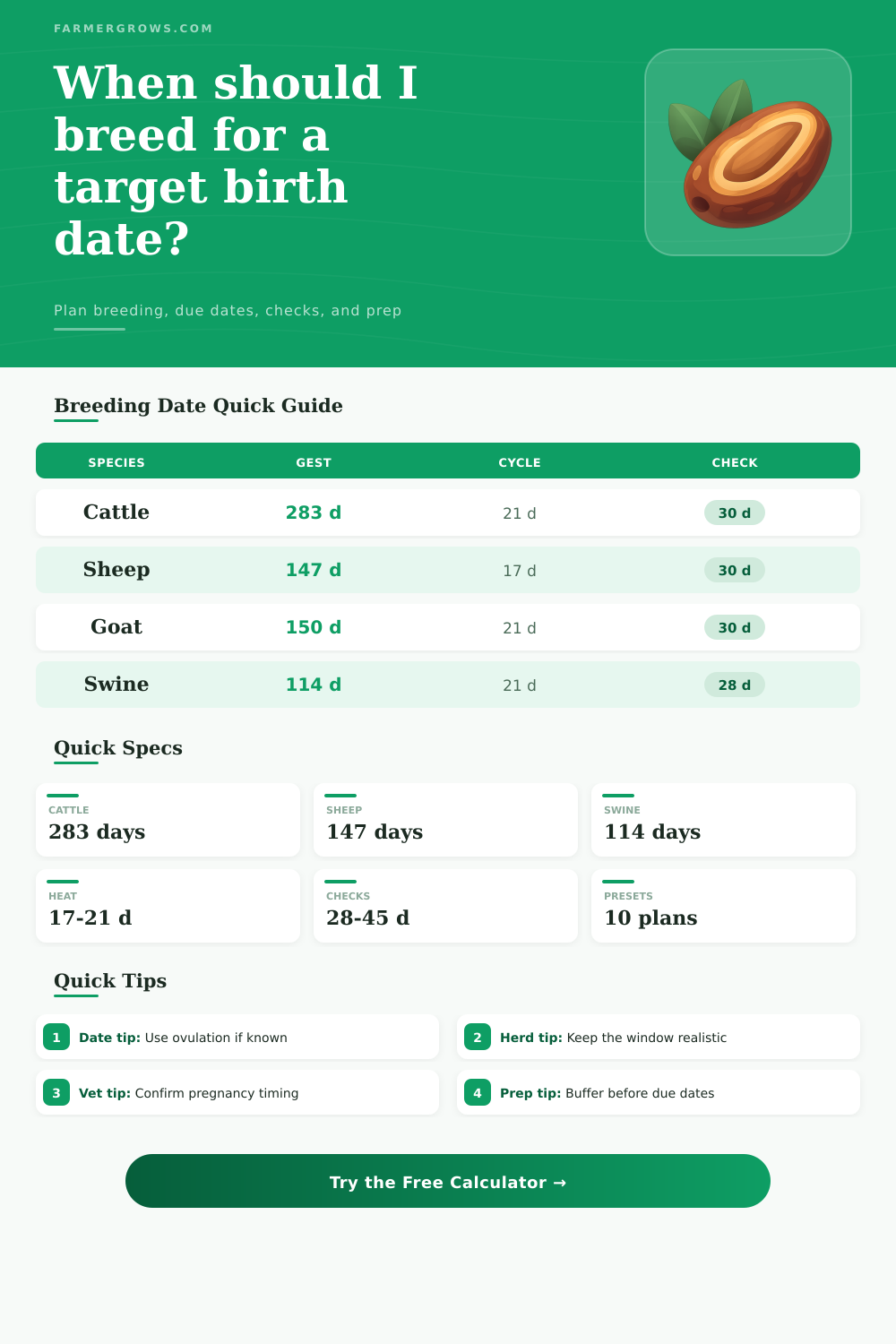
| Cattle | 28 to 35 days after breeding | Recheck open cows near the next heat or herd vet day | Skill, equipment, and fetal aging goals affect timing. |
| Sheep and goats | 30 to 45 days after breeding | Group scan for lambing or kidding count where available | Breed season, body condition, and scan access vary. |
| Swine | 18 to 35 days after service | Watch for return to estrus at 18 to 24 days | Commercial systems may use ultrasound or behavior checks. |
| Horse | 14 to 16 days after ovulation | Heartbeat confirmation around day 25 to 28 | Twin reduction timing makes early scanning important. |
| Rabbit | 10 to 14 days when trained | Prepare nest box around day 27 or 28 | Palpation should be done only by experienced handlers. |
| Dog | 25 to 35 days after ovulation | X-ray count later when advised by the veterinarian | Mating date can be less precise than ovulation date. |
■Reference table 4: breeding windows and prep buffers
| Planning item | Short window | Moderate window | Broad window use |
|---|---|---|---|
| Timed AI service | 1 to 2 days | 3 days for appointment drift | Rare; broad windows reduce due-date precision. |
| Hand breeding or pen exposure | 3 to 5 days | 7 to 14 days | Useful when heat detection is uncertain. |
| Pasture breeding | Not typical | 21 to 45 days | One to two full heat cycles for cleanup groups. |
| Pregnancy check window | One vet day | 7-day reminder range | Batch checks can follow farm handling schedules. |
| Prep buffer | 7 to 14 days | 21 to 35 days | Longer for foaling, calving groups, or remote farms. |
✓Two practical tips
If ovulation, standing heat, service date, and first exposure are mixed in the same herd record, due dates become hard to compare. Pick the most reliable basis for that species and label it clearly.
The next heat dates are just as useful as the target breeding date. Put rebreeding, pregnancy recheck, and cleanup male exposure reminders on the calendar before the group starts.
This breeding date calculator provides planning estimates only. Use veterinary advice for synchronization drugs, pregnancy diagnosis, reproductive disorders, assisted delivery risk, and animal welfare decisions.
Another task that must be perform by a person who manage livestock is the planning of a breeding schedule for those animal. A breeding schedule will allow a livestock manager to ensure that the birth dates of the livestock is not conflicting with other task that must be performed within the farm. For instance, a manager can use a calculator to ensure that the dates for when the animals will give birth are not at the same time as hay must be cut from the farm.
Furthermore, calculators allow a person to calculate these dates both forward and backward in time from either a target birth date or a service date. Thus, using a calculator allows a manager to avoid remember these dates in his or her mind. The length of gestation for the species of livestock that are to be breed will factor into the breeding schedule.
How to Plan a Breeding Schedule for Livestock
For instance, cattle has a gestation length of approximately 280 to 283 days due to the length of time that it takes for a calf to develop to its full size and vigor. In contrast, sheep and goats has a gestation length of approximately 147 to 150 days, which allows farmers to include two lambing or kidding period within the calendar year. Finally, swine have a gestation length of approximately 114 days.
Each of these gestation length can be entered into a calculator to automatically calculate the dates that each group of livestock will be born. The length of the heat cycle for the animals will factor into the breeding schedule. Heat cycle length will indicate how many opportunities there are to rebreed an animal if the initial breeding attempt was not successful.
For instance, cattle have a heat cycle of 21 days, which provide opportunities to breed the animal if the initial breeding attempt was mistimed. Sheep have a more short heat cycle of 17 days. Because the length of heat cycles can differ among breeds, the manager can enter the length of the heat cycle for the breeds of livestock that are to be managed into the calculator to ensure that any breeding schedule is accurate.
Each of the synchronization protocols that will be used will impact the time at which the breeding event will occur. For instance, protocols that utilize prostaglandines require a 14-day lead period between the two doses of the medication. Other synchronization programs, such as Ovsynch or AI programs that are performed at specific times will change the timeline for breeding the female.
Furthermore, these protocols will allow managers to avoid standing heats to breed the animals. Each of these lead periods can be subtracted from the breeding window in the calendar to allow a manager to visually determine the timeline for each of these breeding event. However, calculators will not indicate whether or not each of these protocols will be cost-effective or whether or not they will fit the management facility for that herd of livestock.
The time at which pregnancy check will occur will factor into the breeding schedule. For instance, pregnancy checks must occur at a time that allows for properly rebreeding any animal that are not pregnant with a fetus. If pregnancy checks occur too early, the manager may not be able to detect pregnancies in the animals.
If pregnancy checks occur too late, the same is true for the animals that will be rebred. Thus, each pregnancy check dates can be entered into the calculator, which will allow the calculator to provide a date for a pregnancy check. Furthermore, pregnancy check dates can be provided in a range within the calculator.
Such a date range will allow a manager to batch perform pregnancy checks on the animals at the same time. These pregnancy check dates should coincide with the times when a veterinarian is at the farm or when using the handling system for the livestock. Finally, prep buffers will factor into the breeding schedule.
Prep buffers will allow for time to move the animals and prepare the areas in which the pregnant female will give birth. For instance, a 30-day prep period may be established for the cows to prepare a maternity area. However, prep buffers for swine will likely be less due to the fact that the crate for the swine may be in place and ready for the pregnant sows.
Each of these prep periods can be subtracted from the due dates for the individual herd of livestock to determine prep dates for the animals. Consistency in the data that is entered into the calculator is important. For instance, some farmers use the day upon which the breeding service occurred as the basis for recording pregnancies of the animals.
Other farmers use the observation of the standing heats of the animals as the basis for breeding those animals. Thus, the calculator will not force consistency in how the farmer base his or her breeding records. However, each pregnancy check will provide the basis for the breeding records to be visible to the farmer each time the calculator is used.
Finally, the calculator will not account for biological variable. For instance, it will not account for the nutritional status of the animals, the body condition of the animals, or how the semen was handled prior to breeding the animal. Thus, the calculator will ensure that the arithmetic within the breeding schedules are accurate.
However, it will allow the livestock manager to see how far each date has moved as a result of these biological variable.