
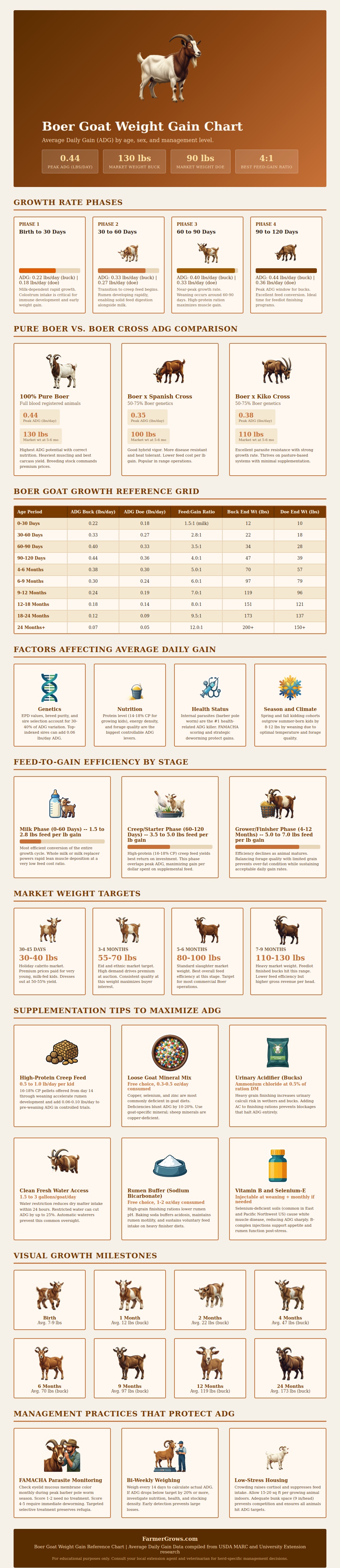
If you’re raising meat goats for a living, you need to know how fast those goat gain weight, since each additional pound you can get from them at selling time means more money in your pocket. And you want them to grow FAST: Boer goats got their name for good reason, having earned a reputation for fast growth. But they don’t do it consistently over there lifetime. They grow in spurts. Here’s what you need to know about that, and when they make the biggest jumps. Why? This helps you know when to buy feed and whether to sell an animal sooner or later. It also helps you avoid common mistake of thinking animals should steadily gain weight all the way until maturity.
Milk is almost all that kids consume early on, while their digestive system is also developing. For the first month, there’s less emphasis on dramatic size changes and more on surviving and supporting a healthy immune system. Kids will start nibbling at solid feed starting at roughly one month old and then growth curve begins to rise as rumen wakes up. This is when most producers make gains … or fall behind. Without access to good pasture or creep feed, the kids can’t even take full advantage of there own genetic potential. This window gives us a chance to see that in the chart so we’re able to manage our timing of those moves rather than react after-the-fact.
How Boer Goats Gain Weight
You’ll notice distinct trends in daily gain between does and bucks even by weaning age. Because of their heavier build with more muscle mass, bucks tend to outgain does, which holds true in feedlot as well. This chart details the differences at various ages so you can use it as a guide to compare to your own animals.
Consistency trumps a specific number on here. If your kid maintains steady gains over time, he’s likely going to finish ahead of a kid who has feast-and-famine cycles due to limited feed access or poor parasite control. Your genetics matter more then most of us think. Even with average does, the buck with strong growth EPDs adds significant pounds to his kids. Keep replacement does from these genetics and your advantage compounds.
Simultaneously, you have a lever you control daily, nutrition. Age interacts with energy density, protein level and mineral balance. Younger goats requires greater protein to support muscle and frame development, whereas older animals can be maintained in condition on poorer quality forage so long as they’re not being pushed for quick gain. You know the same ration isn’t going to work as well for a yearling and a three-month old. The chart shows this through different feed conversion at each stage.
But that doesn’t always happen. One major factor is health status. This affects average daily gain the most in most areas, as internal parasites are still the number one damper on average daily gain. Deworming strategicly and regularly (with a good FAMACHA program) ensures that their mouths stay out of worm fights and into eating. Stress caused by overcrowding slows down intake as well. Stressed goats spend less time eating, and more time guarding territory. Easy tweaks such as clean water and adequate bunk space will protect the projected numbers on that chart.
All this comes together with market timing. For example, some producers strive to get their goats to heavier weights in time to ship to traditional slaughter market; other producers target the smaller holiday kid market. You can compare your feed costs and the growth rate of your goats to match that to one of the targets in the chart. At day 90, if your kids are lagging behind curve, you’ll know it’s time to tweak things before the narrow window of opportunity for profitable gain passes. If your kids are right on track, you’ll be confident in holding them an additional week or two for extra pounds without spending more than you should of on poor feed conversion.
But beyond the money savings, what’s realy valuable about keeping up with weights is that it makes decisions concrete. It removes the guessing and allows you to make decisions you can stand behind. You can manage for what you want instead of following averages.