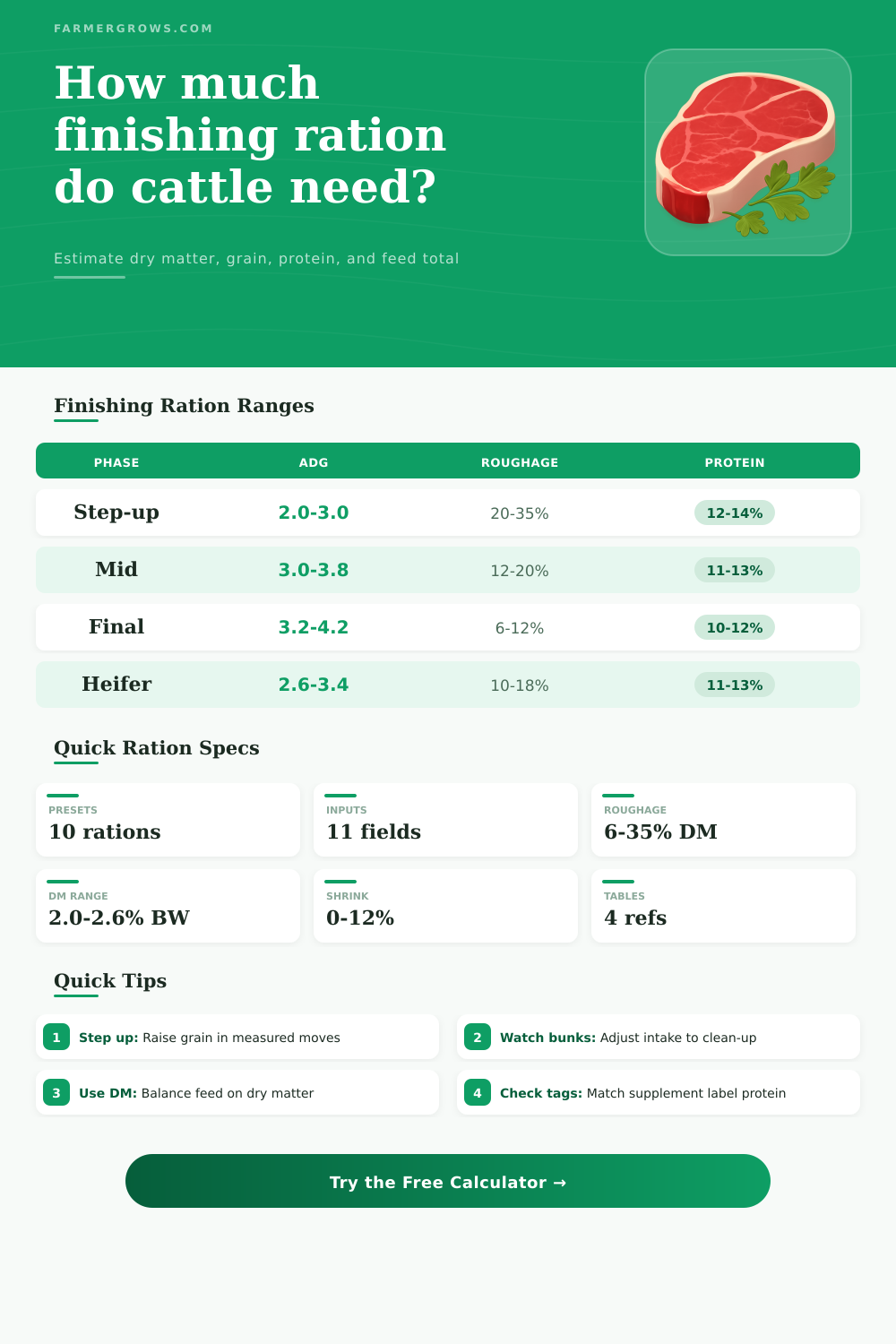
Beef Finishing Ration Calculator
Estimate finishing dry matter intake, as-fed delivery, corn and barley split, supplement protein, ration energy, shrink, and feed totals for steers or heifers.
Use this as a planning estimate for finishing cattle. Final rations should be checked with a nutritionist, local ingredient tests, implant program, bunk management, water access, and animal health conditions.
Finishing Ration Results
Estimated intake and feed delivery will appear here.
| Target ADG | Typical cattle | DMI guide | Management note |
|---|---|---|---|
| 2.0 to 2.8 lb/day | New arrivals, conservative heifers | 2.0% to 2.25% of BW | Useful during adaptation or when health risk is high |
| 2.8 to 3.4 lb/day | Moderate heifers or lighter steers | 2.15% to 2.35% of BW | Balanced gain with a moderate starch load |
| 3.4 to 4.0 lb/day | Healthy steers on finish diet | 2.25% to 2.55% of BW | Requires consistent bunks and strong roughage control |
| 4.0+ lb/day | High-performance cattle | 2.35% to 2.65% of BW | Confirm energy density, implants, and feed calls |
| Roughage % of DM | Common phase | Typical ingredients | Use note |
|---|---|---|---|
| 25% to 35% | Receiving or first step | Grass hay, silage, chopped forage | Best for starting cattle onto mixed feed |
| 16% to 24% | Transition | Silage plus limited hay | Reduces rumen upset as grain increases |
| 10% to 15% | Grow-up to early finish | Corn silage, earlage, straw, hay | Common midpoint before full finish |
| 6% to 10% | Full finish | Processed roughage or silage base | Needs tight bunk and health monitoring |
| Feed dry matter | As-fed effect | Example feed | Calculation note |
|---|---|---|---|
| 88% to 90% | Low water load | Dry grain, dry hay, pellets | As-fed and dry matter weights are close |
| 70% to 78% | Moderate water load | Mixed ration with silage | Common feedyard calculation range |
| 55% to 68% | High water load | Wet distillers, high silage ration | As-fed delivery rises quickly |
| 30% to 40% | Very wet feed | Corn silage base | Use tested dry matter, not book values |
| Protein or energy check | Typical range | Calculator estimate | Practical use |
|---|---|---|---|
| Finishing ration crude protein | 10% to 13% of DM | Supplement, roughage, and grain protein | Check against cattle weight and supplement label |
| Corn NEm reference | 0.98 to 1.05 Mcal/lb DM | User-entered corn energy | Adjust for processing and moisture |
| Barley NEm reference | 0.90 to 0.98 Mcal/lb DM | User-entered barley energy | Often needs careful processing control |
| Energy-dense finish ration | 0.88 to 1.00 Mcal/lb DM | Weighted ration NEm | Compare phases before pushing intake |
Use tested dry matter: A wet load, silage change, or winter feedout can move as-fed delivery more than the ration percentage suggests.
Respect step-up timing: If manure, intake swings, or loose cattle show up, hold the stage and allow the pen to stabilize before adding more grain.
During the final 90 to 120 days of feeding cattle, small decisions regarding the ration of feed to the cattle will have an impact on the final weight of the cattle and the dollars that is deposited into the beef producers settlement check. During this final period of feeding the cattle, a person must manage the energy intake of the cattle, the rumen of the cattle, and the cattle who are on the feed. A finishing ration calculator will assist a person in managing these variables in the final 90 to 120 days of feeding the cattle; the calculator transforms a persons daily feed ration decisions into usable number.
A person can utilize these numbers prior to mixing the feed. The inputs into a finish ration calculator are the same as the variables that a person can manage for their cattle. For instance, the type of cattle that is being fattened and the weight of that current cattle will impact the amount of dry matter that the cattle can consume.
Use a Feed Calculator in the Last 90 to 120 Days of Feeding
The target average daily gain will impact the amount of energy that will be supplied to the cattle; however, a person must manage the target daily gain to ensure that there isnt too much energy supplied to the cattle, which may lead to digestive troubles. The days that the cattle will be on feed and the number of head of cattle on feed allows a person to calculate the total ton of feed that will be required for the cattle pen; otherwise, a person may have to guess the total amount of tons of feed that will be required. Additionally, the step up stage for the cattle will impact the amount of dry matter that the cattle consume; for instance, a step up stage for a starter pen will differ than that of a full finish pen.
Furthermore, variables like roughage percentages, grain type, and supplement protein will impact the nutrient balance of the ration; a proper nutrient balance is required for the cattle to gain weight. Additionally, the energy value for feed like corn and barley will help ensure that the ration contains adequate energy for the cattle. Furthermore, the delivered dry matter for the ration will impact the amount of as-fed feed that is delivered to the cattle bunk; a person must account for shrink and waste.
Waste and shrink will impact the amount of tons of feed that is required to be ordered for the cattle; the more wet the ration or the greater the shrink percentage, the more greater the tons of feed will be required for the cattle pen. These variables can be accounted for ahead of time, before the feed delivery truck arrive with the ration. Furthermore, a person can enter the final total for feed that is to be delivered to the cattle pen into the calculator; this allows a person to test the feeds against the other assumptions of the cattle management situation.
Reference tables will allow a person to remain realistic in their expectation for the dry matter intake of the cattle. For instance, tables can be provided that display the different percentages of dry matter intake of the cattle with different target average daily gains. Additionally, reference tables can show the different percentages of roughage that the cattle consume at the receiving pen, at the transition phase, and during the finish phase of the feeding period.
The value for crude protein and net energy in the ration are not fixed values; rather, the values of these variables will change based off the roughage, supplement, and grain components of the ration. These reference tables display ranges for these variables rather than specific values; however, these ranges will allow a person to ensure that the ration that is being provided to the cattle is within normal expectation for feeding operations. The actual feeding of cattle will never quite meet the numbers that is determined through the finishing ration calculator; various factors will impact the feeding of the cattle.
These factors can include the weather, the condition of the pens where the cattle are being fed, the timing of the implants of the cattle, the amount of water space provide to the cattle, and the health of the cattle. A finishing ration calculator cannot account for the impact of the weather or the health of the cattle; however, performing the calculations within the calculator can help to provide a feeding plan for the cattle. For instance, if the calculator determines that the cattle should consume an aggressive amount of dry matter and roughage, a person knows to monitor the bunks of the cattle accordingly.
Additionally, if the projected feed-to-gain ratio for the cattle pen is significantly higher than the norm, a person can determine if that high feed-to-gain ratio is due to the genetics of the cattle or if that the assumption that is made for the finish ration calculator is incorrect. A finishing ration calculator will never replace the nutritionist for the cattle facility; however, a finishing ration calculator will never replace the observation of the person feeding the cattle daily. The calculator will remove the burden of the mathematics of feeding ration from a persons mind, allowing that individual to focus upon the feeding of the cattle.
When a ration is provided to the cattle and the cattle remain on feed, the feeding period can be managed in such a way that the cattle will remain on feed for the entire period. Thus, the closeout numbers for the feeding operation will reflect the decision that was made weeks prior to the closeout period.