🌾 Barley Seed Rate Calculator
Calculate exact seed quantities for spring barley, winter barley & malting varieties
seeds/m²
seeds/m²
seeds/m²
seeds/m²
seeds/m²
seeds/m²
seeds/m²
seeds/m²
| TGW (g) | 250 seeds/m² | 300 seeds/m² | 350 seeds/m² | 400 seeds/m² |
|---|---|---|---|---|
| 38g | 95 kg/ha | 114 kg/ha | 133 kg/ha | 152 kg/ha |
| 42g | 105 kg/ha | 126 kg/ha | 147 kg/ha | 168 kg/ha |
| 46g | 115 kg/ha | 138 kg/ha | 161 kg/ha | 184 kg/ha |
| 50g | 125 kg/ha | 150 kg/ha | 175 kg/ha | 200 kg/ha |
| 54g | 135 kg/ha | 162 kg/ha | 189 kg/ha | 216 kg/ha |
| 58g | 145 kg/ha | 174 kg/ha | 203 kg/ha | 232 kg/ha |
| Germination % | Multiplier | Example: 138 kg/ha becomes | Note |
|---|---|---|---|
| 99% | 1.01 | 139 kg/ha | Certified elite seed |
| 97% | 1.03 | 142 kg/ha | Certified standard |
| 95% | 1.05 | 145 kg/ha | Typical commercial lot |
| 92% | 1.09 | 150 kg/ha | Good quality |
| 90% | 1.11 | 153 kg/ha | Acceptable minimum |
| 85% | 1.18 | 163 kg/ha | Increase rate significantly |
| Metric | Imperial Equivalent | Metric | Imperial |
|---|---|---|---|
| 1 hectare (ha) | 2.471 acres | 1 kg/ha | 0.892 lbs/ac |
| 1 acre | 0.405 ha | 1 lb/ac | 1.121 kg/ha |
| 1 m² | 10.764 ft² | 100 kg/ha | 89.2 lbs/ac |
| 1 kg | 2.205 lbs | 150 kg/ha | 133.8 lbs/ac |
| 1 tonne | 2,204.6 lbs | 200 kg/ha | 178.5 lbs/ac |
| 48 lbs/bu (barley) | Standard bushel wt | 1 bu/ac | 53.8 kg/ha |
| Field Size | Area (ha) | Seed (kg) | Seed (lbs) |
|---|---|---|---|
| Small plot 10×10m | 0.01 ha | 1.5 kg | 3.2 lbs |
| Half acre | 0.20 ha | 29 kg | 63 lbs |
| 1 acre | 0.40 ha | 58 kg | 128 lbs |
| 5 acres | 2.02 ha | 293 kg | 645 lbs |
| 10 acres | 4.05 ha | 586 kg | 1,292 lbs |
| 50 acres | 20.2 ha | 2,929 kg | 6,458 lbs |
| 100 acres | 40.5 ha | 5,858 kg | 12,917 lbs |
| Quarter section (160ac) | 64.7 ha | 9,374 kg | 20,667 lbs |
Determining the correct barley seed rate is a necessary part of establishing any barley farm. The barley seed rate will determine the final plant populations within the field. If the barley seed rate is too low for the field, there will be to few barley plants to fully develop the necesary tillers for good yields.
However, if the barley seed rate is too high, then the barley plants will competes for the available nutrients in the soil and the barley plants will be more likely to lodge due to the wind. Therefore, calculating the precise rate of barley seeds to be planted will allow each barley plant within the field to have enough space to grow yet avoid underplanting issues caused by weeds and birds in the field. The variety of barley to be planted will dictate the required population of barley plants.
How to Calculate Barley Seed Rate
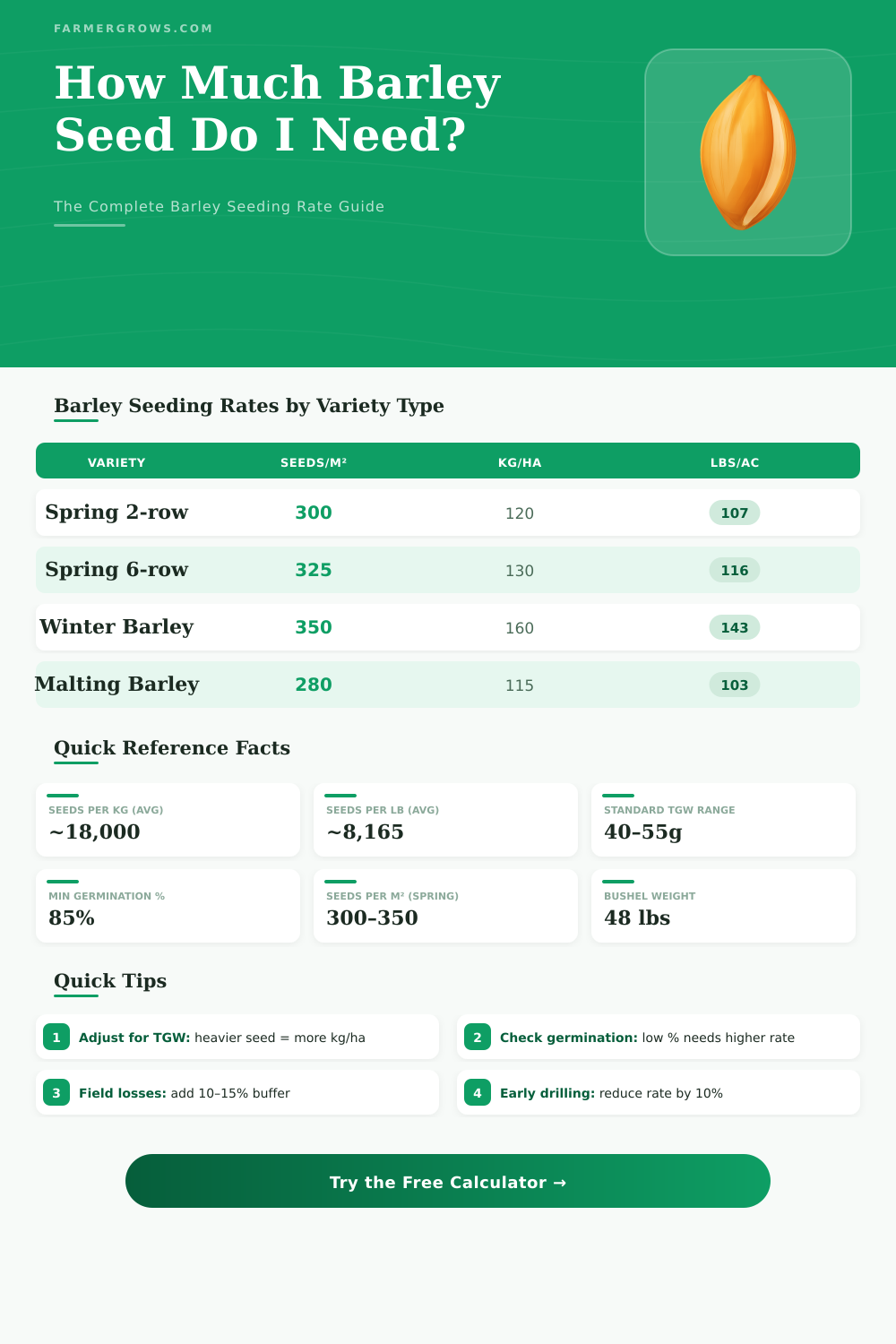
For instance, spring two row varieties will require fewer seeds at a rate of 280 to 300 seeds per square meter. Six-row varieties will require more seeds at a rate of 325 seeds per square meter because they will tiller less than two-row varieties. Finally, winter varieties will require a population rate of 350 seeds per square meter because the barley will have to withstand stress during the winter months.
Thus, farmers must choose the correct variety of barley prior to calculate the correct rate of seeds to be planted. Another factor to consider is the thousand grain weight of the barley seeds. The thousand grain weight will determine the total weight of the barley seed that will have to be purchased.
The lower the thousand grain weight, the higher the total weight of the seeds that will be required to be planted. Conversely, the higher the thousand grain weight, the lower the total weight of the seeds that will have to be purchased for planting. Testing the seed will reveal the thousand grain weight of the barley seeds, allowing the farmer to calculate the total weight of seed that will be required in the field.
The germination rate of the barley seeds will also impact the calculation of the rate of barley seeds to be planted. The germination rate will determine how many of the planted seeds will germinate and grow as barley plant. For instance, if a rate of 95% germination is measured, it is likely most of the planted seeds will germinate.
However, if the germination rate is 85%, there will be fewer planted barley plants than anticipated. Thus, the farmer will have to divide the target population by the germination rate of the barley seed to account for the number of germinating barley plants. Additionally, field losses due to birds or drill errors will also have to be accounted for in the calculation of the barley seed rate.
The final variable to consider is the size of the field to be planted with barley. Using the dimensions of the field, one can calculate the area of the field in hectares or acres. Multiplying the target population of barley plants by the thousand grain weight and germination rate will reveal the total weight of barley seed to be planted into the field.
The calculated rate of barley seed to be planted should match the calibration of the seed drill that will be used to plant the seeds into the field. Environmental factors will impact the barley seed rate that will be planted into the field. For winter barley planted in early September, there is potential for the tillers to multiply.
In this case, one can make an 10% reduction of the barley seed rate. However, if barley is planted late in the season, the barley plants will have less time to establish themself, so a 15-20% increase in barley seed rate is recommended. Additionally, if the soil in which the barley is to be planted is sandy soil, there is a potential for the soil to dry out, thus requiring more barley to be planted.
In contrast, clay soil will retain the moisture better, reducing the amount of barley to be planted. There are a few common mistakes to avoid when calculating the rate of barley to be planted. One of the most common would be to ignore the thousand grain weight of the barley seeds.
Ignoring this will lead to underplanting of the fields. Another mistake would be to overplant forage barley varieties. Forage barley varieties should be limited to 360 seeds per square meter because of the potential to smother the plants.
Finally, buffer error should be avoided when calculating the rate of barley to be planted into the field. Buffering too much will result in buying excess quantities of barley seed. Buffering too little will result in not purchasing enough barley seed for fields plagued with weeds.
By accounting for all of these variable, farmers can establish a correct rate of barley seed to optimize the growing conditions for barley plants and maximize barley yields from each field.