Auger Length Calculator
Estimate working auger length, round to standard sections, and compare the installed reach against your transport setup and material load.
Pick a real farm, feed, or grain layout to seed the calculator. Each preset sets the route mode, lengths, section size, buffer, diameter, material, and transport allowance.
Working length is the straight-line span plus inlet setback, outlet overhang, clearance, and buffer. Section rounding then sets the purchase length.
Calculation Results
These values include your geometry, clearances, buffer, section rounding, and the selected material load estimate.
| Section | Metric | Use | Note |
|---|---|---|---|
| 8 ft | 2.44 m | Short lift | Small bin |
| 10 ft | 3.05 m | Compact unit | Most common |
| 12 ft | 3.66 m | Longer span | Portable tube |
| 16 ft | 4.88 m | Deep reach | Extra trim |
| Angle | Multiplier | Rise from 20 ft run | Span note |
|---|---|---|---|
| 15 deg | 1.04x | 5.4 ft | Very shallow |
| 20 deg | 1.06x | 7.3 ft | Common incline |
| 30 deg | 1.15x | 11.5 ft | Steady lift |
| 45 deg | 1.41x | 20.0 ft | Near vertical |
| Material | Density | Fill | Handling |
|---|---|---|---|
| Corn | 45 lb/ft3 | 33% | General grain |
| Wheat | 48 lb/ft3 | 34% | Densest grain |
| Soybeans | 47 lb/ft3 | 31% | Clean flow |
| Fertilizer | 65 lb/ft3 | 36% | Heavy load |
| Job | Run | Rise | Suggested length |
|---|---|---|---|
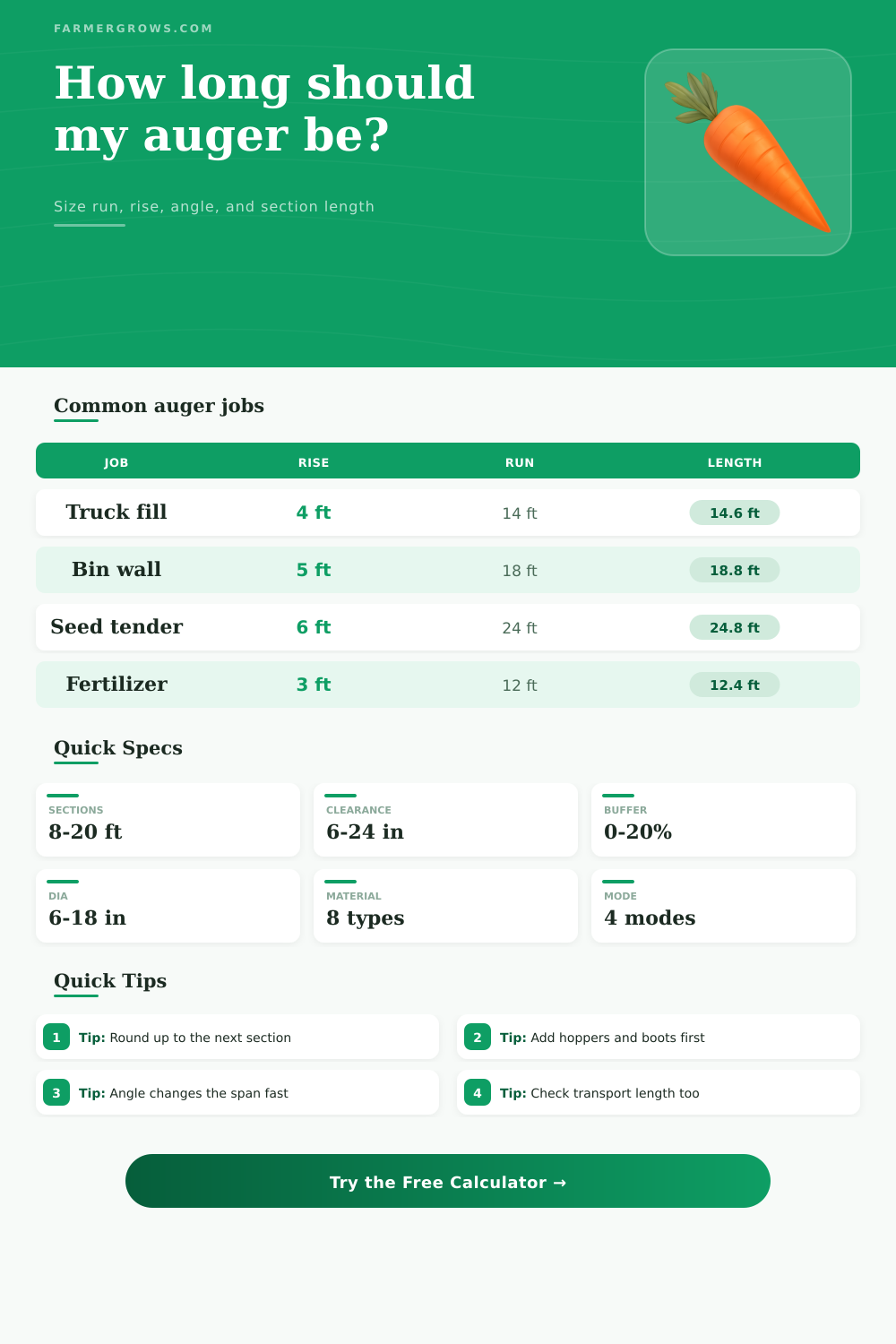
| Truck fill | 14 ft | 4 ft | 16 ft |
| Bin wall | 18 ft | 5 ft | 20 ft |
| Seed tender | 24 ft | 6 ft | 26 ft |
| Flat storage | 40 ft | 10 ft | 45 ft |
Selecting the correct length for a grain auger is a necessary task for any farmer. The length of the grain auger will determine how efficient the farmer are at moving the grain from one location to another. Should the length of the grain auger be too short, the auger will not be able to reach the destination where the grain is to be dispense.
In this case, the grain will spill from the auger. Should the length of the grain auger be too long, however, the farmer must transport the auger to various location on the farm, making the auger difficult to move. Additionally, if the grain auger is too long, it will use more fuels and take more time to position the grain auger to the next task.
How to Choose the Right Length for a Grain Auger
In order to calculate the length of the grain auger that is required for a farm operation, the farmer can use the principles of geometry. More specifically, the grain auger will form a hypotenuse of a triangle. The horizontal run is the distance that the grain auger will travel on the ground.
The vertical rise is the height of the grain auger from the ground to the point at which the grain is to be dispense. These two values can be used to calculate the slant length that the grain auger must travel. However, instead of calculating only the length of the grain auger that is mathematically required to reach from the input point to the output point, the farmer must also calculate for clearances.
The auger must be long enough to allow for the inlet boot to clear the hopper lip, and it must be long enough to allow the outlet spout to swing out without hitting the ground. These lengths will determine the working length of the grain auger. Another factor that will influence the length of the grain auger is the angle at which the farmer will set up the grain auger.
If the angle is shallow, such as 20 degree, the length of the grain auger will be relatively short in comparison to the horizontal run. If the angle is much steeper, such as 45 degrees, the length of the grain auger will be significantly longer relative to the horizontal run distance that is to be covered. Thus, the angle of the grain auger is a critical factor in its length.
Additionally, the farmer will need to consider the angle of the grain auger in relation to the lifting capacity of the tractor in which the grain auger will be implemented. Grain augers is typically available in sections that are between 8 and 16 feet in length. Thus, the farmer will need to calculate the total length of the grain auger that is required for a task, and round up to the nearest section of the grain auger.
The length will need to be rounded up to ensure that the farmer is not without a grain auger of the necessary length to complete the task in the harvest. For instance, if 12 feet of length is calculated for the task, the farmer will need at least two 8-foot section, or two 6-foot sections. Additionally, the length of the auger when transporting it to various locations will also factor into the determination of the length of the grain auger.
For instance, if the auger needs to be transported into a storage shed or on a trailer, the length of the auger must accommodate this transport length. The weight of the material that will be moved is another significant factor in determining the length of the grain auger. For instance, different materials has different densities.
Therefore, different loads will be placed on the grain auger that have different weights. For instance, corn may weigh 45 pounds per cubic foot, while fertilizer pellets may weigh 65 pounds per cubic foot. Thus, the farmer will have to estimate the payload for the grain auger.
Additionally, the payload will impact the load that the tractor will have to lift. If the load is too heavy for the tractor, the tractor may become strained while performing this task. Additionally, the diameter of the auger will impact the payload that the grain auger can lift.
The fill factor will impact the amount of material that remains within the grain auger. Some of the most common tasks with grain augers have established patterns regarding the length that the grain augers should be. For instance, if the task is to load grain into a truck, the grain auger should have a horizontal run of 14 feet and a vertical rise of 4 feet, which calculates to 16 feet of length.
For loading grain into a bin, the horizontal run may be 18 feet and the vertical rise may be 5 feet, resulting in a length of 20 feet. For tasks involving seed tenders, 26 feet of length are required. These lengths have become established through experience, and can therefore be utilized as the starting point for calculating the length of the grain auger that is required for specific task.
One of the most common mistakes that farmers make when purchasing or constructing a grain auger is the forgetting to include the clearances and buffers for the auger. For example, farmers may measure from the boot to the spout of the auger, but they may not account for the length that is required for the auger to swing out of the way of the ground. If these lengths are not accounted for, grain will spill from the auger.
Additionally, another buffer that should be included is the length of 10 to 20 percent of the calculated length of the grain auger. This buffer will account for normal wear of the auger in the harvest. Finally, additional factors to consider include the setup of the grain auger.
For instance, portable grain augers can fold and swing, so their length when transporting will dictate where those portable augers will be stored. Stationary grain augers do not require the same mobility. Thus, the length of the auger should always be somewhat overestimated in relation to the length that might actualy be required.
Thus, by measuring the horizontal run, the vertical rise, the clearances, the buffers and rounding to the nearest section length, farmers will ensure that their auger will perform correct.