🌱 Outdoor Plant Water Calculator
Calculate exactly how much water your garden, lawn, or planting bed needs
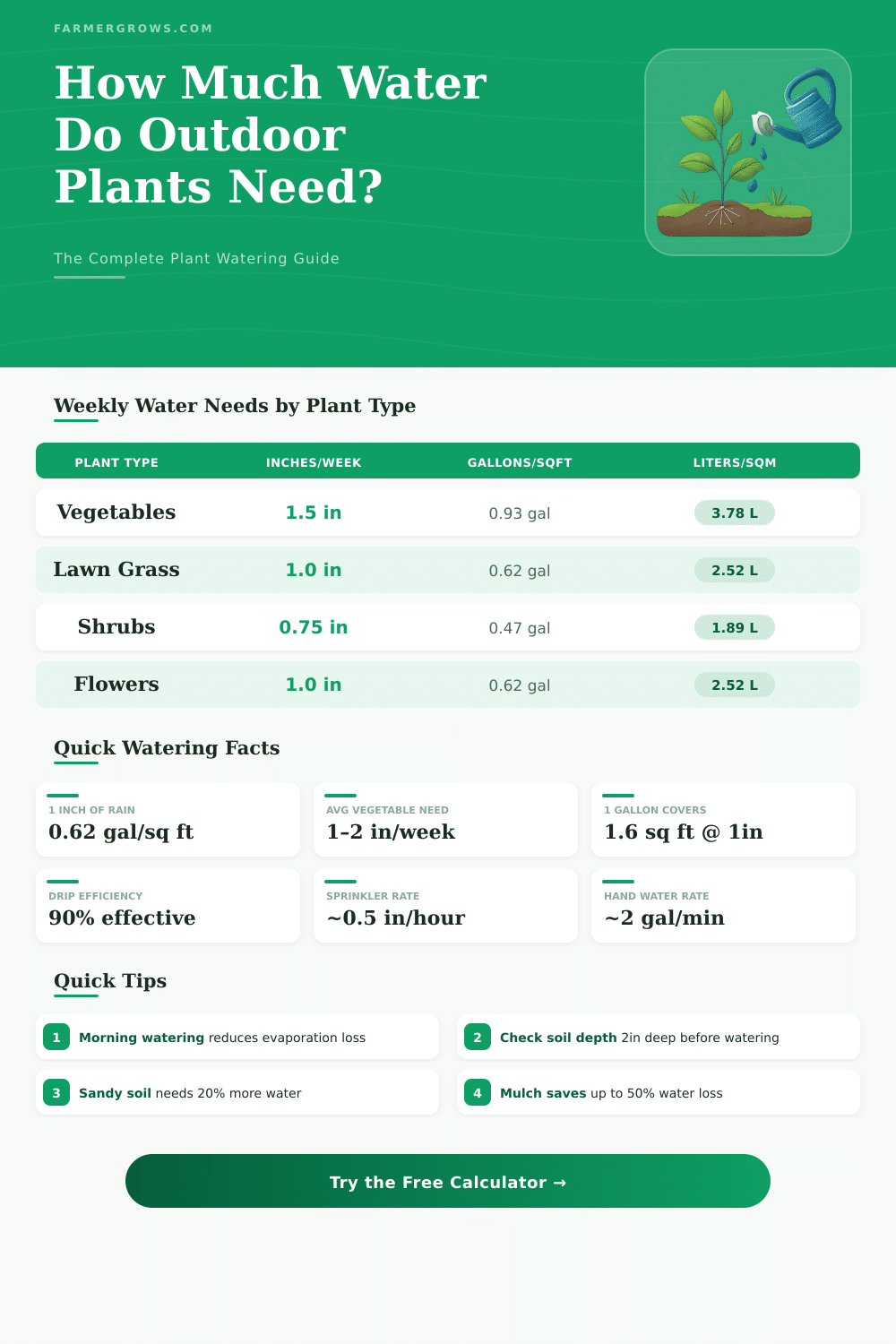
| Plant Type | Inches / Week | Gal / 100 sq ft | Liters / 10 sq m | Climate Factor |
|---|---|---|---|---|
| Vegetables & Food Crops | 1.0 – 2.0 in | 62 – 124 gal | 252 – 504 L | High (x1.3 summer) |
| Cool Season Lawn | 1.0 – 1.5 in | 62 – 93 gal | 252 – 378 L | Moderate |
| Warm Season Lawn | 0.5 – 1.0 in | 31 – 62 gal | 126 – 252 L | Low – Moderate |
| Shrubs & Hedges | 0.5 – 1.0 in | 31 – 62 gal | 126 – 252 L | Low |
| Annual Flowers | 0.75 – 1.25 in | 47 – 78 gal | 189 – 315 L | Moderate |
| Perennial Flowers | 0.5 – 1.0 in | 31 – 62 gal | 126 – 252 L | Low – Moderate |
| Herbs | 0.75 – 1.25 in | 47 – 78 gal | 189 – 315 L | Moderate |
| Succulents & Cacti | 0.1 – 0.4 in | 6 – 25 gal | 25 – 101 L | Very Low |
| Young Trees | 1.0 – 1.5 in | 62 – 93 gal | 252 – 378 L | Moderate – High |
| Water Depth | Gal / 100 sq ft | Gal / 1000 sq ft | L / 10 sq m | L / 100 sq m |
|---|---|---|---|---|
| 0.25 in (6 mm) | 15.6 gal | 156 gal | 63 L | 630 L |
| 0.5 in (13 mm) | 31.2 gal | 312 gal | 126 L | 1,260 L |
| 0.75 in (19 mm) | 46.8 gal | 468 gal | 189 L | 1,890 L |
| 1.0 in (25 mm) | 62.3 gal | 623 gal | 252 L | 2,520 L |
| 1.5 in (38 mm) | 93.5 gal | 935 gal | 378 L | 3,780 L |
| 2.0 in (51 mm) | 124.7 gal | 1,247 gal | 504 L | 5,040 L |
| Method | Output Rate | Efficiency | Best For |
|---|---|---|---|
| Hand Watering (hose) | 2 – 5 gal/min | 60 – 70% | Containers, small beds |
| Sprinkler (oscillating) | 0.3 – 0.5 in/hr | 65 – 75% | Lawns, large areas |
| Soaker Hose | 0.5 – 1.0 gal/ft/hr | 85 – 90% | Rows, borders, beds |
| Drip Irrigation | 0.5 – 2.0 gal/hr | 90 – 95% | Shrubs, trees, veggies |
| Rotary Sprinkler | 0.4 – 0.8 in/hr | 70 – 80% | Lawns, wide areas |
| Watering Can (9L) | 2.4 gal/fill | 95%+ | Seedlings, pots |
| Garden / Project | Area (sq ft) | Gallons / Week | Liters / Week |
|---|---|---|---|
| Small Herb Garden (4x4) | 16 sq ft | 10 gal | 38 L |
| Raised Veg Bed (4x8) | 32 sq ft | 30 gal | 114 L |
| Standard Veg Garden (10x20) | 200 sq ft | 186 gal | 705 L |
| Flower Bed (10x10) | 100 sq ft | 62 gal | 235 L |
| Shrub Border (30x5) | 150 sq ft | 70 gal | 265 L |
| Small Lawn (50x50) | 2,500 sq ft | 1,558 gal | 5,897 L |
| Large Lawn (100x100) | 10,000 sq ft | 6,230 gal | 23,587 L |
| Tree Ring (8ft dia) | 50 sq ft | 39 gal | 147 L |
Plant water is more important than one could believe at first. It deals with everything from care of indoor plants to farming of outdoor plants in pure water without ground. Many small causes deserve to note.
Plant is made up of up to 95 percent water. In short water serves as filler between the carbon chains of the plant. They remove all water, leaving only the dry minerals, and the bulk of those elements come from outside original spots.
Why Water Is Important for Plants
Average drain answers for many plants. Species like the fiddle fig and the peacock plant benefit only by means of simple care by means of tap water. Even so, no two tap waters match one to the other.
Rain picks up nitrogen while it rains through the air and mostly helps plants greatly. Plants commonly appera merrier after use of rain water compared with tap water. Between other useful options is melted snow, water from a dehumidifier or from air conditioning.
Water dried by means of ion change simply kills plants.
Water from fish tanks truly works wonder for plants. While one changes water in aquarium, the used water goes directly to indoor plants, instead of waste. Water from koi pool is useful greatly during summer.
The deposit in the bottom of the water tank gives the nutrients, that makes it ideal for plants.
Bottom care shows a practical mode. One pours in the bit around three inches of water, lays the plants in it and waits, until the upper soil seems wet. A bit of water on top now and then helps the flow inward.
Before give to plant half of cup at once, more well flood and then drain. Cheap moisture meters point, when plant truly needs water. Sticks put in the soil work likewise.
Light and water involve closely. In brighter light plant requires more water. Less light requires less care.
Roots grow slowly in winter, so plants require much less water in cold months with low light levels.
Hydroponics is a method for growing outdoor plants without soil. The term comes from two Greek words for water and work. Hydroponic gardening saves space and uses less water then ground farming.
It escapes unwanted grasses. By means of fake lights one can grow plants all year, even in cold regions like Minnesota. For one kilo of tomatoes by means of strong methods enough is 214 liters of water.
In vertical farming of high level, water is given in precise amounts, so that waste stays low and output grows. Water circles again, one cleans it and fits it to the needs of every plant.
Some plants benefit simply in water. Lucky bamboo grows well here and requires only soft sun. Ivy is other popular sample.
Underwater farming maybe will be morelasting than traditional farming, growing crops like strawberries and grasses under the sea.