🌱 Compost Calculator
Calculate exactly how much compost you need for any garden bed, lawn, or landscape project
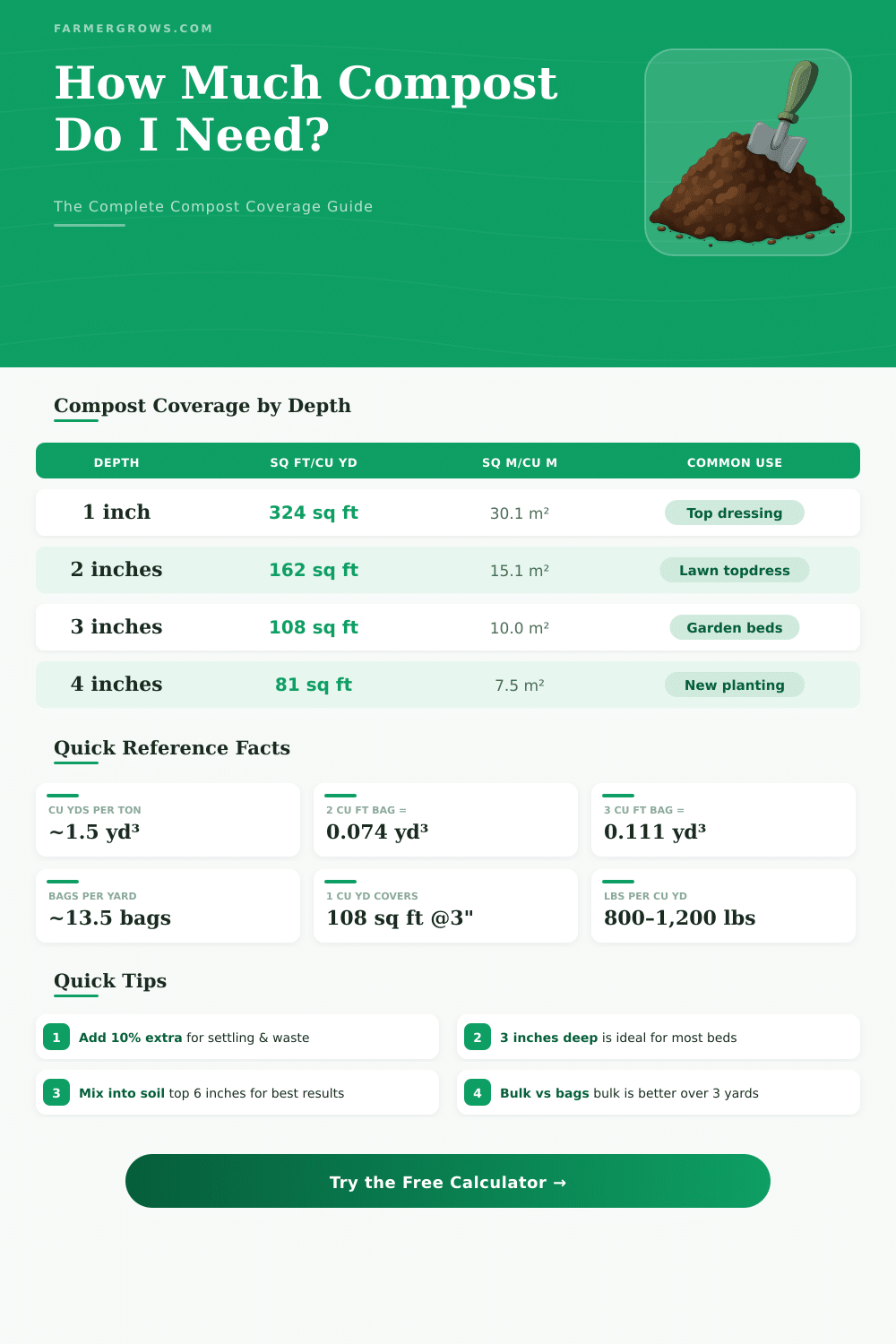
| Depth | Sq Ft | Sq M | Use Case |
|---|---|---|---|
| 1 in (25mm) | 324 sq ft | 30.1 m² | Top dressing |
| 2 in (50mm) | 162 sq ft | 15.1 m² | Lawn feed |
| 3 in (75mm) | 108 sq ft | 10.0 m² | Garden beds |
| 4 in (100mm) | 81 sq ft | 7.5 m² | New planting |
| 6 in (150mm) | 54 sq ft | 5.0 m² | Raised beds |
| Bag Size | Cu Ft | Bags/Yd³ | Covers @3" |
|---|---|---|---|
| 1 cu ft bag | 1.0 cu ft | 27 bags | 4 sq ft |
| 2 cu ft bag | 2.0 cu ft | 13.5 bags | 8 sq ft |
| 3 cu ft bag | 3.0 cu ft | 9 bags | 12 sq ft |
| Bulk 0.5 yd³ | 13.5 cu ft | — | 54 sq ft |
| Bulk 1 yd³ | 27 cu ft | — | 108 sq ft |
| Project | Area | Cu Yards | 2 Cu Ft Bags |
|---|---|---|---|
| Small window box (4×2 ft) | 8 sq ft | 0.09 yd³ | 2 bags |
| Small raised bed (4×8 ft) | 32 sq ft | 0.30 yd³ | 5 bags |
| Veggie patch (6×10 ft) | 60 sq ft | 0.56 yd³ | 8 bags |
| Garden bed (10×20 ft) | 200 sq ft | 1.85 yd³ | 25 bags |
| Medium lawn (30×40 ft) | 1,200 sq ft | 11.11 yd³ | 150 bags |
| Large yard (50×50 ft) | 2,500 sq ft | 23.15 yd³ | 313 bags |
compost is pretty easy, when one well understands the main ideas. So that the pile works well it must have a good mix of materials, that gives organisms the carbon, nitrogen, oxygen and moisture needed to break everything into finished compost. Organisms take carbon for energy and use nitrogen to grow their cells.
When that balance lacks, the whole process becomes much more slow.
How to Make Compost
The best ratio between carbon and nitrogen is around 30:1. Like this the organisms receive enough carbon for energy and nitrogen to produce proteins, so they can work quickly and well. A good mix includes dying plant parts, green plant materials and even meat.
One can use leaves, clippings from the garden, scraps from the kitchen and grasses, everything that works well. Add some shovelfuls of garden soil also is useful. Dry materials must not lack, they mingle with kitchen scraps so that everything stay in harmony.
Oxygen matters a lot. Compost is an aerobic process, so it happens only with enough air. If the compost pile does not have enough oxygen, the breakdown slwos and bad smells emerge.
When air lacks, the pile can become anaerobic and turn into a smelly, sticky mass full of harmful germs. Regular turning of the compost helps to escape that.
Water is also important. Organisms need moisture to stay alive. Water helps too move substances through the pile and make nourishments available for the germs.
While one builds the pile, it is good to add a bit of water with a sprinkler.
Heat also has its role. The breaking down of carbon parts by organisms creates heat, that is useful for extra steps in the compost process. When the pile reaches around 60 degrees Celsius, harmful germs die in some hours.
Even so each bit of the pile must reach that heat, so one must move and turn the compost. Good ratio between green materials and dry helps the pile reach high temperature.
The compost area must have good air flow and sunshine. Well choose a place, that daily gets at least three to four hours of direct sun. At the simplest level, the compost system can be only a pile in the corner of the garden.
You do not need anything extra or fancy.
Finished compost stores three main nourishments, that garden plants need: nitrogen, phosphorus and potassium. It includes also small amounts of calcium, magnesium, iron and zinc. For hay fields applying five to ten tons each acre is the best, although even one to two tons each acre are useful to improve the quality of the soil.
Compost is simply that, what stays after aerobic organisms finished their task breaking down the materials. Really, allcompost makers do only that, that they create space for that aerobic breakdown to happen as maybe most quickly.