🧊 Squash Plant Water Calculator
Calculate exactly how much water your squash plants need based on garden size, growth stage & conditions
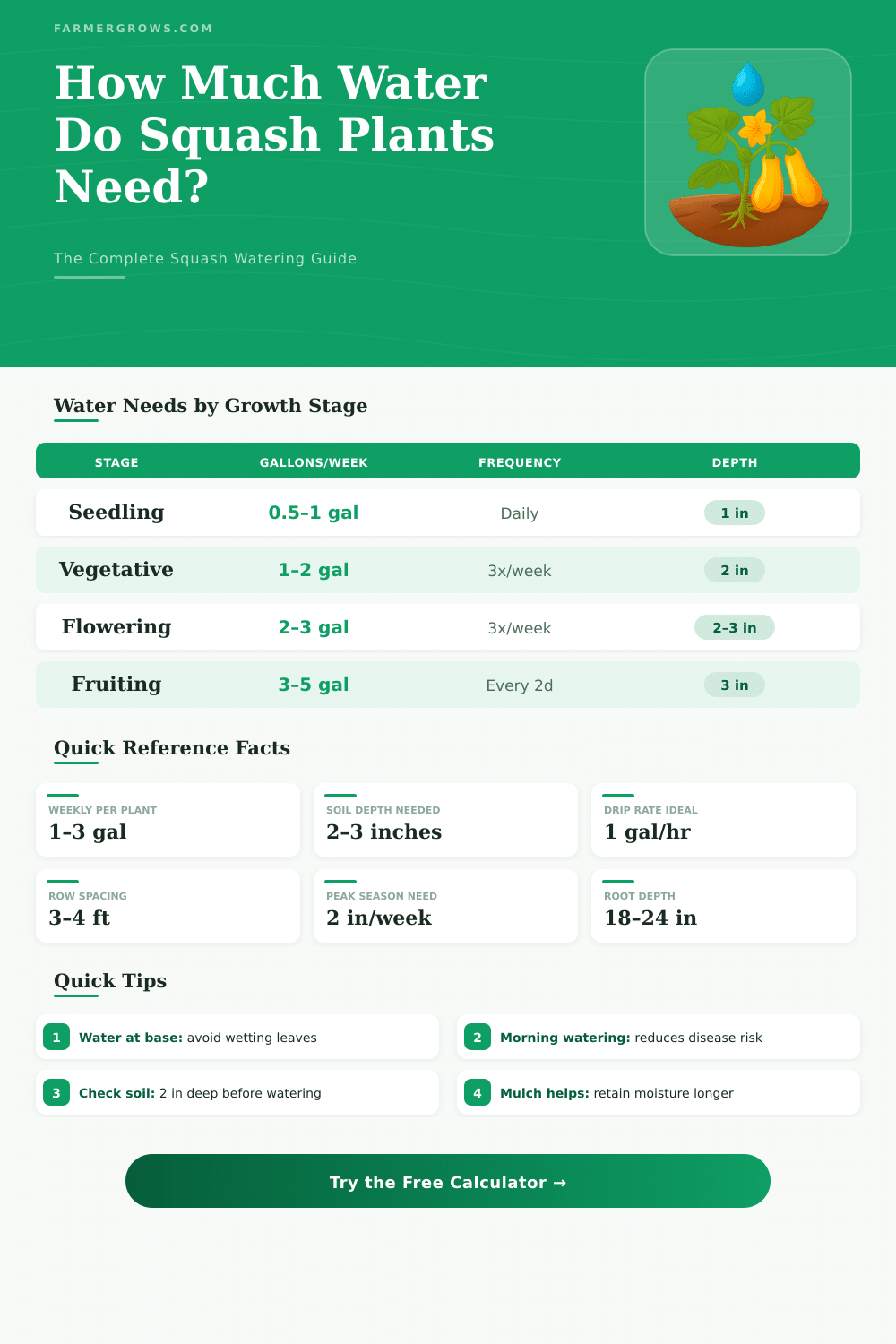
Seedling Stage
Vegetative Stage
Flowering Stage
Fruiting Stage
| Growth Stage | Cool Weather Gal/Plant/Wk |
Moderate Gal/Plant/Wk |
Hot Weather Gal/Plant/Wk |
Inches/Week | Liters/Plant/Wk |
|---|---|---|---|---|---|
| Seedling (0-2 wk) | 0.4–0.6 | 0.5–1.0 | 0.8–1.2 | 1 in | 1.9–4.5 L |
| Vegetative (2-5 wk) | 0.8–1.2 | 1.0–2.0 | 1.5–2.5 | 1–2 in | 3.8–9.5 L |
| Flowering (5-8 wk) | 1.5–2.0 | 2.0–3.0 | 2.5–4.0 | 2 in | 7.6–15.1 L |
| Fruiting (8+ wk) | 2.5–3.5 | 3.0–5.0 | 4.0–6.0 | 2–3 in | 11.4–22.7 L |
| Soil Type | Water Retention | Drainage Speed | Frequency Adjust | Amount Adjust |
|---|---|---|---|---|
| Sandy | Low | Very Fast | +25% more often | +10% |
| Loam (Ideal) | Good | Moderate | Baseline | Baseline |
| Clay | High | Slow | -20% less often | -15% |
| Raised Bed Mix | Good | Fast | +15% more often | +5% |
| Method | Efficiency | Water Needed vs. Baseline | Best For |
|---|---|---|---|
| Drip Irrigation | 90–95% | -20% less water | Large beds, rows |
| Soaker Hose | 80–90% | -10% less water | Garden rows |
| Hand Watering | 70–80% | Baseline | Small gardens |
| Overhead Sprinkler | 60–70% | +20% more water | Large areas |
| Garden Size | Area (sq ft) | Plants | Gal/Week (Moderate) | Liters/Week |
|---|---|---|---|---|
| Small Bed 4x4 | 16 sq ft | 2 | 4–6 gal | 15–23 L |
| Raised Bed 8x4 | 32 sq ft | 4 | 8–12 gal | 30–45 L |
| Garden Row 10x6 | 60 sq ft | 6 | 12–18 gal | 45–68 L |
| Mid Garden 12x8 | 96 sq ft | 8 | 16–24 gal | 61–91 L |
| Large Plot 20x10 | 200 sq ft | 16 | 32–48 gal | 121–182 L |
Note: This article is based on real gardening experience and practical advice about raising.
squash plants require enough water for good grow and give strong harvest. Widely one intends around one inch of water weekly. Some sources suggest between one and one and half of inches weekly, according to the weather.
How to Water Squash Plants
If it rains regularly, you can use the hose a bit less. In pots squash commonly requires even more water, because the soil in pots dries more quickly.
While watering the idea is to soak the soil until roughly eight to twelve inches under the surface. So more are useful deep, good watering than only light outflow up. The soil be humid, but not soaking, and water must can drain alright.
Good drainage is very important for healthy squash plants.
Drip lines and soaker hoses work very well for squash. They bring water directly to the roots and keep the leaves dry. That matters, because squash leaves are tangled and tend to catch fungal diseases, like powdery mildew.
Watering early is wise choice, especially when one expects hot days. Keeping the leaves dry helps, so that disease does not grab.
If the squash leaves wilt already in the morning, that is clear sign, that the plant requires water. Squash commonly a bit wilts during the afternoon heat, and that is normal. If it recovers when outside cools, most commonly everything is in order.
But morning wilting shows, that teh plant genuinely thirsts.
Summer squash has quite a lot high water content, so the plants a lot benefit from regular watering. Steady watering is key for stable production. In dry climates squash willingly will take more then the minimal one inch weekly.
During dry periods in the summer, regular watering becomes even more important.
squash plants widely are real water lovers. When they enter their growth explosion, they become especially thirsty. The frequency of watering should be adapted according to weather conditions, rain and how quickly the soil dries.
Steady watering matters most, when the plants start to bear fruit.
squash vines carry extra roots as they crawl on the ground. Those feeding roots enter the soil more near the tips of the vines, which helps the plant take water and nutrients from shorter distance than the main root. If squash grows on trellis and those extra roots can not form, the plant depends entirely on one root source.
Worth keeping that in mind.
Choose sunny place, that is not too windy, helps squash reach its full potential. Full sun and fertile soil makes big difference. One grower noticed, that bed filled with compost became very dry, when summer heat and drought hit, even though it was very fertile.
The need for water can quickly jump, when conditions become warm and dry, so it is usefulto stay careful about that.