🍍 Pineapple Plant Water Calculator
Calculate exactly how much water your pineapple plants need based on plant count, growth stage, and climate
| Climate Zone | Adjustment Factor | Avg Freq (days) | Notes |
|---|---|---|---|
| Tropical (High Humidity) | –20% less water | 7–10 | Rely on rainfall, supplement only |
| Subtropical (Moderate) | Baseline | 5–7 | Standard watering schedule |
| Arid / Dry | +25% more water | 3–5 | Mulch essential; drip preferred |
| Indoor / Container | +15% more water | 4–6 | Check soil moisture twice a week |
| Mulch Status | Water Saving | Watering Frequency | Evaporation Reduction |
|---|---|---|---|
| No Mulch | 0% | Baseline | None |
| 2–3 inch Organic Mulch | 25–30% | Extended by 2–3 days | Up to 70% |
| 4–6 inch Organic Mulch | 35–40% | Extended by 3–4 days | Up to 80% |
| Plastic Mulch / Ground Cover | 40–50% | Extended by 4–5 days | Up to 90% |
| Method | Efficiency | Water Loss | Best For |
|---|---|---|---|
| Hand Watering / Hose | 60–70% | 30–40% | Small gardens, containers |
| Drip Irrigation | 90–95% | 5–10% | Rows, beds, commercial |
| Overhead Sprinkler | 55–65% | 35–45% | Large areas, not ideal |
| Soaker Hose | 80–90% | 10–20% | Rows, raised beds |
| Plant Age / Size | Gal / Plant / Week | Liters / Plant / Week | Root Depth |
|---|---|---|---|
| Young (0–6 months) | 0.5–1.0 | 1.9–3.8 | 4–6 inches |
| Mature (6–18 months) | 1.0–2.0 | 3.8–7.6 | 6–12 inches |
| Large (18+ months) | 1.5–2.5 | 5.7–9.5 | 12–24 inches |
Pineapples are nice exotic plants, and they need only quite a lot of simple attention if one cares for them correctly. They easily brighten any corner with tropical atmosphere. If their needs for Water, humidity, light and temperature are met, they can give delicious fruit for many years.
Correctly watering is a bit tricky cause. The soil must stay moist, but never fully soaked. Think about it like a good cake, moist, but not slimy wet.
How to Water Pineapple Plants
Too much Water is a common problem with Pineapple plants, so pouring a whole bucket of Water on them is not the right way.
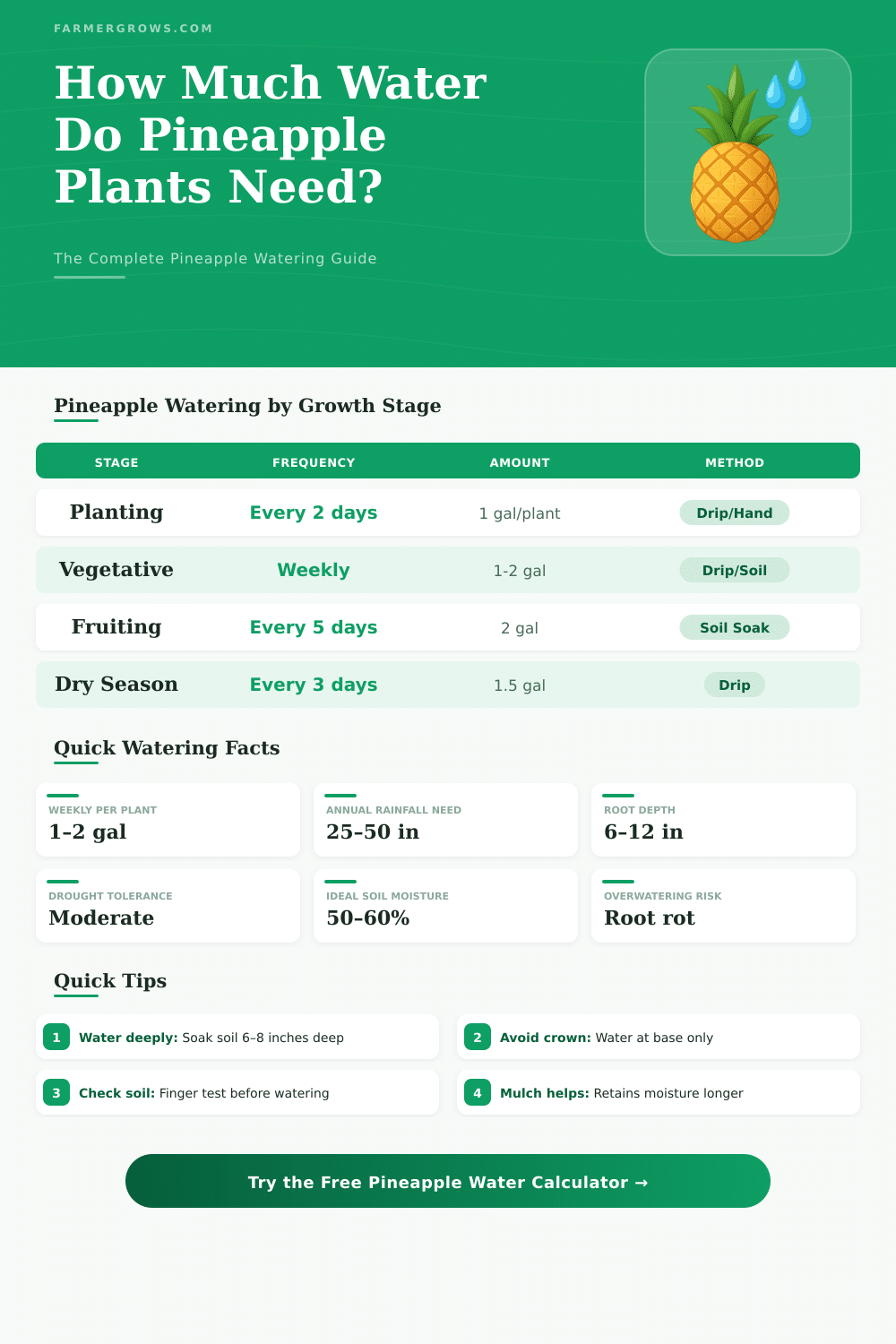
A good method is to put your finger about one inch down in the soil. If it feels dry, then came the time for Water. Checking once weekly and half usually works well.
Some growers Water indoor plants only once every two to four weeks. In warm places like Florida, watering every second week can be enough, because teh weather helps. Sometimes even once weekly is too often, so always check that the soil is a bit dried before adding more Water.
Pineapples belong to the family of bromeliads. That means that they absorb Water both through the roots and through the leaves. While watering, pour a bit of Water up, so that it fills the cracks between the leaves.
The leaves indeed form a funnel, that helps to direct the Water into the plant. Spraying the leaves also is a good idea. Also help to keep a tiny pool of Water there, where the leaves meat the centre of the plant.
For a Pineapple in a 5-gallon jar, that does not receive direct sunshine, around half a cup of Water each 12th day is a useful guideline. Drip watering can also work well, delivering correctly the right amount without much trouble. Pineapple plants do not need a daily drink, only regular checks.
Pineapples can handle long dry periods, because they store Water in their leaves and use it when everything becomes dry. They mostly use little Water, so they can live with a tiny amount of Water in the soil. Even so, they are sensitive to lack of Water during the growing stage.
Right then decides the size of the plant and its productive traits. If the plant does not get enough Water during that time, flowering is delayed, what later pushes back the ripeness of the fruit and the harvest. The need for Water is highest near the end of the growing stage.
Make sure to use well drained soil. Pineapples do not like “wet feet”. It is possible to start a Pineapple crown in Water, but after it roots, daily wetting the soil helps the roots cross from life in pure Water to life in soil.
Rich soil, improved with compost, also helps. Coffee grounds, eggshells and rice Water can serve as homemade compost. For regular fertilizer, liquid or powder type, mixed inWater, does the work.