🍌 Banana Plant Water Calculator
Calculate exactly how much water your banana plants need daily and weekly
⚡ Quick Presets
⚙️ Calculator Inputs
📊 Your Banana Plant Water Requirements
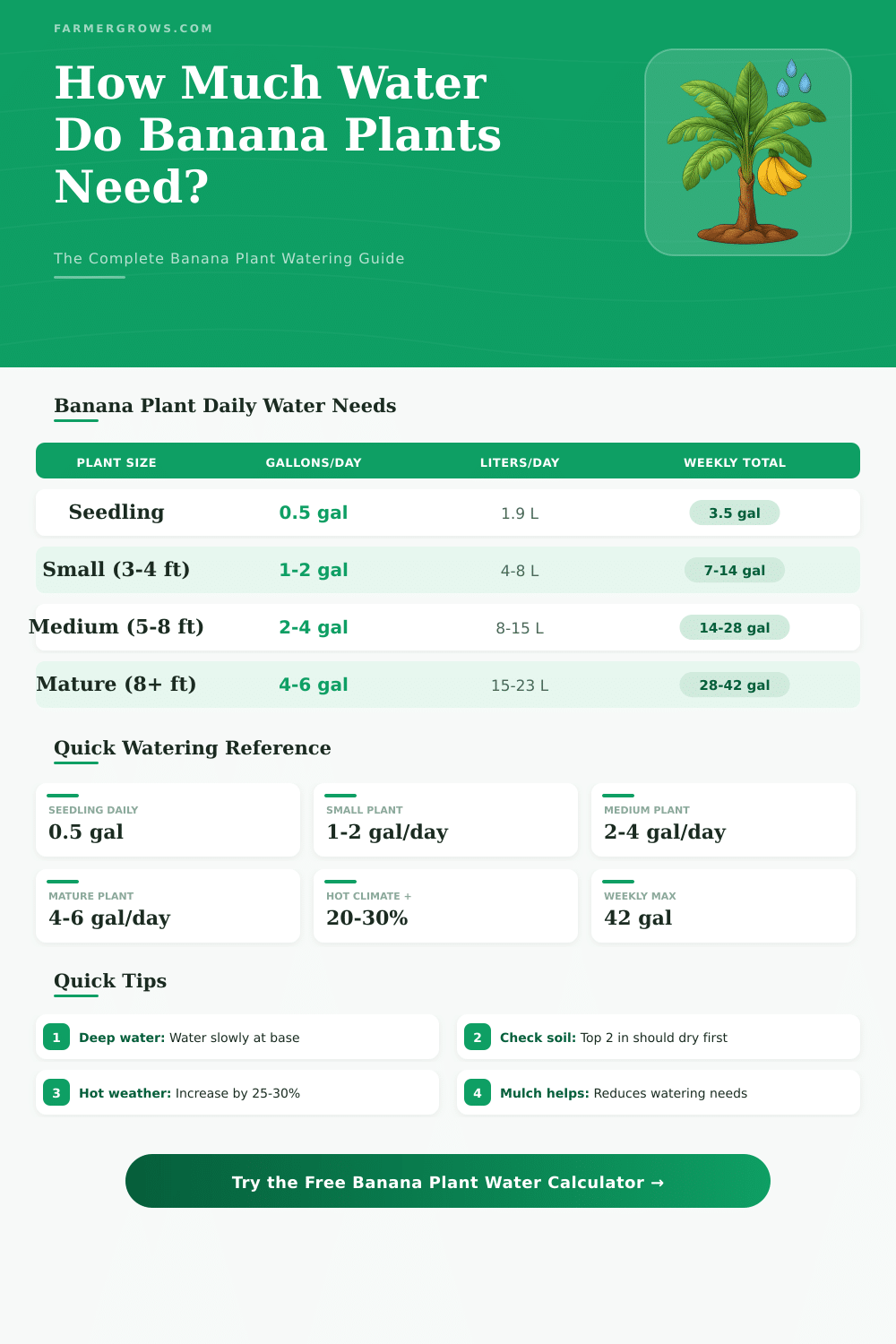
📋 Water Needs by Plant Size & Climate
🌡️ Daily Water Needs by Plant Size & Climate
| Plant Size | Temperate | Subtropical | Tropical | Arid/Hot |
|---|---|---|---|---|
| Seedling | 0.3 gal (1.1 L) | 0.5 gal (1.9 L) | 0.7 gal (2.6 L) | 0.9 gal (3.4 L) |
| Small (1–4 ft) | 0.8 gal (3 L) | 1.2 gal (4.5 L) | 1.8 gal (6.8 L) | 2.5 gal (9.5 L) |
| Medium (4–8 ft) | 1.8 gal (6.8 L) | 2.5 gal (9.5 L) | 3.5 gal (13.2 L) | 5 gal (18.9 L) |
| Mature (8+ ft) | 3 gal (11.4 L) | 4 gal (15.1 L) | 6 gal (22.7 L) | 8 gal (30.3 L) |
🌍 Soil Type Adjustment Factors
| Soil Type | Drainage | Water Retention | Adjustment |
|---|---|---|---|
| Loamy (ideal) | Moderate | Good | No change (1.0x) |
| Sandy | Very Fast | Poor | +25–35% more water |
| Clay | Slow | Excellent | –15–20% less water |
| Container / Pot | Fast | Low | +30–40% more water |
| Raised Bed Mix | Moderate-Fast | Moderate | +10–15% more water |
| Hydroponic | Controlled | N/A | Set by system schedule |
🌿 Mulch Impact on Water Needs
| Mulch Depth | Evaporation Reduction | Water Saved/Week | Recommended For |
|---|---|---|---|
| No Mulch | 0% | 0 gal saved | Hydro / Indoor |
| Light (1–2 in) | 15–20% | 1–3 gal/plant | Container plants |
| Deep (3–4 in) | 25–35% | 3–8 gal/plant | In-ground, tropical |
💧 Weekly Water Totals by Plant Count
| Plant Count | Seedling (gal) | Medium (gal) | Mature (gal) | Mature (liters) |
|---|---|---|---|---|
| 1 plant | 3.5 | 17.5 | 28 | 106 L |
| 3 plants | 10.5 | 52.5 | 84 | 318 L |
| 5 plants | 17.5 | 87.5 | 140 | 530 L |
| 10 plants | 35 | 175 | 280 | 1,060 L |
| 25 plants | 87.5 | 437.5 | 700 | 2,650 L |
banana plants truly are not trees. In science, they are big herb plants, so to call them trees is not exactly right. The banana itself is an oblong, tasty fruit, that in botany is called a berry.
It comes from various species of big flowering plants from the group Musa. In some regions, cooked bananas are called plantains, what separates them from the sweet dessert types. The fruits range in size and shade.
How to Grow and Care for Banana Plants
Sometimes folks believe that there is only one kind of banana plant, but actually there are many species and even hundreds of varieties. The differences between banana types are big, especially in height. In natural surroundings, such a plant can rise to 6 to 12 metres.
So it matters to choose a good variety, especially if one wants to grow it indoors. Low species, like the Extra Dwarf Cavendish or the Nana Lady Finger, work well for pots and small areas. The famous Cavendish does not suit for home settings, because it rises too much.
banana plants like plenty of light, heat and steady food. In pots, they need full sunshine, around six to eight hours of direct light daily. Also much water they need, so that the big leaves stay fresh.
One should check the ground, when the upper one to two inches feel dry. Around 22 degrees Celsius in the room wroks well for most of the time. Under 14 degrees, the growth simply will stop.
When the heat drops more, the fruits suffer, the skin turns grey and the leaves can turn yellow.
From the center up grow new leaves in a roll shape, and are truly amazing, as a big leaf sharply opens from the whole. While new leaves appear, the old ones dye and fall. Strong wind can tear them, so a safe place against wind is the best option.
Taking care of banana plants is fairly simple, so they work for newcomers among the gardeners. Even so they are hungry creatures. They need a lot of heat, light, food and space for roots.
In thin soil, as in Florida, one must feed them four to six times yearly. Fruits grown indoors are not usual, and if it happens, it takes three to four years. The Ice Cream banana plant can self-pollinate, so one alone plant can give fruits.
But each banana plant fruits only one time during its whole life.
There are also cold-hardy tough types. After cutting the whole plant at the end of the growing season, covering with mulch can help it last the winter. During spring, one can uncover the trunk, when new leaves come out.
From the base of the main stub grow young plants, called pups, and one plant soon becomes awhole group. Common types of bananas are seedless plants, that spread only by means of vegetative growth. Wild species, rather, fill themselves with black, hard seeds.