🪴 Potted Plant Water Calculator
Calculate exactly how much water your potted plants need based on pot size, plant type & conditions
of pot vol/week
of pot vol/week
of pot vol/week
of pot vol/week
of pot vol/week
of pot vol/week
of pot vol/week
of pot vol/week
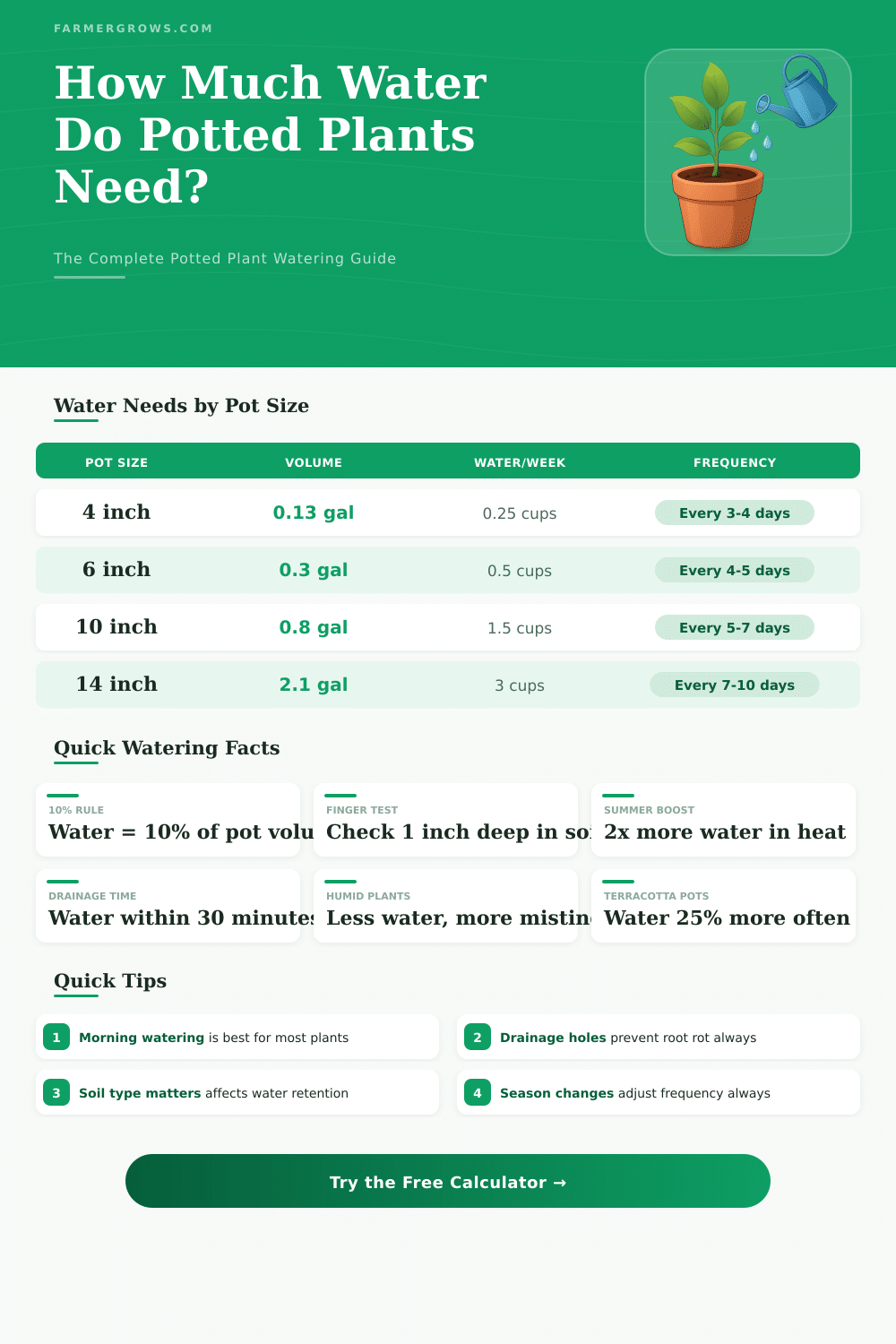
| Pot Diameter | Pot Volume | Water per Watering | Frequency | Weekly Total |
|---|---|---|---|---|
| 4 inch (10 cm) | 0.13 gal (0.5 L) | 1.5 oz (44 ml) | Every 3–4 days | 3 oz (89 ml) |
| 6 inch (15 cm) | 0.29 gal (1.1 L) | 3.5 oz (104 ml) | Every 4–5 days | 6 oz (177 ml) |
| 8 inch (20 cm) | 0.52 gal (2.0 L) | 6.5 oz (192 ml) | Every 5–7 days | 10 oz (296 ml) |
| 10 inch (25 cm) | 0.81 gal (3.1 L) | 10 oz (296 ml) | Every 5–7 days | 16 oz (473 ml) |
| 12 inch (30 cm) | 1.17 gal (4.4 L) | 14 oz (414 ml) | Every 6–8 days | 20 oz (591 ml) |
| 14 inch (36 cm) | 2.1 gal (7.9 L) | 25 oz (740 ml) | Every 7–10 days | 28 oz (828 ml) |
| 16 inch (41 cm) | 3.2 gal (12.1 L) | 38 oz (1,124 ml) | Every 7–10 days | 44 oz (1,301 ml) |
| 20 inch (51 cm) | 6.3 gal (23.8 L) | 76 oz (2,248 ml) | Every 7–14 days | 80 oz (2,366 ml) |
| Factor | Condition | Multiplier | Effect |
|---|---|---|---|
| Season | Spring | 1.0x (baseline) | Moderate growth, balanced needs |
| Season | Summer | 1.5x | Higher evaporation, active growth |
| Season | Fall | 0.75x | Slowing growth, less water lost |
| Season | Winter | 0.5x | Dormancy, minimal water needed |
| Light | Low light | 0.75x | Less transpiration |
| Light | Medium light | 1.0x | Baseline transpiration |
| Light | High / direct sun | 1.4x | High evaporation rate |
| Humidity | Low (<30%) | 1.3x | Faster moisture loss from soil |
| Humidity | Medium (30–60%) | 1.0x | Normal evaporation |
| Humidity | High (>60%) | 0.8x | Soil retains moisture longer |
| Pot Material | Plastic / Glazed | 1.0x | Non-porous, retains moisture |
| Pot Material | Terracotta / Clay | 1.3x | Porous, loses moisture through walls |
| Pot Material | Fabric / Grow Bag | 1.5x | Very porous, air prunes roots |
| Soil Mix | Peat-based | 0.85x | Retains moisture well |
| Soil Mix | Cactus / Sandy | 1.4x | Drains very quickly |
| Soil Mix | Perlite-heavy | 1.5x | Fastest drainage |
| Common Name | Diameter (in) | Volume (gal) | Volume (L) |
|---|---|---|---|
| Seedling / 4" pot | 4 | 0.13 | 0.5 |
| 6" Standard | 6 | 0.29 | 1.1 |
| 1-gallon pot | 6–7 | 1.0 | 3.8 |
| 2-gallon pot | 8–9 | 2.0 | 7.6 |
| 3-gallon pot | 10–11 | 3.0 | 11.4 |
| 5-gallon pot | 12 | 5.0 | 18.9 |
| 7-gallon pot | 14 | 7.0 | 26.5 |
| 10-gallon pot | 16 | 10.0 | 37.9 |
| 15-gallon pot | 18 | 15.0 | 56.8 |
| 25-gallon pot | 22 | 25.0 | 94.6 |
plants in pots simply means plants grown in a flowery jar. That common idea covers a wide range of ways to bring greenery in any place, inside or outside.
Mature plants in pots, that clean the air can arrive right at the door. Many of them are safe for pets and fit various levels of light, what makes them great for all rooms. Ready-made plants in jars ship widely across the whole land, usually with a return option, so the risk drops when one buys something fresh.
How to Grow Plants in Pots
Plants in pots for inside add life and shape to the home very easily.
To choose the right plant in a jar, think about some things: the amount of sunshine, that the place gets, the rate of watering and the wish about look. Succulents and cacti work well for sunny areas, because they do not suffer drying between waterings. Tropical plants are among the most simply grown in pots in warm places.
Plants with dense clay ground in the soil sometimes do mroe well when one moves them in jars instead. Local plants with roots near the surface usually benefit in pots, while those with big main roots need bigger pots.
Also the kind of jar plays a role. Glazed jar keeps the moisture more well. Unglazed clay dries more quickly, so it works for plants, that like dry soil.
Round jars with narrow base and open holes keep the ground moisture and humidity more steady, what does not always help plants with broad leaves. Ceramic jars come in many colours and match with any setup. Heavy iron or forged iron pots weigh a lot, but they last years, so one rarely must replace them.
Plastic jars cost less, way less and come in all styles.
One big plus of gardening in pots is the control. Jars allow you to change the ground, the drainage and the light for every plant, without touching the whole garden. Lasting plants and bushes can grow in jars too.
Good potting soil from a bag works well four growing plants in pots, and over time gardeners learn what they like most. The mix for potting should be free of weeds, and the leaves should look healthy without spots or holes.
Watering needs care. A good way is to push two fingers deep and check, if the ground is still damp before adding water. Bottom watering works also well, lay the jar in water until the upper ground gets wet.
The most many flowers in jars need water one time each week. You do not need to change the ground often. Plants can pass years without repotting.
Light is likely the most key factor, mostly for plants brought inside, because the natural light level outside greatly beats anything inside. Even windows facing south with extra lamps do not reach what plants getunder the sky.
Double potting helps with the drainage, lay the plant in a plastic jar with holes inside a nicer outer jar. Supplies for plant care, like natural potting mix and natural fertilizer, ease the whole task right from the start.