🌺 Hibiscus Water Calculator
Calculate exactly how much water your hibiscus plants need daily, weekly, or per watering session
| Season | Container Frequency | In-Ground Frequency | Notes |
|---|---|---|---|
| Summer (hot) | Daily or twice daily | 2–3x per week | Check soil daily; wilt = urgent |
| Spring | Every 1–2 days | 1–2x per week | Increase as temps rise |
| Fall | Every 2–3 days | Once per week | Reduce as growth slows |
| Winter (dormant) | Every 5–7 days | Every 2–3 weeks | Let soil dry more between |
| Winter (indoor) | Every 7–10 days | N/A | Low light = slow water use |
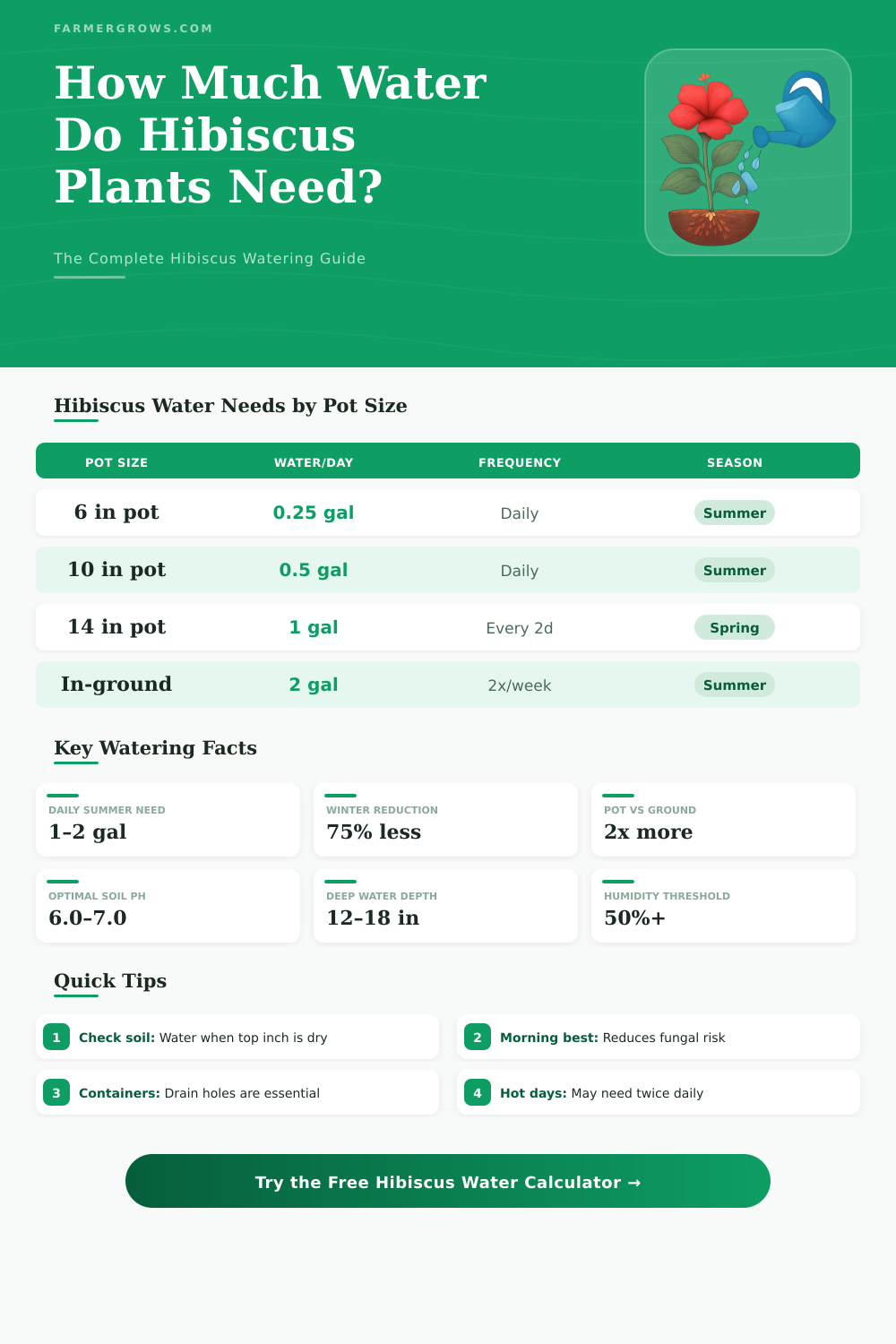
| Pot Diameter | Volume per Watering | Liters Equivalent | Days Between (Summer) |
|---|---|---|---|
| 6 in (15 cm) | 0.25 gal | ~0.95 L | 1 day |
| 8 in (20 cm) | 0.35 gal | ~1.3 L | 1 day |
| 10 in (25 cm) | 0.5 gal | ~1.9 L | 1 day |
| 12 in (30 cm) | 0.75 gal | ~2.8 L | 1–2 days |
| 14 in (36 cm) | 1.0 gal | ~3.8 L | 1–2 days |
| 16 in (41 cm) | 1.5 gal | ~5.7 L | 2 days |
| 20 in (51 cm) | 2.0 gal | ~7.6 L | 2–3 days |
| Plant Age | Gallons / Watering | Liters / Watering | Weekly Total |
|---|---|---|---|
| Newly planted (0–3 mo) | 1–2 gal | 3.8–7.6 L | 7–14 gal (daily) |
| Young (3–12 mo) | 1.5–2 gal | 5.7–7.6 L | 4.5–6 gal (3x/wk) |
| Established (1–3 yr) | 2–3 gal | 7.6–11.4 L | 4–9 gal (2x/wk) |
| Mature (3+ yr) | 3–5 gal | 11.4–19 L | 6–10 gal (2x/wk) |
| Factor | Condition | Adjustment | Reason |
|---|---|---|---|
| Soil type | Sandy | +25–30% | Drains water rapidly |
| Soil type | Clay | –20% | Retains moisture longer |
| Humidity | Low (<30%) | +15–20% | Higher evapotranspiration |
| Humidity | High (>60%) | –10–15% | Slower moisture loss |
| Mulch layer | 2–3 in mulch | –20–30% | Reduces soil evaporation |
| Temperature | Extreme (>100°F) | +30–50% | Rapid water loss |
| Sun exposure | Intense / reflected | +20% | Extra transpiration |
Hibiscus plants are known because of their brave, tropical flowers. Some of them reach great size, similar to plates for dinners. Those plants like full sunshine, regular Water and rich soil because of what they bloom well in warm season.
The strong Hibiscus, that one also calls Pink of Sharon, fit to live even in less warm climates.
Hibiscus Plants: Types and Care
The group Hibiscus belong to the family of mallows, Malvaceae. It forms quite a large group with some hundreds of species. This group come from warm, mild and tropical regions around the globe.
The word Hibiscus does come from Greek “hibiskos“, what meant marshmallow. The sticky root or stem of some plants from that family inspired this name.
Hibiscus plants offer rich variety of colours, forms and levels of resistance. Some types even last zone 4, what allows tropical look in really cold places. They prove to be very flexible plants.
One uses them well in regular garden, in flower beds, in jars or even as fence. Hibiscus also wroks as isolated plant in the garden.
There are two main species, that one must know. The tropical Hibiscus form a small bush. The strong Hibiscus, rather, grow as a lasting plant.
It dies back every winter, later slowly greens again in spring. After it starts, it soon rises to four feet in early summer. The strong Hibiscus belong to the last lasting plants, that appears and flower.
Flowers reach size of a dinner plate, and the whole plant can become impressive. Sometimes one must support them so that they stay standing because of their wait. They favour clay ground and flower during the whole summer.
Hibiscus work also as house plant, even in warm areas. The main challenge inside is the light. Because those are plants, that do best in full sun, they need most light inside.
Slow move of Hibiscus from inside to outside in spring help. Start on balcony, later under filtered light beside tree and finally in full sun. Bring that back in autumn before the first cold.
During the past thirty years, breeders of plants did great with strong Hibiscus from marshes of North America. What once were simple wild flower, now are showy lasting plants, that give big, colorful flowers more than extended hand. The yellow Hibiscus is the state flower of Hawaii.
The tropical Hibiscus also improve by means of breeding, gettingmany colours and flower forms as simple, double or ruffled.