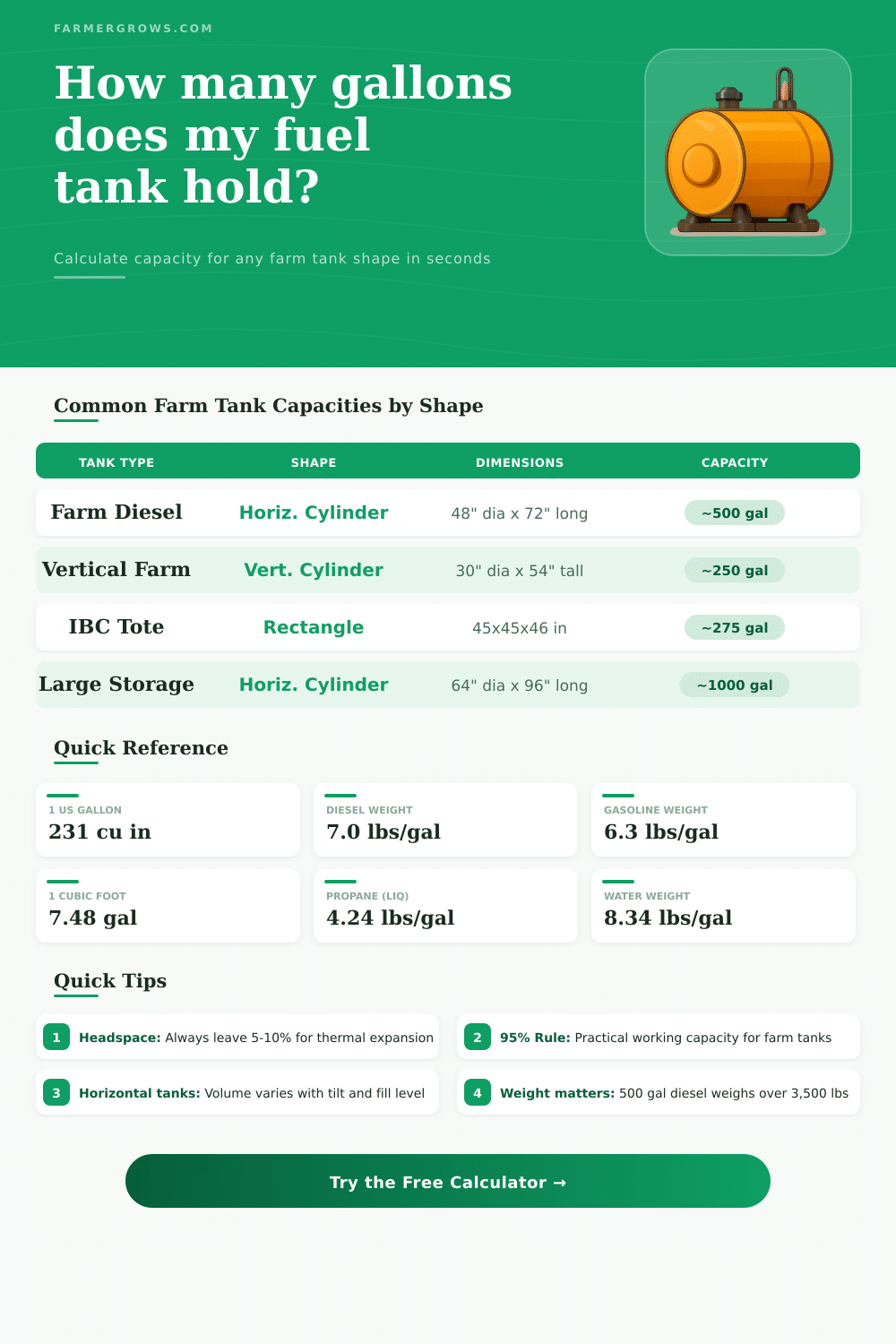
Fuel Tank Capacity Calculator
Calculate volume, usable capacity, and fuel weight for any tank shape
| Size | Shape | Typical Dimensions | Capacity | Common Use |
|---|---|---|---|---|
| Small | Vert. Cylinder | 22" dia x 28" tall | ~55 gal | Gasoline, small equipment |
| Medium | Vert. Cylinder | 30" dia x 54" tall | ~250 gal | Farm diesel, seasonal use |
| IBC Tote | Rectangle | 45" x 45" x 46" | ~275 gal | Water, liquid fertilizer |
| Standard | Horiz. Cylinder | 48" dia x 72" long | ~500 gal | Farm diesel, main storage |
| Large | Horiz. Cylinder | 64" dia x 96" long | ~1000 gal | High-volume farm diesel |
| Irrigation | Vert. Cylinder | 36" dia x 48" tall | ~300 gal | Water storage |
| Underground | Rectangle | 38" x 44" x 62" | ~500 gal | Diesel, buried storage |
| Propane Ref. | Sphere | 24" radius | ~263 gal | Propane reference only |
| Fuel Type | lbs / Gallon | kg / Liter | Weight per 100 gal | Notes |
|---|---|---|---|---|
| Diesel | 7.0 | 0.839 | 700 lbs | Most common farm fuel |
| Gasoline | 6.3 | 0.755 | 630 lbs | Lighter than diesel |
| Propane (liquid) | 4.24 | 0.508 | 424 lbs | Lightest liquid fuel |
| Water | 8.34 | 1.000 | 834 lbs | Heaviest per volume |
| Used Oil | 7.5 | 0.899 | 750 lbs | Slightly heavier than diesel |
| Unit | Gallons | Liters | Cubic Feet | Cubic Inches |
|---|---|---|---|---|
| 1 US Gallon | 1 | 3.785 | 0.1337 | 231 |
| 1 Liter | 0.2642 | 1 | 0.03531 | 61.02 |
| 1 Cubic Foot | 7.481 | 28.317 | 1 | 1,728 |
| 1 Cubic Inch | 0.00433 | 0.01639 | 0.000579 | 1 |
| 100 Gallons | 100 | 378.5 | 13.37 | 23,100 |
| 500 Gallons | 500 | 1,892.7 | 66.84 | 115,500 |
Count the fuel tank capacity is more difficult than one could believe. The tank of a typical car stores around 50 to 60 liters, what is about 12 to 16 gallons, according to the kind of vehicle. Most sedans and similar cars stay in this middle range, what gives them good distance between fill-ups.
Even so, these numbers change quite a lot according to the model of the car that one uses.
Fuel Tank Sizes for Cars, Trucks, and Tractors
Small cars usually have smaller tanks, between 10 and 12 gallons. On the other hand, big SUVs and pickups fit to store much more, from 20 gallons to even more than 36. Large SUVs, like the Suburban, usually pass the 30 gallons.
On the otehr hand, heavy trucks for long-range ways work in an entirely other world. They fill between 400 and 1,200 liters. Most of these rigs use double tanks, so the total capacity reaches from 800 to 2,400 liters.
The tanks of trucks do not follow any general rule. One could receive a single 75-gallon tank, double each 150 gallons or something between. Also the materials matter, steel or aluminum (and they come in different shapes), round ore square.
Everything depends on what was planned when the truck left from the factory line.
Here something useful to know: the stated capacity? It does not describe everything. A tank listed at 275 gallons indeed delivers only around 250 to 256 gallons, that one truly uses.
The listed number comes from averaging of various volumes of the tank, and it maybe covers only the usable fuel or both usable and the trapped part. Always stays a bit of fuel in the bottom, where the pump does not reach it.
The size of the engine and the size of the tank are two different things, what confuses many folks. When one sees “2.2L”, that relates to the engine volume, how much air passes through it during one full turn. The fuel tank capacity of your car could store 40 to 45 liters, no matter what.
When the gauge on your dash reads empty, fuel even so yet stays there. Most small cars and basic versions leave around 1 to 2 gallons unused. In some vehicles, 2 to 3 gallons stay in reserve, because one can not leave the tank entirely empty, that could harm hybrid systems.
It is possible to expand the capacity of your tank by means of refills and aftermarket options. There exist 58-gallon backup systems, that are allowed in all 50 states for gas cars. Ford Transit vans can receive 45-gallon expanded replacement.
Another way is exchange to a 52-gallon tank, where the original factory capacity was only 30.5 gallons.
Closed operations need an entirely other approach to the storage of fuel. Middle farms usually need 500 to 1,000 gallons on hand. Big farm gear, like combines and tractors, carry tanks between 150 and 300 gallons, while smaller tractors store 50 to 75 gallons.
Choosing the right size matters, too small means constant refueling, toobig leaves fuel simply unused.