🌱 Planting Date Calculator
Calculate your ideal planting windows based on frost dates, crop type, and growing zone
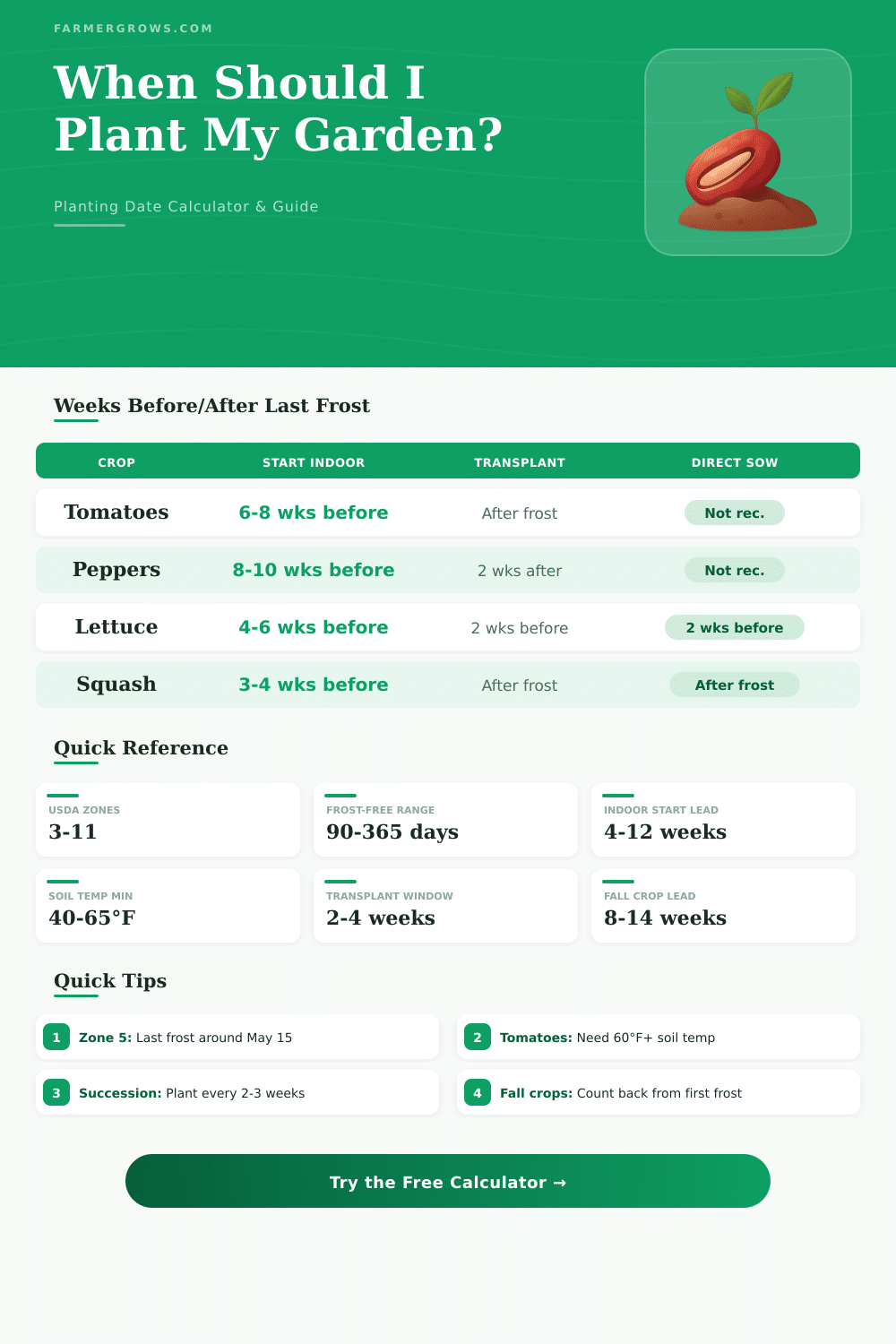
| Crop | Start Indoors (Wks Before Last Frost) | Transplant (Relative to Last Frost) | Min Soil Temp |
|---|---|---|---|
| Tomatoes | 6–8 weeks | After last frost | 60°F / 16°C |
| Peppers | 8–10 weeks | 2 weeks after | 65°F / 18°C |
| Broccoli | 4–6 weeks | 2–4 weeks before | 40°F / 4°C |
| Cucumbers | 3–4 weeks | 1–2 weeks after | 60°F / 16°C |
| Watermelon | 3–4 weeks | 2 weeks after | 70°F / 21°C |
| Squash | 3–4 weeks | After last frost | 60°F / 16°C |
| Corn | Not recommended | N/A | 60°F / 16°C |
| Crop | Sow Outdoors (Relative to Last Frost) | Seed Depth | Days to Harvest |
|---|---|---|---|
| Lettuce | 2–4 weeks before | 0.25 in / 0.6 cm | 45–60 days |
| Peas | 4–6 weeks before | 1 in / 2.5 cm | 55–70 days |
| Spinach | 4–6 weeks before | 0.5 in / 1.3 cm | 37–45 days |
| Carrots | 2–3 weeks before | 0.25 in / 0.6 cm | 70–80 days |
| Beans | 1–2 weeks after | 1 in / 2.5 cm | 50–65 days |
| Squash | 1–2 weeks after | 1 in / 2.5 cm | 50–65 days |
| Corn | 1–2 weeks after | 1.5 in / 3.8 cm | 60–100 days |
| Cucumbers | 1–2 weeks after | 0.5 in / 1.3 cm | 50–70 days |
| Depth | Sq Ft per Cu Yd | Sq M per Cu M | Common Use |
|---|---|---|---|
| 1 in / 2.5 cm | 324 sq ft | 40 m² | Seed starting topdress |
| 2 in / 5 cm | 162 sq ft | 20 m² | Light mulch or amendment |
| 3 in / 7.6 cm | 108 sq ft | 13.3 m² | Standard garden bed |
| 4 in / 10 cm | 81 sq ft | 10 m² | New bed preparation |
| 6 in / 15 cm | 54 sq ft | 6.7 m² | Raised bed partial fill |
| 12 in / 30 cm | 27 sq ft | 3.3 m² | Deep raised bed fill |
| Bag Size | Volume per Bag | Bags per Cubic Yard | Coverage at 3 in Depth |
|---|---|---|---|
| 1 cu ft bag | 0.037 cu yd | 27 bags | 4 sq ft |
| 1.5 cu ft bag | 0.056 cu yd | 18 bags | 6 sq ft |
| 2 cu ft bag | 0.074 cu yd | 13.5 bags | 8 sq ft |
| 3 cu ft bag | 0.111 cu yd | 9 bags | 12 sq ft |
| Bed Size | Area | Cu Yds at 3 in | 2 cu ft Bags Needed |
|---|---|---|---|
| 4 x 4 ft raised bed | 16 sq ft | 0.15 cu yd | 2 bags |
| 4 x 8 ft raised bed | 32 sq ft | 0.30 cu yd | 4 bags |
| 4 x 12 ft raised bed | 48 sq ft | 0.44 cu yd | 6 bags |
| 10 x 10 ft garden plot | 100 sq ft | 0.93 cu yd | 13 bags |
| 10 x 20 ft garden plot | 200 sq ft | 1.85 cu yd | 25 bags |
| 20 x 30 ft garden plot | 600 sq ft | 5.56 cu yd | 75 bags |
| 25 x 40 ft large garden | 1000 sq ft | 9.26 cu yd | 125 bags |
To calculate fall planting dates, take your first fall frost date and subtract the crop's days to maturity plus 14 days as a buffer. For example, if your first frost is October 15 and broccoli takes 80 days, start counting back 94 days to get a July 13 planting date.
Seeds germinate based on soil temperature, not air temperature. Soil warms 2–4 weeks behind air temps in spring. Use a soil thermometer at 2–4 inch depth to confirm planting readiness. Most warm-season crops need soil at 60°F (16°C) or higher for reliable germination.
Get the last cool date for your region when you plant can do or destroy your whole garden season. It ranks between those basic causes that stands beside the temperature, miss it and you risk everything yearly. Cold nights and sudden cold?
They will destroy young plants before you notice what happened. Each who grows vegetables or fruits too well know that feeling.
Know Your Last Frost Date
The wise step is check the date of the last cold in your area first. That date shows you have roughly equal chance, half of the yearly colds come before it, half after it. Many folks prefer to wait one or two weeks after that standard date before putting anything in the ground, although follow the weather forecast always helps.
When temperatures repeatedly drop you would want to add a bit of protection. Packets for seeds help a lot here. They point exactly how many weeks before the last cold you should start seeds inside, and whether seeding directly or transplanting would happen in front or after those cool data.
Online plant calendars are practical resources. Type in your zip code in something like the plant calendar of the Old Farmer’s Almanac and you receive suggested data for everything, from vegetables and fruits to grasses, fitted to your place. Some of them even send emails about expected frost periods and when to start with seeds.
There are also calculators for colds that go around, where you put your date of the first frost-free period in spring and receive suggested time ranges for seeding and transplanting different crops.
Geography seriously matters hear. In one same district you could find four different zones of hardiness with around 30 days between their planting times. Microclimates add change…
Southeast slopes warm more soon, while northeast stay cool more long. In some places one does not touch potatoes until April arrives, and tomatoes, peppers or corn does not enter until mid-May at earliest. Even then, the last cold can come surprisingly and create troubles.
Beans interest because earlier planting times usually give bigger amounts. Growers try seeding early so that the plants receive more sunshine. Using types that mature late helps, because they commonly give richer harvests.
Before they usually spread crops through the season. Currently many growers want to lay everything in the soil during one short period. Even so, sometimes later crops beat the early, depending on your place.
Different crops do well in various seasons. Squash, carrots, beans and eggplants like summer heat. Winter brings garlic, peas and asparagus in its time.
The best spring period works for broccoli, radishes, onions, lettuce and cauliflower. Warm beds heat the ground more quickly, while common covers protect plants against overnight cold and pests at the same time. Late summer or early autumn is the mainstreamoption for working the soil and mixing compost or other organic material, to prepare you before the temperature drops.