🌱 Soybean Seed Spacing Calculator
Calculate seed population, spacing, and seed quantity needed for your soybean field
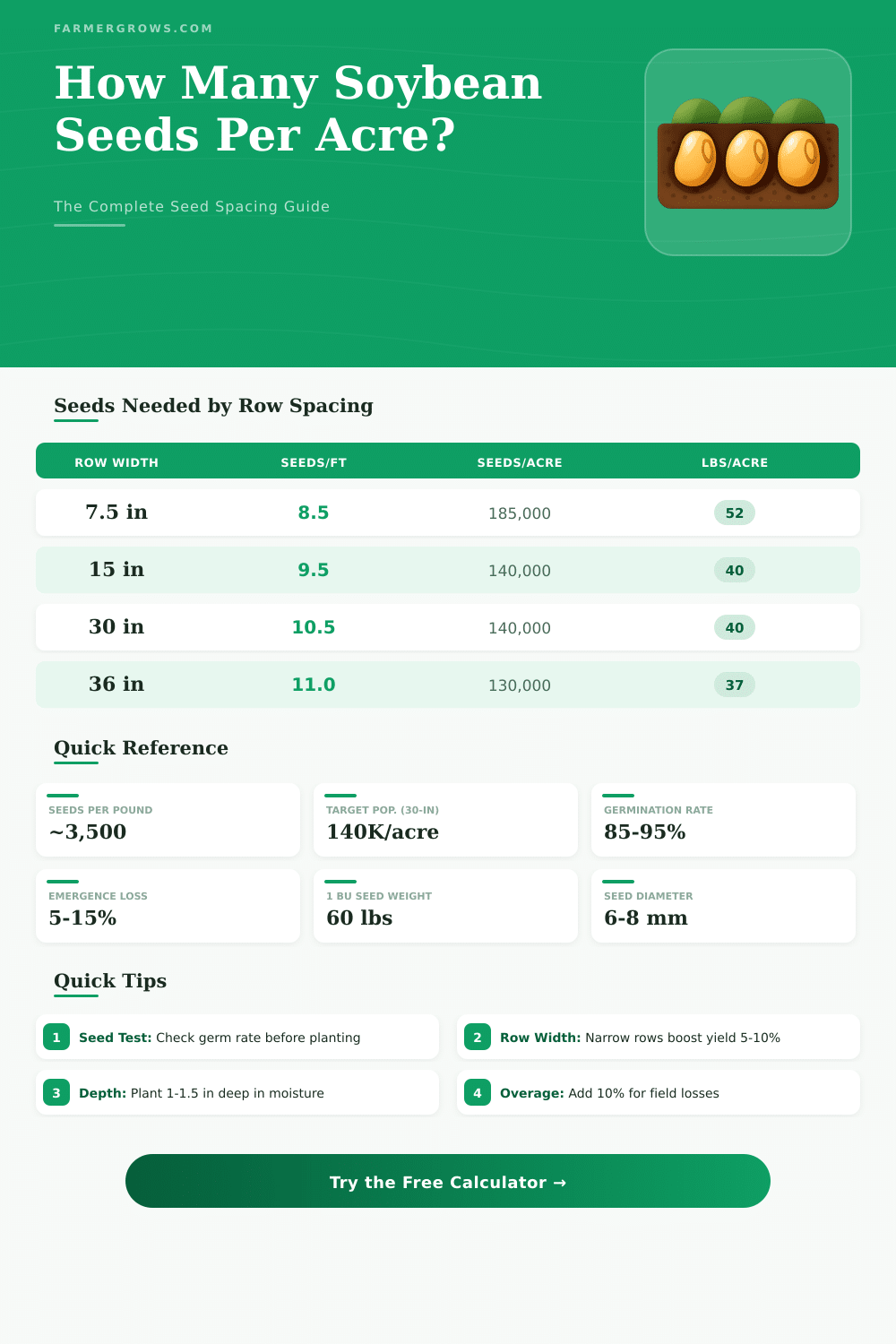
| Row Spacing | Target Pop. (seeds/acre) | Seed Spacing at Target | Lbs/Acre (3,000 seeds/lb) |
|---|---|---|---|
| 7.5 in (19 cm) | 140,000 – 180,000 | 2.5 – 3.0 in | 47 – 60 |
| 10 in (25 cm) | 130,000 – 160,000 | 2.5 – 3.0 in | 43 – 53 |
| 15 in (38 cm) | 120,000 – 150,000 | 2.0 – 2.8 in | 40 – 50 |
| 20 in (51 cm) | 120,000 – 150,000 | 1.8 – 2.2 in | 40 – 50 |
| 30 in (76 cm) | 120,000 – 150,000 | 1.5 – 2.0 in | 40 – 50 |
| 36 in (91 cm) | 110,000 – 140,000 | 1.5 – 2.0 in | 37 – 47 |
| In-Row Spacing | Seeds/ft of Row | 30-in Row (seeds/acre) | 15-in Row (seeds/acre) |
|---|---|---|---|
| 1.0 in (2.5 cm) | 12.0 | 209,088 | 418,176 |
| 1.5 in (3.8 cm) | 8.0 | 139,392 | 278,784 |
| 2.0 in (5.1 cm) | 6.0 | 104,544 | 209,088 |
| 2.5 in (6.4 cm) | 4.8 | 83,635 | 167,270 |
| 3.0 in (7.6 cm) | 4.0 | 69,696 | 139,392 |
| 4.0 in (10.2 cm) | 3.0 | 52,272 | 104,544 |
| Unit Size | Weight | Seeds (at 3,000/lb) | Acres Covered (140K pop.) |
|---|---|---|---|
| 1 Bushel | 60 lbs (27.2 kg) | 180,000 | 1.3 acres (0.52 ha) |
| 50 lb Bag | 50 lbs (22.7 kg) | 150,000 | 1.07 acres (0.43 ha) |
| Unit (140K seeds) | ~47 lbs (21.3 kg) | 140,000 | 1.0 acre (0.40 ha) |
| Small Bag (25 lb) | 25 lbs (11.3 kg) | 75,000 | 0.54 acres (0.22 ha) |
| Bulk Tote (2,500 lbs) | 2,500 lbs (1,134 kg) | 7,500,000 | 53.6 acres (21.7 ha) |
| Field Size | Area (sq ft) | Seeds Needed (140K/acre) | Lbs Needed (3,000/lb + 10%) |
|---|---|---|---|
| Quarter Acre | 10,890 | 35,000 | 12.8 lbs (5.8 kg) |
| 1 Acre | 43,560 | 140,000 | 51.3 lbs (23.3 kg) |
| 5 Acres | 217,800 | 700,000 | 256.7 lbs (116.4 kg) |
| 10 Acres | 435,600 | 1,400,000 | 513.3 lbs (232.9 kg) |
| 40 Acres | 1,742,400 | 5,600,000 | 2,053.3 lbs (931.4 kg) |
| 100 Acres | 4,356,000 | 14,000,000 | 5,133.3 lbs (2,328.6 kg) |
soybean seed become truly attractive when one grasps them a bit more. They vary according to many sizes and colours of the pods, for instance black, brown, yellow or green. Some form almost round patterns, while others stay flat and long.
The seed sizes range between 5 and 11 mm, and the pods can have one colour or mix of two tones.
How Soybean Seeds Look, Grow and Are Used
The soybean plant grows from 12 to 36 inches. Stems and leaves cover themselves with hairs. Flowers appear white with lavender shade.
Pods meet in groups of three to five, and each of them carries around 2 to 4 seed. The length of the pods ranges from 1 to 4 inches.
For the crop, place soybean seed at a depth of half inch to two inches, with spacing of around 4 to 6 inches between them. Rows separate at 18 to 24 inches one from the other. Soil stays humid, with pH value between 6 and 6.8.
They require full sunshine and mature after around 50 to 60 days. If seed rest simply on teh ground surface, germination becomes weak, and creatures can eat them. Best output happens in well drained soil, that is not too sandy, at pH of 6.5 or more.
Early crop faces big dangers because of low ground temperature in the first 24 hours. Soybean seed attract around 50 percent of their wait from water during that first day after planting. One calls that absorption.
Beans first came from Asia. One uses them in the green pod phase as edamame, and also to dry them, make tofu, soy milk, soy sauce or flour. Dried, the seed store around 40 percent of protein, 21 percent of oil, 34 percent of carbohydrates and 5 percent of ash.
Beans belong to few plant foods that have all natural amino acids, similar to those in meat.
They are rich in fibers, rich in protein and have little packed fat. They do not carry cholesterol or lactose. Beans deliver good omega-3 fatty acids and antioxidants.
Non-GMO heritage soybean seed provide many vitamins B, C and E, together with calcium, iron, magnesium, phosphorus and protein.
Beans and products from soy reduce risk of heart diseases, stroke cases, heart problems and some cancer types, together with help for bone health. One breeds certain types for tolerance against dryness and resistance to diseases. The Hutcheson type is known because of its strong build, mid-high height and medium brown seed.
Onesoybean plant gives pods that store around tenfold more beans than the planted.