💧 Netafim Drip Irrigation Calculator
Calculate tubing length, emitter count, flow rates, and mulch/gravel cover for your drip irrigation zone
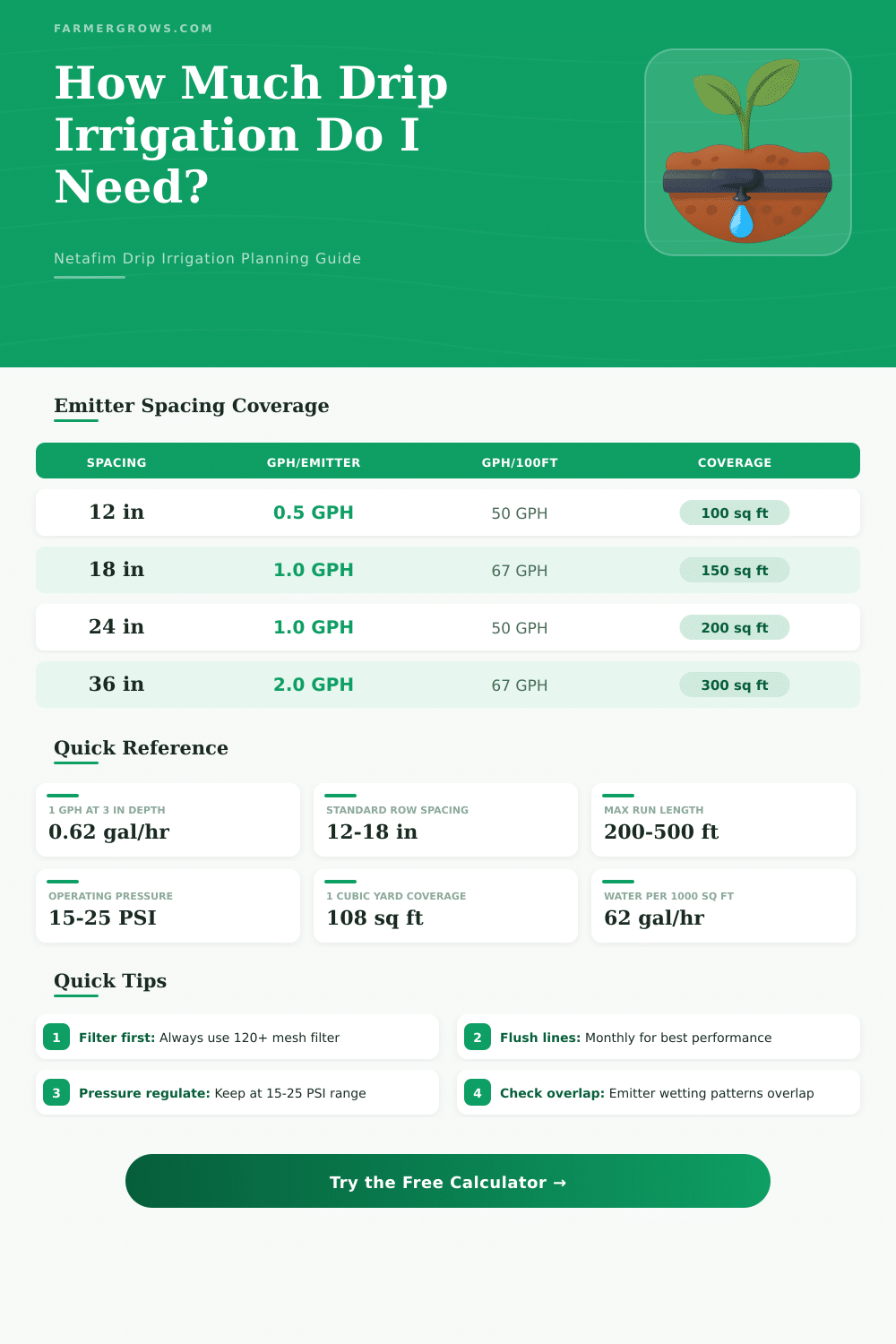
| Row Spacing | Tubing per 100 sq ft | Tubing per 10 m² | Best For |
|---|---|---|---|
| 12 in (30 cm) | 100 ft | 33 m | Vegetables, dense beds |
| 18 in (45 cm) | 67 ft | 22 m | Perennials, flowers |
| 24 in (60 cm) | 50 ft | 17 m | Shrubs, ground cover |
| 36 in (90 cm) | 33 ft | 11 m | Trees, wide shrubs |
| 48 in (120 cm) | 25 ft | 8 m | Orchards, vineyards |
| Emitter Spacing | Emitters per 100 ft | GPH per 100 ft (0.5 GPH) | GPH per 100 ft (1.0 GPH) |
|---|---|---|---|
| 6 in (15 cm) | 200 | 100 GPH | 200 GPH |
| 12 in (30 cm) | 100 | 50 GPH | 100 GPH |
| 18 in (45 cm) | 67 | 33.5 GPH | 67 GPH |
| 24 in (60 cm) | 50 | 25 GPH | 50 GPH |
| 36 in (90 cm) | 33 | 16.5 GPH | 33 GPH |
| Material | Weight (lbs/yd³) | Weight (kg/m³) | Coverage at 3 in (sq ft/yd³) |
|---|---|---|---|
| Hardwood Bark Mulch | 400–600 | 237–356 | 108 |
| Cedar Mulch | 350–450 | 208–267 | 108 |
| Pine Bark Nuggets | 300–450 | 178–267 | 108 |
| Rubber Mulch | 1,200–1,500 | 712–890 | 108 |
| Pea Gravel | 2,400–2,700 | 1,424–1,602 | 108 |
| River Rock | 2,500–2,800 | 1,483–1,661 | 108 |
| Decomposed Granite | 2,500–3,000 | 1,483–1,780 | 108 |
| Compost | 800–1,100 | 475–653 | 108 |
| Project | Area | Tubing (18 in rows) | Emitters (12 in spacing) |
|---|---|---|---|
| Small Garden Bed | 80 sq ft (7.4 m²) | 53 ft (16 m) | 53 |
| Raised Bed 4×8 | 32 sq ft (3.0 m²) | 21 ft (6.5 m) | 21 |
| Veggie Garden 10×20 | 200 sq ft (18.6 m²) | 133 ft (41 m) | 133 |
| Flower Border 6×40 | 240 sq ft (22.3 m²) | 160 ft (49 m) | 160 |
| Orchard 50×100 | 5,000 sq ft (464 m²) | 3,333 ft (1,016 m) | 3,333 |
| Full Landscape 50×50 | 2,500 sq ft (232 m²) | 1,667 ft (508 m) | 1,667 |
| Bag Size | Volume | Bags per Cubic Yard | Coverage at 3 in |
|---|---|---|---|
| 2 cu ft bag | 0.074 yd³ | 13.5 bags | 8 sq ft |
| 3 cu ft bag | 0.111 yd³ | 9 bags | 12 sq ft |
| 1 cu yd bulk | 27 cu ft | 1 | 108 sq ft |
Install Netafim drip tubing on top of the soil surface, then cover with 2–4 inches of mulch. This protects the tubing from UV damage while maintaining easy access for inspection. Avoid burying drip lines deeper than 4 inches under gravel as it can impede root-zone moisture detection.
Total zone flow (GPH) must not exceed your water supply capacity. A typical residential hose bib delivers 200–480 GPH at 40–60 PSI. Always add a pressure regulator (set to 20–25 PSI for Netafim) and a 120-mesh or finer disc filter before the mainline to prevent emitter clogging.
Drip Irrigation is made up of a small Irrigation system, where water flows slowly to the roots of the plants, whether on top of the soil or through buried tubes. The basic idea stays easy: one delivers the water directly to the root zone area, instead of spreading it everywhere else.
This method gives water together with nutrients exactly where the plants most need them… In right amounts and at the right moment. Pipe ties water to separate outlets called emitters, that release the water correctly beside the base of every plant.
How Drip Irrigation Works and Saves Water
Like this every plant receives exactly what it needs, without some waste.
It is possible to save water thanks to one of the main advantages. Drip systems operate with more than 90 percent efficiency, because the water flows slowly in the ground through plastic tubes. It targets directly the root zone, so lost amounts from evaporation, drainage or too deep soaking disappear.
Compared with center pivot or flood Irrigation, drip setup can boost the watre efficiency at crops until 70 percent. Moreover, the energy costs commonly drop by around 50 percent.
This method now is the best standard for giving water and nutrients to crops. It strongly reduces the use of water and the drainage, what is useful for growers as well as for nature.
For garden beds in landscaping, for vegetable gardens and for planters, drip Irrigation really works. It helps to spare water, time and money. One can tie the parts to a water source and leave it work, even so you need to check it regularly in the garden.
Here something useful to know: soaker tubes work differently than drip tubes. Soaker tubes release water along there whole length, what works for groups of plants. Drip tubes, rather, deliver water more targeted by means of emitters at every separate plant.
The water spills controlled and a bit more slowly, so the soil has time to absorb it before drainage starts.
Another bonus gives the control of unwanted grasses. Because water arrives only to the plants and not to the surrounding ground, unwanted grasses between them do not receive water directly. Sprinklers, on the other hand, spray everything visible…
Including those unwanted plants.
Different emitter types and their uses match different needs. Button drippers with 0.5 gallons per hour work well for little plants and grasses. For bigger plants, as tomatoes, other emitter types could be better.
At big jars I found, that button drippers of 1 gallon per hour work for the needed amount. Pressure-compensating emitters form another reliable choice. Almost every packaging points out how much water every emitter gives during one hour.
Installing itself is not hard, if you want that. The price ranges between 2.50 and 4.50 dollars per foot, according to the kind. Brands like Orbit, Rain Bird and DIG offer drip materials in big stores, and they mostly match between themselves.
Basic drip emitter tube counts between the cheapest and easiest solutions.
The trouble is that those narrow tubes and emitters can clog over time. Deposits, minerals or organic buildup can gather. That causes uneven flow of water and uneven spread.
Drip systems need regular checks and care so that they work well. Leaks, breaks and clogged bends all can happen. Lower quality emitters sometimes fail after only some years of blockage or steady usage.
Drip tape also creates problems, it commonly curls in the ground after only one growing season. Drip tube has longer life, and some makers even give guarantees up to 16 years for their products. Naturally, the system needs more effort and money than simpler watering methods.
But the saving of water and the good results commonly worth the expense. It allows gardeners andgrowers to spare water, use it more wisely and keep the soil healthy all at once.