🌿 Compost Weight Calculator
Calculate exactly how much compost you need by area, depth, and material type
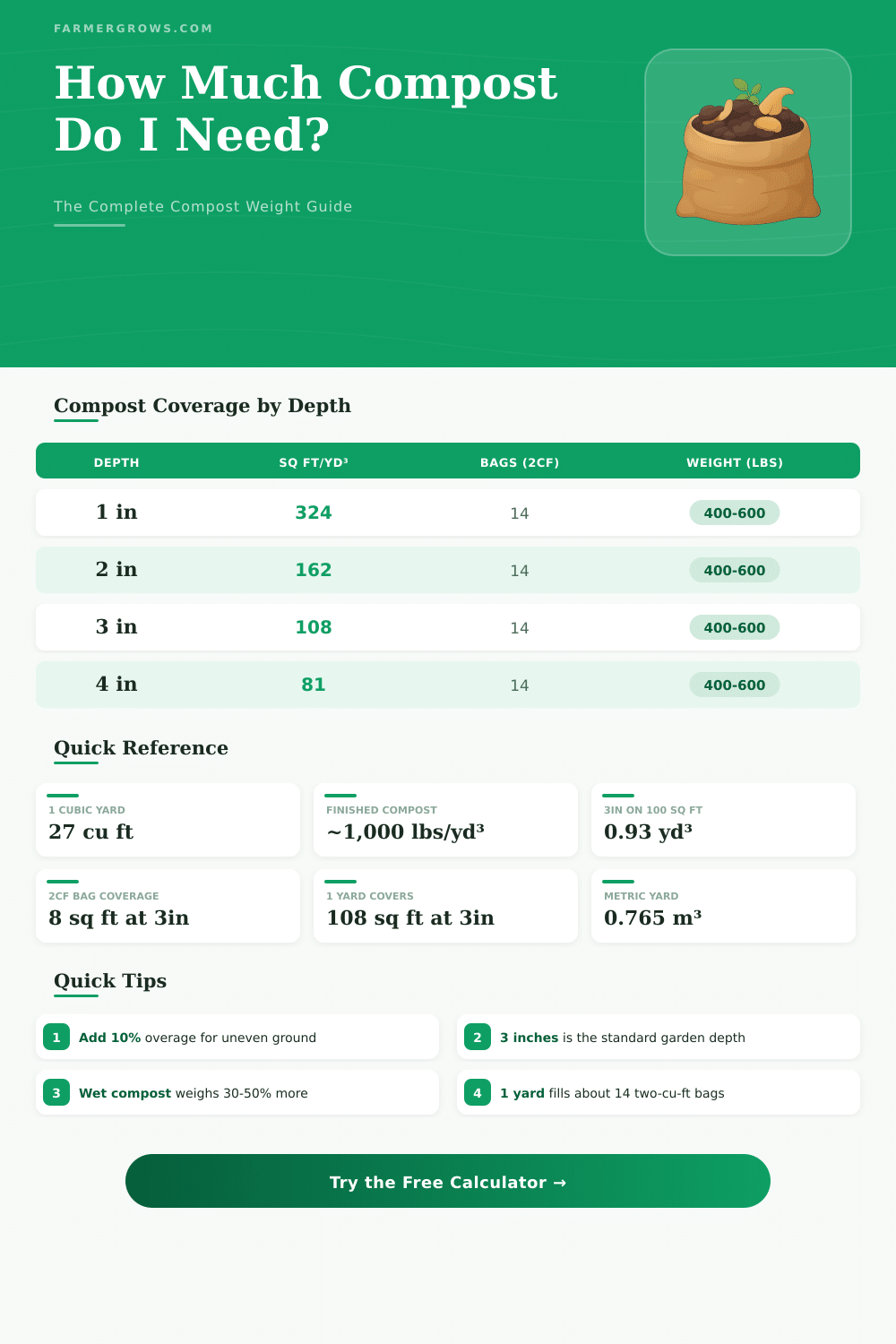
| Depth | Sq Ft / Yd³ | Sq M / Yd³ | Sq Ft / M³ |
|---|---|---|---|
| 1 in (2.5 cm) | 324 | 30.1 | 423.5 |
| 2 in (5 cm) | 162 | 15.1 | 211.8 |
| 3 in (7.6 cm) | 108 | 10.0 | 141.2 |
| 4 in (10 cm) | 81 | 7.5 | 105.9 |
| 6 in (15 cm) | 54 | 5.0 | 70.6 |
| Bag Size | Volume per Bag | Bags per Yd³ | Coverage at 3 in |
|---|---|---|---|
| 1 cu ft (28.3 L) | 1.0 cu ft | 27 | 4 sq ft |
| 1.5 cu ft (42.5 L) | 1.5 cu ft | 18 | 6 sq ft |
| 2 cu ft (56.6 L) | 2.0 cu ft | 13.5 | 8 sq ft |
| 3 cu ft (85 L) | 3.0 cu ft | 9 | 12 sq ft |
| 40 lb bag (~0.75 cu ft) | 0.75 cu ft | 36 | 3 sq ft |
| Project | Area (sq ft) | Cubic Yards | 2 cu ft Bags |
|---|---|---|---|
| Small flower bed | 50 | 0.46 | 7 |
| Raised bed 4×8 | 32 | 0.30 | 5 |
| Garden border 4×25 | 100 | 0.93 | 13 |
| Veggie garden 15×15 | 225 | 2.08 | 29 |
| Side yard 10×30 | 300 | 2.78 | 38 |
| Large bed 20×30 | 600 | 5.56 | 75 |
| Full yard 50×50 | 2,500 | 23.15 | 313 |
compost is made up of a mix of various elements, that one uses as natural dressing to improve the physical, chemical and biological traits of the ground. It usually prepares from rotting plant residues and food wastes by means of recycling of organic stuff and animal dungs. Like this one receives nutrient rich material, that well answers for gardening.
One applies compost chiefly as addition to the soil, that provides nutrients to the plants, even so it can not replace the basic ground.
What is compost and how to make it
compost making is the controlled, oxygen-based biological breakdown of organic materials by means of tiny organisms. For that process does not lack oxygen, that is needed. Here organic materials mean carbon-based everything, for instance plants, leaves, garden waste, forest slices and food residues.
Straw, animal dungs and other usual wastes also can join to the mix.
compost making genuinely is the intended activity of collection of plant materials and allow them to age in time. After that time, one gets fresh soil. The decay itself is natural process, that works constantly in nature.
Because of it, natural places are not covered by crowds of old plant residues.
During germs work through the materials, they first attack the most easily broken parts. Later, the remaining particles become hardly able to scatter. When the germ activity gets stronger, it creates heat, and the temperature in the compost crowds quickly rise.
To produce compost, one requires air, water and good balance between carbon and nitrogen in the organic wastes. The common materials or ingredients include leaves, straw, plants and alike wooden items as barks or sawdust. Green and brown garden wastes, kitchen veggie slices, coffee grounds and egg shells all answer for the compost pile.
Plenty of brown materials, as cardboard and paper, help too control the smell.
compost bins come in different forms. Store-bought plastic bins keep everything together and allow access of air. Easy solution is bind four pallets together.
Bins from rot-proof cedar are quite big for veggie residues, lawn slices and leaves. Bins with sides, turning cover and panels that open below help to keep creatures away from the raw material.
compost making well helps to reduce waste and care about the health of gardens. It also offers a green replacement for chemical dressings. If one applies compost regularly, the germs grow and spread more.
Compost making promises to increase the water skill, restore the ground health and help the air purify. It also strengthens the structure of the ground, what matters, because many gardeners do not have ideal soil originally. Healthy soil forms the basic element to create a strong garden.
Through compost making, food residues, old newspapers, used paper towels and othercauses receive new life.