🧪 Fertilizer & Rust Scrap Calculator
Calculate exact coverage, volume, and weight for fertilizer treatments, iron-based rust removers, and soil amendments
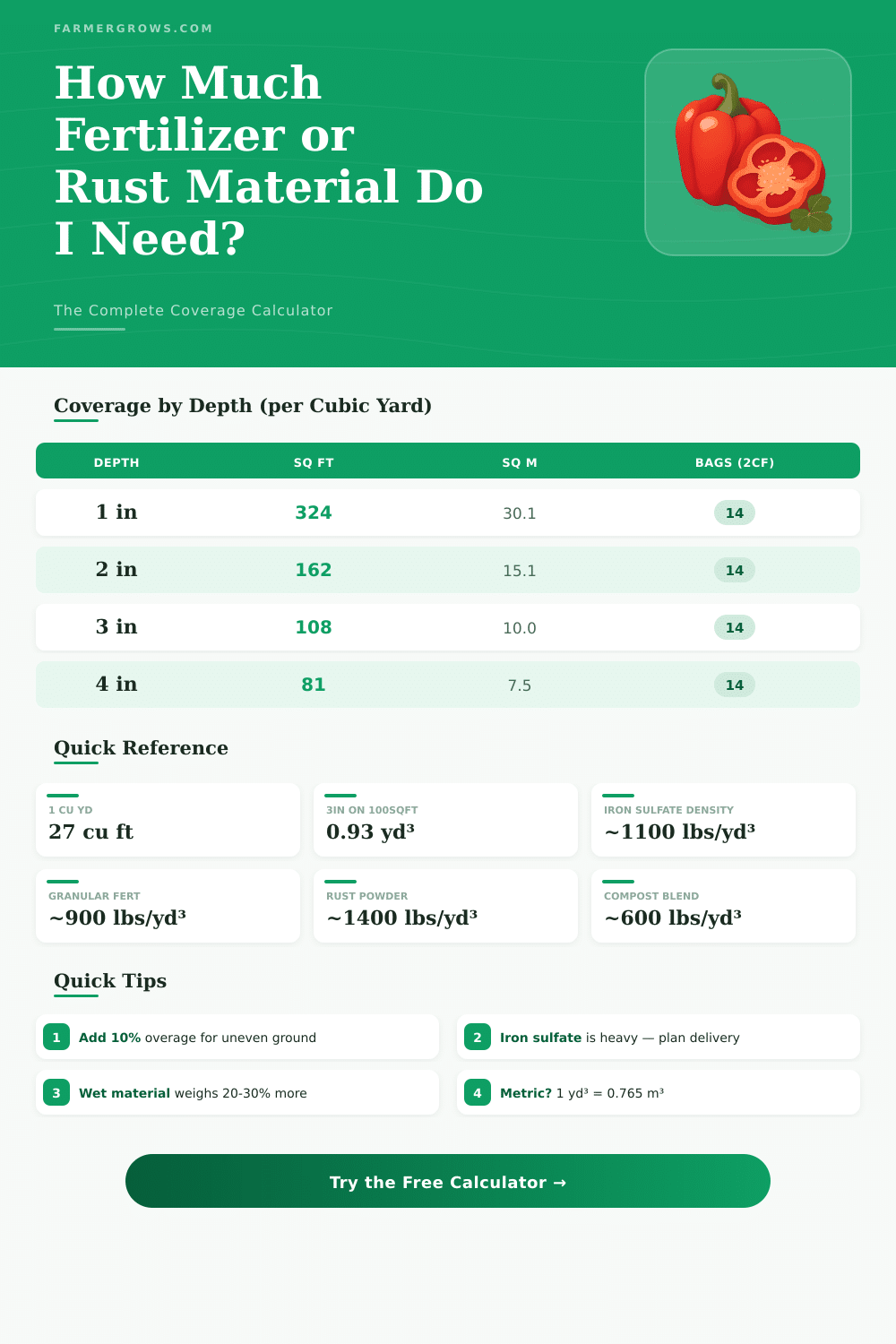
| Depth | Sq Ft Coverage | Sq M Coverage | Cu Ft per Sq Ft |
|---|---|---|---|
| 1 in (2.5 cm) | 324 sq ft | 30.1 m² | 0.083 |
| 2 in (5.1 cm) | 162 sq ft | 15.1 m² | 0.167 |
| 3 in (7.6 cm) | 108 sq ft | 10.0 m² | 0.250 |
| 4 in (10.2 cm) | 81 sq ft | 7.5 m² | 0.333 |
| 6 in (15.2 cm) | 54 sq ft | 5.0 m² | 0.500 |
| Bag Size | Volume per Bag | Bags per Yard | Coverage at 3 in |
|---|---|---|---|
| 2 cu ft bag | 2.0 cu ft (0.057 m³) | 13.5 bags | 8 sq ft (0.74 m²) |
| 3 cu ft bag | 3.0 cu ft (0.085 m³) | 9 bags | 12 sq ft (1.11 m²) |
| 40 lb bag (fert) | ~0.67 cu ft (0.019 m³) | ~40 bags | 2.7 sq ft (0.25 m²) |
| 50 lb bag (iron) | ~0.75 cu ft (0.021 m³) | ~36 bags | 3 sq ft (0.28 m²) |
| Project | Area | Cu Yards | Bags (2 cu ft) |
|---|---|---|---|
| Tree Ring | 36 sq ft (3.3 m²) | 0.33 yd³ | 5 bags |
| Small Bed | 100 sq ft (9.3 m²) | 0.93 yd³ | 13 bags |
| Garden Row | 200 sq ft (18.6 m²) | 1.85 yd³ | 25 bags |
| Medium Lawn | 900 sq ft (83.6 m²) | 8.33 yd³ | 113 bags |
| Full Yard | 2,500 sq ft (232.3 m²) | 23.15 yd³ | 313 bags |
| Large Field | 5,000 sq ft (464.5 m²) | 46.30 yd³ | 625 bags |
fertilizer is made up of any substance, whether natural or artificial, that when one uses it on soil or plant roots, delivers nourishment. Simply said it operates as food for plants. Like this it ensures the elements that plants require to grow and stay alive.
When soil lacks the right nourishment, plants hardly grow. Some soils have too little of what plants require, so fertilizer fills that gap.
What Fertilizer Is and How to Use It
In fertilizer there are three main elements: nitrogen, phosphorus and potassium, that one commonly shows as NPK. Nitrogen backs the whole growth and makes plants green, with thick leaves. Phosphorus leads the nourishment in plants to the right places.
Potassium forms strong, solid stems and cares about the general good state of plants. These are the three that most commonly lack in soil and so must receive additions for heatlhy growth of plants.
Every label of fertilizer shows three figures. They point to the percentage of nitrogen, phosphorus and potassium. For instance, a bag with mark 10-5-5 explains the share of every nourishment inside it.
A bag weighing 5 pounds of such 10-5-5 carries 0.5 pounds of nitrogen. One calls that simple system the grade of fertilizer. Balanced types, like 10-10-10 or 12-12-12, commonly are useful as fare choices.
When plant growth slows because of absence of one element, adding more others does not benefit. So it matters to adapt the share of fertilizer to the actual needs of the plant. A ratio of 3:1:2 works well for many species.
Also pH-level and temperature can control how much nourishment indeed reaches the plant.
fertilizer appears in various forms. One finds granules, powders, crystals and liquids. Granules usually dissolve in water after spreading.
A common way to use it is sowing, so simply scatter it above fields or meadows. Liquid form one can apply directly on plants. Regardless of the method, there always stays a part that is not fully used.
Organic kinds offer an alternative. They mostly require some weeks to work, rather than factory prepared. Worm droppings help to reduce the need of bought fertilizer.
Dug grasses operate as a fast, cheap supply of nitrogen, together with a bit of phosphorus and potassium. Compost delivers nourishment too.
Proper usage of fertilizer on meadows drives strong, thick grass and helps the surface recover after usage. Prices of fertilizer really disturb. Recently those of urea went up sharply.
Sellers mention supply problems andglobal changes, that leave little chance for price decline. Fertilizer itself is not bad, it counts as a good resource, when one applies it correctly.