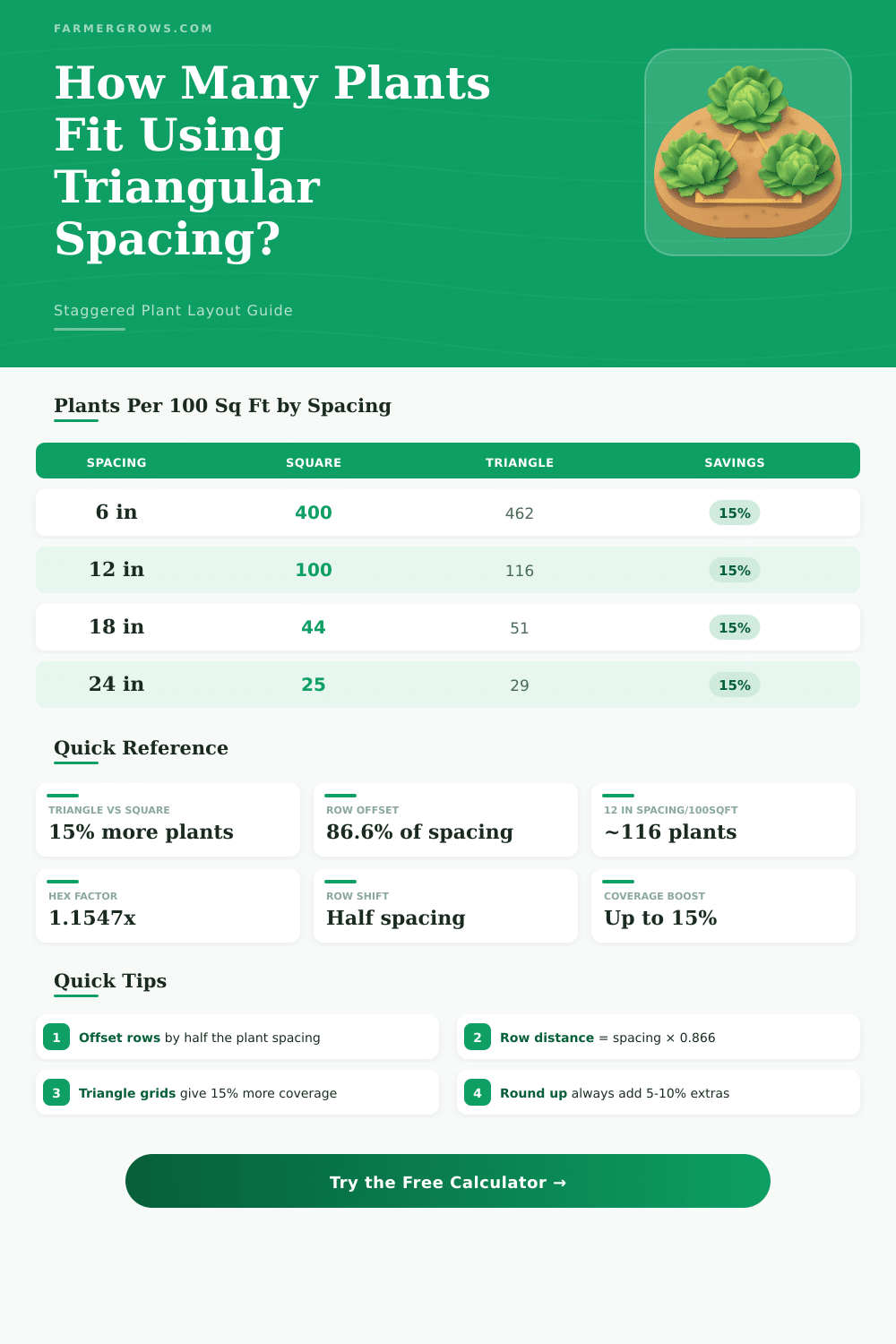
🌱 Triangular Plant Spacing Calculator
Calculate exact plant counts for staggered (offset) row layouts — fits 15% more plants than square grids
| Spacing | Square Grid (per 100 sq ft) | Triangular Grid (per 100 sq ft) | Extra Plants (%) |
|---|---|---|---|
| 4 in (10 cm) | 900 | 1,039 | +15.5% |
| 6 in (15 cm) | 400 | 462 | +15.5% |
| 8 in (20 cm) | 225 | 260 | +15.5% |
| 10 in (25 cm) | 144 | 166 | +15.3% |
| 12 in (30 cm) | 100 | 116 | +16.0% |
| 18 in (46 cm) | 44 | 51 | +15.9% |
| 24 in (61 cm) | 25 | 29 | +16.0% |
| 36 in (91 cm) | 11 | 13 | +18.2% |
| 48 in (122 cm) | 6.25 | 7.2 | +15.2% |
| Plant Spacing | Row Distance (×0.866) | Offset Per Row | Plants per 10 ft Row |
|---|---|---|---|
| 6 in (15 cm) | 5.2 in (13 cm) | 3 in (7.6 cm) | 20 |
| 8 in (20 cm) | 6.9 in (17.6 cm) | 4 in (10 cm) | 15 |
| 10 in (25 cm) | 8.7 in (22 cm) | 5 in (12.7 cm) | 12 |
| 12 in (30 cm) | 10.4 in (26.4 cm) | 6 in (15 cm) | 10 |
| 18 in (46 cm) | 15.6 in (39.6 cm) | 9 in (23 cm) | 7 |
| 24 in (61 cm) | 20.8 in (52.8 cm) | 12 in (30 cm) | 5 |
| 36 in (91 cm) | 31.2 in (79.2 cm) | 18 in (46 cm) | 4 |
| 48 in (122 cm) | 41.6 in (105.6 cm) | 24 in (61 cm) | 3 |
| Project | Area | Plants @ 12 in Tri | Plants @ 18 in Tri |
|---|---|---|---|
| Small Flower Bed | 25 sq ft (2.3 m²) | 29 | 13 |
| Garden Border | 50 sq ft (4.6 m²) | 58 | 26 |
| Medium Bed | 100 sq ft (9.3 m²) | 116 | 51 |
| Large Planting | 250 sq ft (23.2 m²) | 289 | 128 |
| Full Front Yard | 500 sq ft (46.5 m²) | 578 | 257 |
| Commercial Bed | 1,000 sq ft (92.9 m²) | 1,155 | 513 |
| Park Planting | 2,500 sq ft (232 m²) | 2,887 | 1,283 |
| Estate Landscape | 5,000 sq ft (465 m²) | 5,774 | 2,566 |
| Pack Size | Coverage @ 6 in Tri | Coverage @ 12 in Tri | Coverage @ 18 in Tri |
|---|---|---|---|
| 6-pack | 1.3 sq ft | 5.2 sq ft | 11.7 sq ft |
| 18-cell flat | 3.9 sq ft | 15.5 sq ft | 35.1 sq ft |
| 36-cell flat | 7.8 sq ft | 31.1 sq ft | 70.3 sq ft |
| 48-cell flat | 10.4 sq ft | 41.5 sq ft | 93.7 sq ft |
| 72-cell flat | 15.6 sq ft | 62.2 sq ft | 140.5 sq ft |
Triangular spacing packs roughly 15% more plants into the same area compared to a square grid, and from what Ive seen that 0.866 row multiplier is the number that makes it all work.
The info below does not come from any calculator or tool used on that page. They base on actual gardening experience, discussions in forums and shared experiences found through the net.
How to Space Plants in Your Garden
Good spacing of plants can seem hard cause, even so it is natural. If plants stand too closely one to the other, they fight for food, water and light. Too much density reduces the air flow, what causes humidity that helps funguses and bacteria spread.
The leaves stay wet for more time after rain or watering what expands the dangers of diseases as powdery mildew or wilting. Too tight arrangement limits also the roots growing, resulting in shallow or weak root systems.
Packets of seeds and labels of plants point precise distances. For tomatoes usually work 24 to 36 inches between them. Lettuce requires 8 to 12 inches.
Following those tips can push the garden half empty during weeks, with bare ground around while the children grow. That empty look commonly urges gardeners to plant too much or exceed the spacing. However the empty period is natural and passing.
Tips about spacing commonly show “from centre”. This wants to say, that the distance measures from the stem of one plant, not from the edge to edge of others. So, if label mentions six inches, every plant requires three inches of space at every side.
When flower-packet says to plant three feet apart, that usually implies, that the plant reaches three feet of width, hence one foot and half one leave at both sides of the roots.
For lasting plants, trees and bushes, too much density can become long problem, because it stays fixed for many years. Every species has its mature height and width. During planting one should consider that maturity.
For instance, if tree spreads itself in 15 feet, one leave about 7.5 feet of space at every side of the trunk.
Intensive planting is a liked method, that uses every available area. Plants arrange themselves more heavily, allowing leaves to touch for enclose more of them in less big ground. The idea is give to every plant only the needed place for roots and leaves, without gross space.
In three-inch distance, it is possible too lay even 16 plants in one square foot.
Various setups are possible for planting. In a grid one splits the ground in rows and spread the plants equally along each. Row planting allows more space between rows, but less between plants inside them.
Diagonal method, where every second row moves a bit, fits more plants in same area, while keeping the distance between centres. Triangular setup gives fuller look, even so keeps fit spacing.
Between rows usually book space for farming, as add compost or mulch. It helps also for walk easy. Many tips about row distance on seed packets think about big rural farms with tractors or machines.
In raised beds or small gardens, that extra space commonly does not need, and one can ignore it without danger.
For fences plant at 75 percent of the mature distance works well. Filling planting helps also. If bush will not reach its full size for some years, one can use lasting or alike plants to fill the spaces meanwhile.
For edible fences one lays them at around one metre, so about three feet, between each, so that they grow in their dense form without feeling of tightness.
Trees need much more of space. Six feet between trees are too little. Better work 10 to 12 feet for smaller trees, and 25 feet or more for canopy trees.
Evergreens range according to the species.
The centre of offered spacing range widely give good filling inside two years, if one cares well. Nearer setup fills more quickly. Broader distance is more saving, but requires more time.
Sometimes bigger amounts of products for area come from wise spacing, even in raised beds. Space for roots matters also. In water systems as NFT, one suggests around 20 inches for tomatoes, because roots can block the channels if one does it too heavily.
Less density for lettuce is other good effect. One plants six romaine lettuces in six to eight inches apart, later pulls every second toeat at small size, like this the rest have full 12 inches to grow big.