🌽 Corn Plant Spacing Calculator
Calculate seed population, row spacing, and plants per acre or hectare
seeds/56 lb bag
seeds per lb
seeds/bag
seeds per lb
seeds per lb
seeds per lb
seeds per lb
seeds per unit
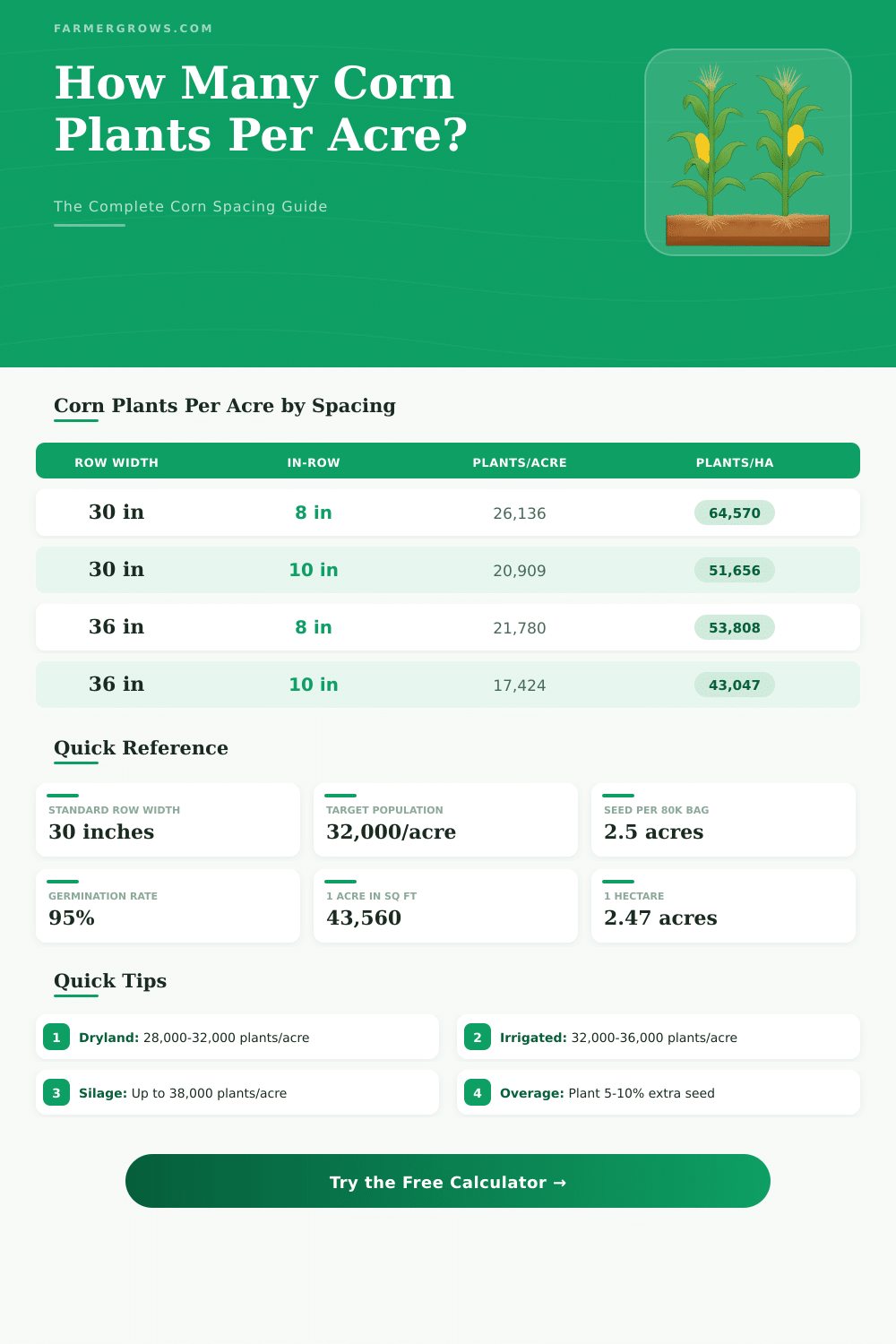
| Row Spacing | Plant Spacing | Plants/Acre | Plants/Hectare |
|---|---|---|---|
| 30 in (76 cm) | 6 in (15 cm) | 34,848 | 86,095 |
| 30 in (76 cm) | 7 in (18 cm) | 29,870 | 73,810 |
| 30 in (76 cm) | 8 in (20 cm) | 26,136 | 64,570 |
| 30 in (76 cm) | 10 in (25 cm) | 20,909 | 51,656 |
| 30 in (76 cm) | 12 in (30 cm) | 17,424 | 43,047 |
| 36 in (91 cm) | 8 in (20 cm) | 21,780 | 53,808 |
| 36 in (91 cm) | 10 in (25 cm) | 17,424 | 43,047 |
| 36 in (91 cm) | 12 in (30 cm) | 14,520 | 35,872 |
| 20 in (51 cm) | 8 in (20 cm) | 39,204 | 96,854 |
| 20 in (51 cm) | 6 in (15 cm) | 52,272 | 129,141 |
| Bag Size | Seeds per Bag | Coverage at 30″ rows, 8″ spacing | Acres per Bag |
|---|---|---|---|
| Standard (80k) | 80,000 | ~3.06 acres | 3.06 |
| Mini Bag (40k) | 40,000 | ~1.53 acres | 1.53 |
| Large Bag (100k) | 100,000 | ~3.83 acres | 3.83 |
| Bulk (1 unit = 80k) | 80,000 | ~3.06 acres | 3.06 |
| Sweet Corn (1 lb) | ~5,500 | ~0.21 acres | 0.21 |
| Sweet Corn (5 lb) | ~27,500 | ~1.05 acres | 1.05 |
| Project | Area (sq ft) | Plants at 30″/8″ | Seeds Needed (+10%) |
|---|---|---|---|
| Small Garden 10×20 | 200 | 120 | 132 |
| Backyard Plot 25×50 | 1,250 | 750 | 825 |
| Half Acre | 21,780 | 13,068 | 14,375 |
| 1 Acre | 43,560 | 26,136 | 28,750 |
| 5 Acres | 217,800 | 130,680 | 143,748 |
| 10 Acres | 435,600 | 261,360 | 287,496 |
| Quarter Section (160 ac) | 6,969,600 | 4,181,760 | 4,599,936 |
At 30 inch rows with 8 inch plant spacing youre looking at roughly 26,000 plants per acre. Bump to 36 inch rows and that drops to about 21,780. I kept running into 32,000 as the target for irrigated fields, which means tighter 7 inch spacing on 30 inch rows gets you there.
Real knowledge and discussions in communities, that spread through different forums and pages on the net form the content here. No machine for count or translate.
How to care for a corn plant
The corn plant (Dracaena fragrans or Dracaena massangeana, depending on who one asks) comes from tropical Africa and belongs to the asparagus family. It is a large evergreen plant, that became very liked as a house plant through United States and other lands, although it comes from warm climates. The name “corn plant” comes from a pretty simple reason: the leaves genuinely look like leaves of corn, which one notices, when one first sees such plant.
One finds those plants in two separate forms: tree form and cane variant. The cane species has slim trunk covered by bark, with all leaves grouped up, which gives it an entirely different look. The leaves themselves are long and narrow, in dark green, with that distinctive lime-green strip along the center, that makes them immediately recognizable.
In its natural surroundings outside, they can grow up to 30 feet or even more. When one grows them indoors, they usually raech around 7 to 10 feet. There even exist confirmed cases, where one of them reached almost 15 feet after nine years in a home.
This plant genuinely is among the easiest for beginners. They do not require a lot. Almost every soil works, unless it is too full of peat.
More serious is the watering; those plants like to stay almost entirely dry between the sessions. They do not require water weekly; rather, that commonly causes trouble quickly. Too much water leads directly too rot of roots, so if something seems weird, check the roots when you have time.
If one catches the problem early, one can remove the dead parts, replant in fresh soil with good drainage and revive it.
It is most normal, that bottom leaves become yellow and later fall, as the plant matures. Brown tips on leaves? Usually that simply shows, that the plant thirsts.
Marks on leaves appear commonly and genuinely do not deserve big attention. Those plants like light, but direct sunshine does not suit them. They grow better in a slightly shady place, away from strong rays through a window.
Turning the plant weekly helps, so that everything receives equal light. A window facing south can become too strong during summer, although some plants adapt to that over time.
Pruning does not require special tools. Simply choose, where you want to cut the plant, and cut cleanly through the stem under a node, here, where leaves or shoots attach to it. Refreshing the root system by half and adding new soil can help growth, but new leaves or shoots commonly require time to appear after such work.
Surprisingly, corn plants indeed can flower. Many folks do not expect that. Removing the flowers will not change anything.
The flowers maybe will not appear before seven or eight years, sometimes evenmore late.