🌿 Cubic Yard Mulch Calculator
Calculate exactly how much mulch you need in cubic yards, bags, and weight
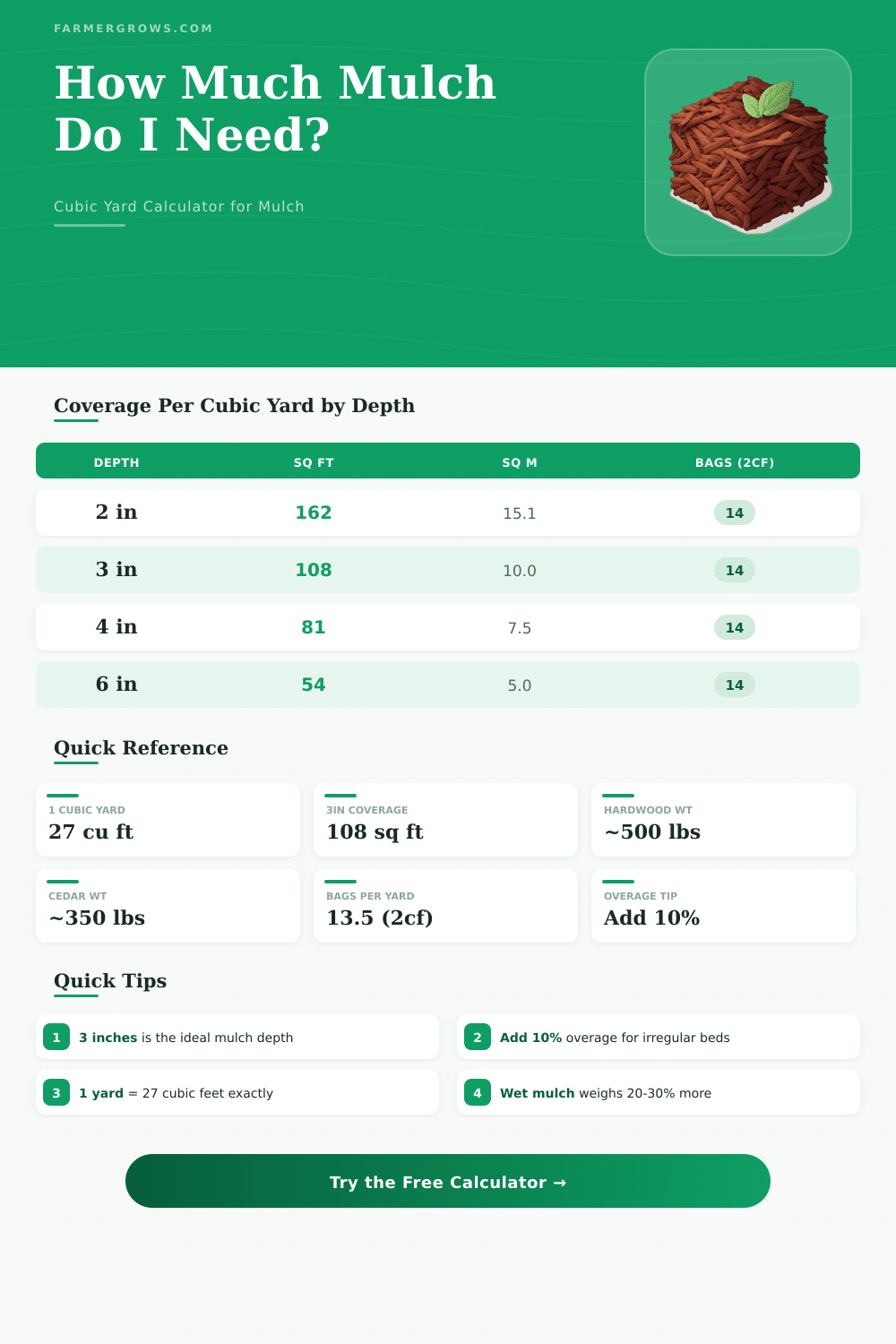
| Depth | Sq Ft / Yd³ | Sq M / m³ | Metric Depth |
|---|---|---|---|
| 1 in | 324 | 30.1 | 2.5 cm |
| 2 in | 162 | 15.1 | 5.1 cm |
| 3 in | 108 | 10.0 | 7.6 cm |
| 4 in | 81 | 7.5 | 10.2 cm |
| 6 in | 54 | 5.0 | 15.2 cm |
| Bag Size | Volume / Bag | Bags per Yd³ | Coverage at 3 in |
|---|---|---|---|
| 2 cu ft bag | 2 cu ft (0.057 m³) | 13.5 | 8 sq ft (0.74 m²) |
| 3 cu ft bag | 3 cu ft (0.085 m³) | 9 | 12 sq ft (1.11 m²) |
| Project | Area | Cubic Yards | 2 cu ft Bags |
|---|---|---|---|
| Small tree ring | 28 sq ft (2.6 m²) | 0.26 | 4 |
| Small flower bed | 40 sq ft (3.7 m²) | 0.37 | 5 |
| Medium garden bed | 200 sq ft (18.6 m²) | 1.85 | 25 |
| Large landscape bed | 500 sq ft (46.5 m²) | 4.63 | 63 |
| Front yard beds | 625 sq ft (58.1 m²) | 5.79 | 79 |
| Full yard | 1,000 sq ft (92.9 m²) | 9.26 | 125 |
| Large property | 2,500 sq ft (232.3 m²) | 23.15 | 313 |
| Commercial lot | 5,000 sq ft (464.5 m²) | 46.30 | 625 |
One cubic yard of mulch can seem like a big crowd, even so it actual covers only 108 square feet at three inches thickness. That kind of detail commonly surprises many gardeners. If you shrink it to two inches, then it covers 162 square feet but the most many landscape specialists that I talked to, advocate a minimum of three inches for well stopping unwanted grasses.
Expand to four inches, and the covering limits to only 81 square feet each yard. Almost half of what the more lightweight layer fits.
Mulch: How Much to Use and Why It Helps
mulch from hard wood usually weighs around 500 pounds each cubic yard, sometimes even 600, when it is a bit damp. Pine straw, on the other hand, is much more lightweight, between 150 and 250 pounds each yard. For a small area of 500 square feet at three inches, I counted around 4.6 yards; so I would advise roudning upward to 5, with a little buffer of 10 percent for uneven banks and edges, what the most many suppliers already consider.
For a space of 1 000 square feet, you require more than 9 yards, what is not small, probably around 4 500 pounds of hard wood, if you choose that type. Passing to metric units, one cubic yard matches 0.76 cubic metre, and those 108 square feet at three inches result in just more than 10 square metres.
The following details do not come from a calculator or converter. They are based on real experience, forum talks and opinions from the big gardening community.
mulch is made up of any material that you lay on top of the ground in a garden or landscape, it can be organic or inorganic, natural or fake. Organic mulch, like wood chips, straw, compost, grass clippings or leaves, breaks down over time and does feed the soil. One can use a chipper, shredder or automatic leaf mulcher too prepare own home mulch.
The common idea of landscape mulch is to copy the natural woods. In woods, various chips, leaves, stems and branches pile up on the ground and protect the soil. In our yard or garden, we must ourselves add that organic covering.
mulch does many positive things. It helps to keep moisture in the soil, so that water does not dry out that quickly. It protects against rain impact, which stops erosion.
Mulch blocks unwanted grasses, temperature swings and helps as a visible mark to keep mowers and blades away from the garden areas. Of course, it gives any landscape a cleaner, finished look, that truly ties the whole thing together. Mulch comes in all colours, from deep reds to rich blacks, so you can match it to the style of you’re yard.
Mulching around trees ranks among the most useful things for their health. Even so, one must escape too much mulch, the layer should not be too thick. Good organic mulch is hardly wrong used, if you keep it to around three inches.
Simply do not pile it right at the main trunk, because plants and germs need oxygen exchange.
While mulch breaks down over time, it adds organic matter to the soil, but itself does not become soil. Decay happens more quickly on the surface, where oxygen is plenty, and germs do the main work. If you mulch well, you maybe even can skip regular feeding, except casual nitrogen boosters like blood meal, manure or worm castings.
Even so, one must watch green, fresh materials. For instance, piling fresh cut grass can create sudden heat. I heard even about young veggie plants that cooked, when some used fresh grass to protect them against cold.
Stay with brown, woody mulch types, and you will escape such problems.
mulch also settles well in shady places, where grass hardly grows. Instead of fighting a hopeless struggle with the lawn, you can replace it with mulch and shade-loving plants, like rhododendrons. A little more care, and you win flowers too.
Buying mulch from a landscape supplier in big amount is more cheap than bags from a store, even with delivery or renting a truck, you spare a lot compared to processed options. Moreover, turning a gravel yard into a mulch area makesthe whole thing a lot fresher, because it lowers the heat that builds up in the ground.