
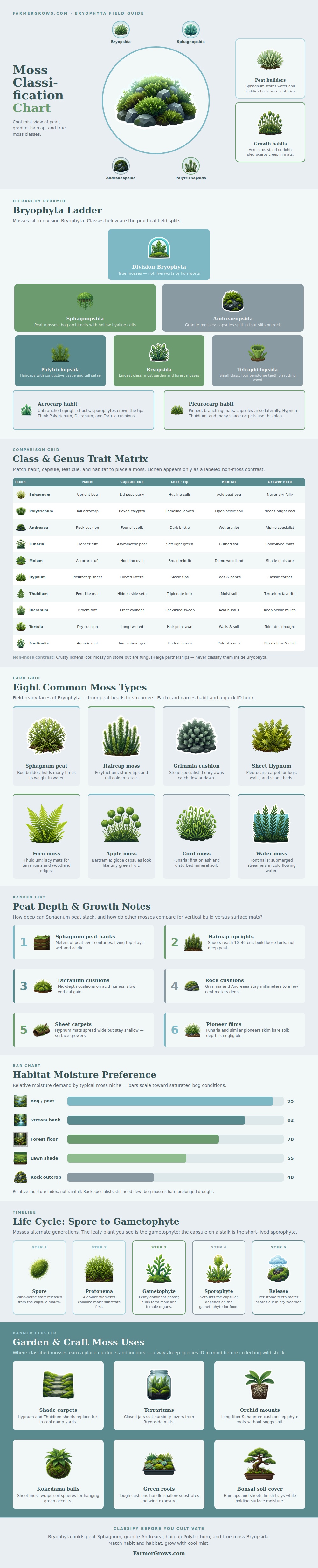
The moss itself has all kinds of survival strategies. Moss isn’t just this flat plain of green across a wall, for instance; it’s actualy a colony of plants. It is a carpet. But it is not just any old kind of plant. There are various types of mosses (as the chart indicates). They belong to various divisions. This is why I say it is not just one thing called “moss,” but rather division Bryophyta. Within that division, there are also various class. Each class behave differently, grows in specific places, and needs special care. Knowing these things will help you manage your moss, whether you want to grow more or get rid of it.
The second distinction is whether the moss is creeping or upright. Why does this matter? It shows what form the moss take when building itself. Creeping Moss (pleurocarp) grows sideways, sending out shoots in search of sunlight; its capsules forms on the sides. Upright Moss (acrocarpus) grows straight upward, with capsules forming right at the top. The moss resembles a little broom. Which one do you have? Look for the capsule. Is it on the end of the stem? It is an acrocarp. Is it on the side? It is a pleurocarp. This will get your guess right most of the time.
How to Tell Moss Types Apart
These are mosses. But some are generalists: they’ll colonize any substrate from stone to bark to soil. Others are picky. Some mosses grows only on specific types of rock or only in the shade.
Then there’s a special group called Sphagnopsida, which are commonly called peat mosses. Sphagnopsida, commonly known as peat moss, is a type of bog architect. The mosses create an environment other plants can’t endure. By trapping and holding so much water (many times its own weight), they slow-acidify surrounding soil. Eventually, you have a very different kind of environment. This is not suitable for Sphagnum growing in dry, alkaline ground. No way. It want cool mist and wet conditions. Want to try forcing peat moss to grow in your dry rock garden? Fat chance. Granite moss wants acid-faced rocks. Rich, moist compost? Rot city.
Moss isn’t like seed plants in their life cycle. Most of the time it’s dominated by leafy, green moss (the gametophyte). It’s independent. It makes its own food through photosynthesis. The capsule and stalk are the sporophyte. It’s short-lived. It live off the parent plant. This alternation of generations is what makes mosses different than seed plants. The sporophyte doesn’t live long but produces spores that gets carried away on the wind. This starts the cycle anew. Sometimes you will have a healthy mat of moss one year, then no moss the following year. The moss may be completing its cycle of reproduction.
Match the moss to the microclimate, what it wants. For instance, Hypnum (above) and Thuidium are good for shady walks. They will spread out, horizontally. They’ll take some light foot traffic. They form dense mats that keep weeds down. Don’t mow them! Haircap moss, called Polytrichum, is taller. It adds vertical interest. Requires cooler conditions; likes brighter light. Cannot take summer heat. The chart compares those characteristics. It links habitat with habit. It makes an informed choice possible. Doesn’t require that you be a botanist. Just watch where things want to grow.
Moss: People call it a weed. A pioneer, more like. Colonizes bare soil. Stabilizes surfaces. Something grass just can’t do. Are they uprights (brooms) or carpets that creep? Know the difference. You have a new way to look at nature. The next time you notice green patches, look closer. It might be a pioneer waiting for rain. It might be a rock climber. It might be a peat builder. Pay attention to details; they matters.