
Whatever happened? You had such great intentions. You purchased that gorgeous fiddle leaf fig because it was statement piece in a magazine. Or, you thought it would die if you didn’t water it. And then, you did, and here it is now, a yellowing sad thing, and you wonder: What did I do wrong?
The answer isn’t usually neglect; it’s overcare. The most common cause of indoor plant distress are not that we forgot to water them; it’s that we love them, too closely, too wetly, and too much.
Why Your Plants Are Getting Sick
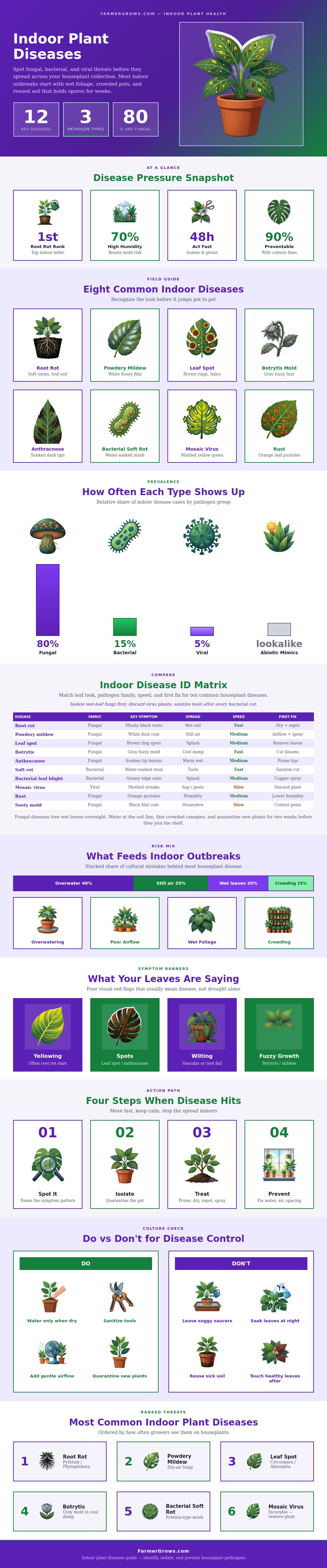
This visual breakdown (above) of what’s really happening with indoor plants is surprisingly harsh, but also super helpful. Turns out most problems fall into one category: fungus.
Why does that matter? Because when your plant get sick, your first impulse is likely to feed it, or water it; thinking it’s thirsty or hungry. That’s where humans go wrong. Moisture is fuel for fungi. When you’re battling some sort of fungal problem and then add more water, you might as well be adding gasoline to a small fire.
You’ll learn from this chart that the number one cause of houseplant death are root rot. It isn’t a flashy thing; instead, it’s slow, silent suffocation. When soil remains soaked for long periods, the roots can’t breathe, they start to rot, and the plant loses its ability to take up food. Leaves turn yellow not because they’re thirsty, but because the plumbing have failed.
Knowing what’s what; virus versus fungus versus bacteria, shifts the strategy for tackling a diseased plant. For instance, fungi can usually be tackled in time, such as with powdery mildew. Fungi can usually be tackled in time (like powdery mildew or leaf spot). You can do this with careful pruning by removing the affected leaves, improving airflow throughout canopy, and letting the planting area thoroughy dry out before watering again.
But what about bacterial soft rot? That turns plant parts watery and smelly and then mushy, and once inside the plant it’s very difficult to stop. Bacteria entering through the plant’s vascular system can mean there’s no going back. You have to cut off the bad part, or perhaps the whole plant if the infection runs deep.
Viruses (like mosaic virus) are the bad news; they don’t go away, is super-easy to spread (in sap, on tools), and incurable. Isolation and sanitation are top strategies, as shown in the graphic above. However, if you think you have a virus, it is best of simply get rid of the plant to save others from the same fate.
Most of these conditions are under your control as an environmental factor. The chart indicates that the perfect storm for any pathogen is crowding, extra moisture from too much watering, poor air circulation, or wet foliage. How does it compare with your home situation? Do you have your plants crowded onto a windowsill? Are you watering them from above and leaving their leaves damp all night long? All those little things adds up. A room with high humidity (whether closed up or not) will increase the potential for mold considerabely.
Surprisingly, the cure is to allow the soil to dry between waterings; to separate the pots to improve airflow around them; to stop misting your plants (popular, but generally promotes fungal leaf growth).
The thing with disease: Panic doesn’t help. Better to take a systemic approach. Know the pattern of symptoms first. Is it yellowing leaves (root rot?)? Is it a white dust-like film on foliage (powdery mildew?)? Or is it sunken dark tips (anthracnose?)?
Then isolate the pot ASAP once you know what’s wrong; don’t wait to see whether it jumps to another one. Next, treat the plant by pruning off damaged bits, letting it dry between waterings, and maybe even repotting if needed. And last: Prevent recurrence by correcting your watering routine, and/or adjusting space around each plant so air can circulate.
Wanting perfectly healthy plants isn’t the point. The goal is not to have perfect plants, but to have healthy ones. But don’t forget: they’re resilient. If treated properly, they’ll bounce back from disease, pests, and stress.
How do you know what’s wrong? Read the signs of their leaves. Yes, those are living organisms. They want you to treat them as such and create an environment for balance.
What does that mean? Treat it like an organism, not a diva. Give it what it needs. Often doing less (not more) is the best cure. Let the plant breathe. Let the air circulate. Let the soil dry. Then manage the diseases.
And then you’ll see: being a slave to the watering can wouldn’t of been necessary.