
Sunlight is a binary switch most gardeners think. Six hours of direct sun are just right; four will do for lettuce; six is best for tomatoes. But such thinking overlooks physics of light. It simplifies the complex exchange into a crude assessment of time.
Forget what clock says; plants don’t care about that. They care about photons. About how much usable light energy they can absorbs in course of daylong exposure to it, from dawn to dusk. The transition from time to energy are the difference between a surviving garden and a realy thriving one.
Stop Counting Sun Hours
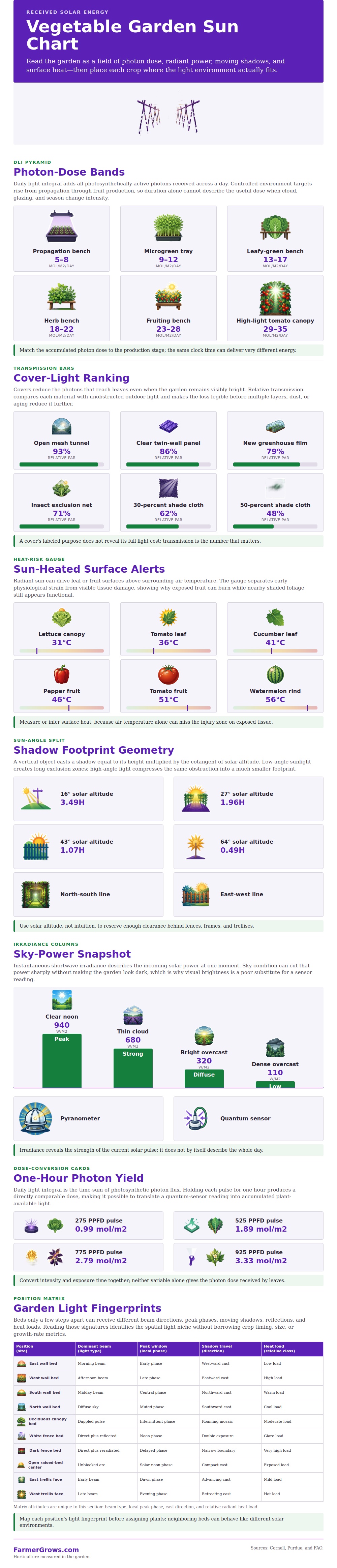
This is what that means: The breakdown above explain this concept using something called the daily light integral. That’s the total number of photosynthetically active photons a plant is exposed to each day. Why does that matter? Because daylight intensity vary wildly due to seasonal angles, clouds, and yes, even color of your shade cloth.
You may have a long day, but low intensity. Think about it this way: Tomato plants in late fall get 10 hours of sun. But if it’s a weak day, they will collect less energy than a head of lettuce that gets only four hours of super-strong midsummer light.
Different growth stages also needs different doses; see pyramid in the visual. Propagation trays don’t need as much cumulative energy as fruiting crops. Understand that, and you’ll understand why seedling grown indoors tend to go leggy. They typically get enough hours… But not enough power.
Light conditions vary based off structures as well. Greenhouse films and other shade cloths is popular with many gardeners. Think that’s just heat I’m getting rid of? Yes, but it’s also filtering certain wavelengths. It cuts the usable light dramaticly.
Look at the chart; the relative transmission rates are highlighted. Even a basic shade cloth reduce available light by almost half. That’s what most folks don’t see. They look around and notice things aren’t as bright. They figure, oh, sure, I’ve got some energy here. But the plants is starving. It is in plain sight.
An ordinary cover marked “30 percent shading” are going to diminish the photon count greatly, slowing down fruit production without leaving a visible leaf-level clue that anything amiss has happened.
And then there’s heat. Heat is something people often confuse with light intensity. But you can have a very bright surface that’s cool, or an extremely hot one that’s dim. The heat-risk gauge in the graphic divides air temp from surface temp, and what it shows is how easy it is for exposed fruit to get cooked while the ambient air is mild. A watermelon rind can reach temperatures that cook eggs even while the air around it is comfy.
This explains how easily fruit sunscald occur in July. You’re not simply dealing with light. You’re dealing with wild variations in radiant heat load on a patch of bare ground vs. It is a wall in the shade. The visual maps these microclimate: An east-facing bed will be cooler than a west-facing wall (which retains heat).
Shadows are another villain in the failed garden plot. Guessing about where they fall is what we do, right? Sun follows a different kind of geometry each season, so a tall fence that throws a brief shadow in June can make a long no-zone in March. In fact, as the solar angle section explains, low winter sun will cast a shadow many times bigger than the object’s actual size, effectively killing off any planting space that appears open on an after-summer-afternoon stroll.
By checking the sun’s angle instead of your gut, you should of know to save enough space for when fences and trellises goes up.
Growing vegetables isn’t as much about keeping to a calendar as it is learning to read the light pattern of your own yard. Your beds all has different mixes of how the light shines in or doesn’t. They also have different shadow length and different levels of heat.
Once you stop counting hours and think instead about real-time temperature and how much light hits any spot, you’ll know exactly where to put each crop. The light doesn’t happen to the garden; it’s the ultimate tool for shaping it.