
Your plant’s ability to get nutrients depends on soil pH. When tomatoes goes limp and stunt, most of us think “bad seed” or “pests.” More likely: wrong soil chemistry. Knowing what those numbers mean makes the difference between a decent crop and a great one.
Soil is a complex system full of chemistry; think of it that way. Think of your sample as a snapshot of what’s happening in the soil where roots is growing. How you take that snapshot, your sampling method (is step one).
How to Check and Fix Soil pH
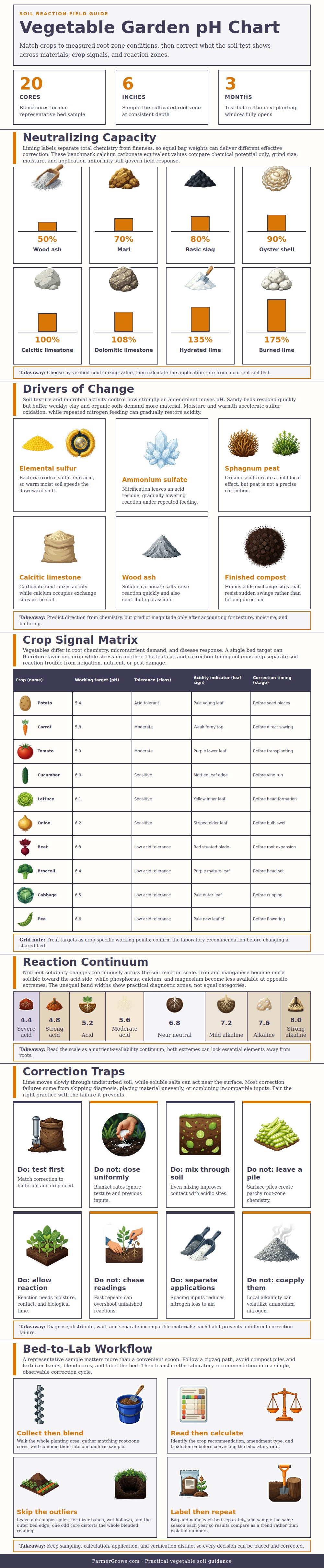
Scooping up a sample from handy compost-rich spots skews result. Zigzag across the whole bed instead. Walk in a straight line, collect cores from a uniform depth, and combine them all into one mix. Sounds tiresome, but one off-core can throw results. Then you go amend soil that doesn’t really need it.
But wait: What happens when you get your lab results? Now is where the rubber meets the road. That number you’re looking at? It represents half the story. Soils fall somewhere on this continuum of soil reaction. Phosphorus can precipitate out of reach (on the alkaline side), while other micronutrients such as iron become all-to-soluble (on the acidic end).
Want proof? Why do tomatoes sometimes have purple lower leaves even after you add some bone meal? Because the pH was too high, the roots couldn’t reach the phosphorus. Too-acidic soils can burns young foliage with excess manganese, too.
Adjusting soil composition takes time. To many gardeners’ surprise, broadcasting lime or sulfur evenly across garden is actualy a recipe for failure; you have to mix it in instead of just piling it on the surface. It is a recipe for failure. Lime is slow to move in undisturbed soil. Over months, it will react with biological activity and moisture. When piled on top of surface, you’ll have patchy chemistry. You need to incorporates it.
Besides, which kind? Dolomitic limestone can be more powerful per pound different than calcitic limestone, whose base neutralizing value is good. Guessing what rate to apply from general instructions on a bag of wrong stuff is another no-no; it’s like taking the wrong dose of medication.
The best soil pH are not the same for all veggies. For example, potatoes like it slightly on the acid side (about 5.4), which reduces risk of certain scabs, while lettuce/cabbage likes things more neutral toward 6.5 to 6.8. Growing multiple crop in a single bed, at the same pH, can stress some. Separate beds and crop rotation make sense as practical necessities for nutrient management.
Treat soil amendments as slow-acting tools. “Bacterial oxidation” gradually reduces pH (soil acidity) using elemental sulfur. Soil must be warm and moist for it to do its job. To raise pH (neutralize acid), add lime; it must come in contact with soil particles. Don’t expect results overnight… None of this stuff happens fast. You should of waited too. Test again too early post-application, and you’ll get a false reading because the chemistry hasn’t balanced out.
It’s not about getting precisely on target each year but creating an environment that stabilizes so plants can thrive. Gardening success depends on knowing what’s happening in the soil, its chemistry. The language of leaves (color clues); can turn chance into strategy. Be mindful of your amendments’ own makeup. Take samples seriously, and use them for accurate data. Your plants are speaking to you, telling you what they need. Learn to read their language.