
Last year you think maybe you had rotated, since you transplanted your tomatoes into what was previously the bean row. Phew, progress! That is the correct instinct. But guess what? In most cases, it’s still not good enough.
Here’s why: You didn’t transplant the disease… No, you simply didn’t move the plants. Most garden rotation plans fail because boundaries are broken, not because there is no diagram. If you replace one crop with something in the same botanical family, you haven’t broken the disease cycle; you’ve merely assigned the same pests a new name tag. People messes up on this point.
Rotate Plant Families, Not Just Crops
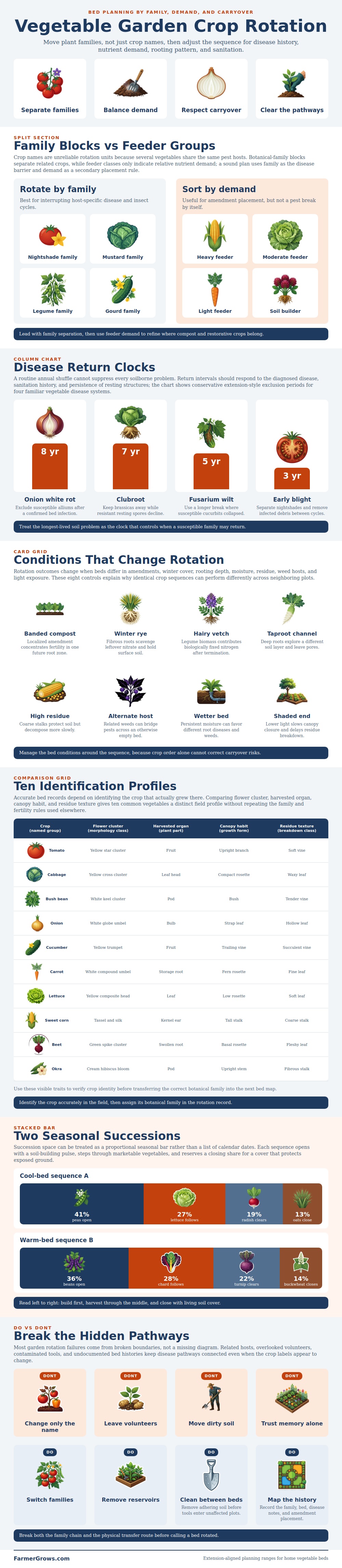
To break it down further (and make things more complicated), below I focus not just on the name of the crop, but its botanical family. That is an important detail with big consequences. Each of these botanical families has distinctive profiles when it comes to pests and diseases, regardless of what vegetable you call them. For instance, a plant in the nightshade family, mustard family, gourd family or legume family has certain disease and pest profile, and you’d be wasting time calling those plants different names. When you garden, you don’t want to grow potatoes in one bed and then peppers in another; likewise, a bed that had tomatoes last year should never get eggplant next year. Thinking you’re being clever by rotating crops one year at a time are exactly the wrong approach.
To defeat disease and keep your soil happy, rotate whole families of plant. Use the family as your disease barrier. Then you can adjust your plan based off the amount of nutrients needed. Onions is forgiving light-feeders; corn, cabbage and such require richer soil. But without separating those plant families first, the nutrient ratio won’t help: the root rot will be lying in wait anyway.
Here’s where I’ll insert the other secret part that few casual gardeners know: It’s also about sanitation. Even if you plan the perfect rotation, and get it wrong, if you don’t break the chain of how diseases travel physically you will fail. Pull out those volunteer seedlings that sprout here and there which are reminders of last year‘s beets, carrots, potatoes, or whatever else was left behind. Clean your tools from one bed to the next. Record which crops actualy did grow in which place (not just what you wish had grown). That’s why the infographic points to these do and don’t lists. Spores are moved on dirty trowels. Rotting beet tops holds fungi. Remembering isn’t good enough; you want a map. If you can’t prove you cleaned the bed, then you didn’t clean it.
Success depends hugely on timing. Shuffling around your crops year after year doesn’t mean all of your soil issues dissapears. Many diseases has long memories. For example, onion white rot can last up to eight years. Brassica clubroot can wait seven. These aren’t made-up figures; they match the biological life of any resting spores lingering in the soil. The chart indicates longer-term periods of exclusion for such persistent troubles. Think of it this way: treat the longest-lived one as the clock to tell you when to replant that family again. Frustrating, I know. But true.
Adding lots of compost wouldn’t of help if you try to grow susceptible cucurbits in a bed where there was recently fusarium wilt. Not a good idea. Lastly, think about the condition of the bed. The effectiveness of a rotation varies according to moisture levels, whether amendments were applied, and if winter covers were added. Is it a high-residue covered bed? Does it have deep taproot channels? A shady corner hold moisture longer and decomposes more slowly. All these factors mean that two seemingly identical sequences on adjacent plots will produce different results. Work with the conditions surrounding the sequence.
First build the soil (cover crop such as vetch or peas); then grow vegetables; then close with a protective cover (such as buckwheat or oats). It’s a rhythm. Begin with a clean slate. Honor the family lines. Watch the soil come alive. Your garden will thank you.