
You have no plan and only seeds in your hand when you stand in your backyard. Then you have chaos, plants that baked in the sun; plants drowned in shade; plants confused altogether. A good planting strategy prevent that chaos. It makes the guessing game into a system.
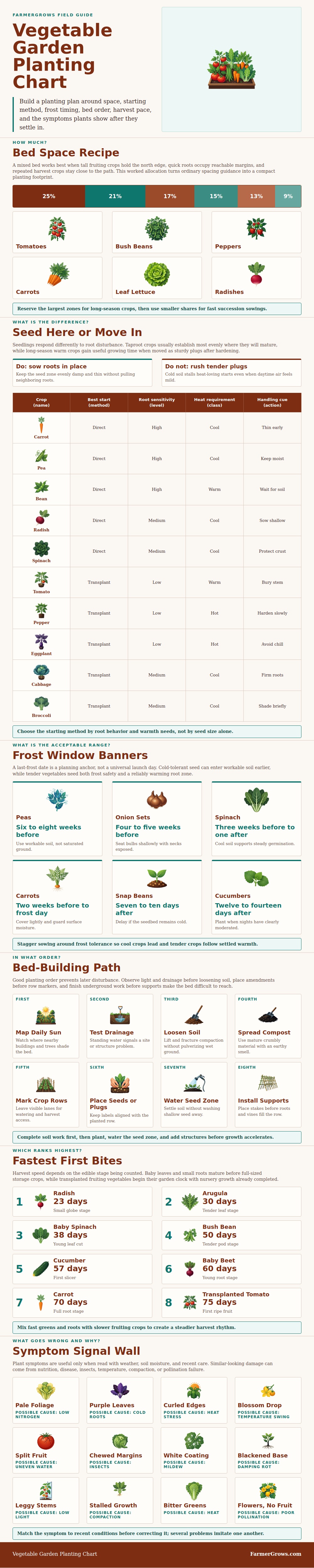
How do you allocate space in the bed? That’s step one of chart, above. Treat each square inch in your garden bed like real estate; make sure tall fruiting crops (peppers, tomatoes) goes on the north edge so they don’t cast shade on their shorter underlings. On the other hand, put your fast-growing leafy greens and roots right at the edges nearest you, things you plan to harvest before they flower and set seed, so you can get them with an outstretched arm. It is a little shift but it makes big difference in how you work day to day. After that, map the space and build the bed to match.
A Simple Plan for Your Garden
The sequence matter. The most common mistake: “People jump right to digging,” the infographic says. Here’s how to proceed deliberate. First: Map the sun. Next, test drainage because compost cannot fix a spot where water collect. Loosen the soil (don’t pulverize), and next break up compacted areas gently, soil that’s tight as a rock will strangle roots. Next: Work in the compost, mark your rows, and now sow.
Before the plants get big, set up the supports and stakes. You don’t want to be trying to hammer a stake into a planting of full-size tomato vine. Do the heavy work when area is still open to access.
Timing is also important. No need to wait for calendar to announce “spring.” Observe what the ground does instead. Spinach and other cool-season crops can handles early conditions; you can plant them weeks before last frost. You have to be patient with warm-season crops like beans and cucumbers, as they won’t go into ground until soil warms.
The chart spells it out: Sow in stages, which means a consistent harvest, not an all-or-nothing glut followed by a month-long drought. Stagger, and make a rhythm.
And then there are the transplanting and direct-sowing considerations: Radishes and carrots, for instance, has taproots; disturb these guys, and they’ll get all tangled up and grow stunted. Don’t move ’em; sow in place. Tomatoes, by contrast, is long-season crops that appreciates an early start in containers. Just be sure to harden them off. A familiar mistake is planting a tender seedling in cold ground which promptly halts progress.
Things don’t always go right no matter what we do, and then they appear wrong. The chart also has a handy primer on the symptoms of each plant. If something’s purple, it’s probably cold in its root zone; if leaves is pale, the plant is most likely lacking nitrogen. Take a breath: First check the weather. A rapid shift in temperatures can results in blossom drop that appears to be a disease, but isn’t, just a bit of temperature shock.
Knowing which symptom matches up with recent conditions will keep you from overdoing it with either pesticides or fertilizer, because the problem was the environment different than those products. It’s all about learning to observe.
It isn’t so much about controlling as it is about respecting the nature of gardening. Gardening are creating a system that responds to time, light, and soil. Read what your plants tell you, build the bed in the proper sequence, and honor their spacing, and suddenly gardening doesn’t feel like a chore. It’s just a string of little but-satisfying-successes. Begin with a good map, then let things fall into place naturaly.