
What’s wrong with this picture? Maybe you sowed a vegetable seed with high hopes, and then watched it emerge…and then marveled at why this seemingly healthy seedling now looks so tired, even though you’ve watered faithfully. This is one of gardening’s great frustrations.
Most often, it has nothing to do with sunlight. Or even seed quality. What’s wrong: The soil. Roots aren’t abstract, but an engineering project governed by chemistry and physics. How you treat your soil structure, and how you use water, change when you understand what roots wish to be.
How to Water Your Garden
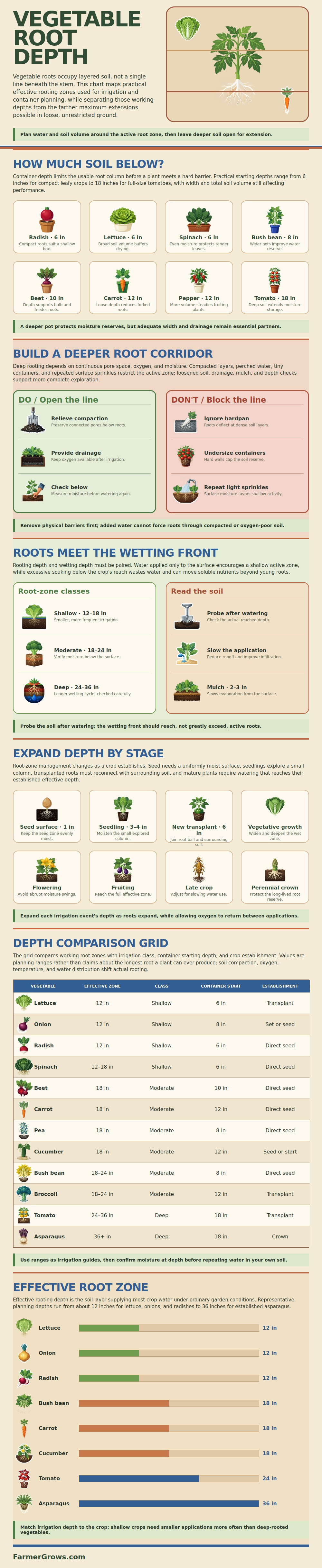
This is what that looks like graphed out as the visual guide to root zones. It shows the diffrence between the area actively used for drinking and the maximum depth roots could theoretically reach. Why does this matter? Because you want to irrigate based off the active zone.
Lettuce and other leafy greens, such as spinach, play the shallow game. They don’t require a foot of medium; just a couple of inches of steady hydration for happy foliage, and it use less water. On the opposite side of the equation are tomatoes, deep divers who require ample soil volume to hold moisture and fit growing fruit. You cannot expect a full-size tomato to perform well in a smallish pot. Sure, it might survive, but it won’t thrive.
The primary goal is to make a pathway for the roots to travel. A compacted clay won’t allow roots to punch through. Roots find the path of least resistance. And when you have a hardpan layer like eight inches down, those roots stops. Before planting it’s essential to loosen up that soil. You’re making the road for the roots.
Where does the road end? So does the journey. But so does how you water. If you’re giving things frequent light spritzes; keeping the soil moist on top; you are encouraging a shallow root system. A shallow root system dry out fast when it’s hot. Instead, water deeply and less frequently; force those roots downward. Reward depth with hydration and train your plants to be self-reliant.
As plants grow, their watering requirement change. You want a growing plant (like a seedling) to have moist soil on its surface; a plant that’s flowering want it wet down in the root-zone. As the chart illustrates, the area that gets the job done just keeps getting bigger. Overwatering your baby plants and underwatering your big girls is no good. It’s a waste of time… And money.
One thing that helps bridge those stages is mulch. Mulch prevents the surface from drying out. It allows roots to explore deeper. It buys you more time on hot days. Matching the watering and the depth of containers with their contents’ root needs create plant strength. Gardening is a practice of matching root needs with what’s above them. Begin with soil structure, match it with root depth, and the harvest will follow.
You should of started with better soil.