
One Tuesday, you buy fresh spinach and plan to eat it sometime before Friday. By Thursday, it’s all slimy and piled up in a heap. How annoying! But the blame doesn’t lie with your refrigerator, it typically lies with your lack of understanding about how to treat veggies: as if they’re all one thing.
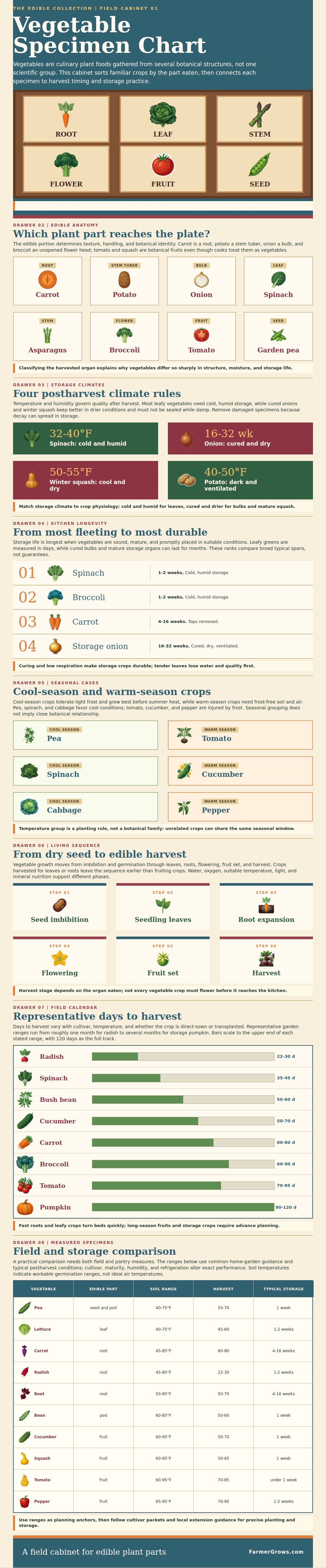
You treat them as if delicate leaves can be tossed together with sturdy roots, and everything should last just as long. It turns out that vegetables aren’t a single botanical family at all (a fact revealed in the vegetable chart). They’re a group of various parts of plants. And those parts needs to survive in their own ways.
How to Store Vegetables
How do you treat something when you know what part of the plant it’s from? That’s where it gets interesting. Broccoli is a flower head; a potato is a stem tuber; a carrot is a root. Knowing that grouping help us understand its texture and moisture content, and therefore its shelf life. A tomato may be a “vegetable” to the cook, but botanically speaking, it’s a fruit.
This isn’t just academic trivia; it also explains why a winter squash will keep in your pantry for months, and why a cucumber will wilt in days. If you examine the components of what’s being stored, the storage requirements make themselves clear: Spinach-type leafy greens require a cool and humid environment. Dry them out, and they’ll go bad rapidly; leave them wet, and they’ll lose moisture rapidy. Onions (and other such bulbs) want dry, but also well-ventilated. Put a moist onion into a plastic bag, and it will turn to soup. That split jumps off the page of this chart, which illustrates that dry-cool is protective for bulbs and hearty fruits, and cool-humid for leaves.
Take out any that are showing damage before you tuck them away, since things don’t improve in sealed quarters. The same is true with harvest time. Spinach and other leaf crops, or peas and any root crop, exit the growth race early: They don’t need to flower, after all, to become edible. More of the life cycle has to happen with those crops that bear fruit, like peppers and tomatoes.
That makes a big difference in how you plan your garden. When it comes to cool-season crops, they love springtime and can take some light frosts. These crops are ones you want planted before summer’s heat arrives. With warm-season crops, you want a frost-free environment in the soil and the air where they’ll live. Group your crops by season so you know what to plant when. This way, you won’t try to plant tomatoes in the chilly spring weather or peppers in midwinter.
When will the meal reach your plate? Some foods zip right to your table, going from seed to radish in about three weeks. Others take longer, like a pumpkin which can take up to four months. That is why timing matters. For fast-growing crops such as leaves and roots, you can plan to use the space again soon. For long-season items like pumpkins, prepare to wait.
You should of also plan ahead by marking your calendar months in advance. Spinach, sown every couple of weeks, provides a succession of greens. The other thing that impacts how well things will grow is the temperature of the soil. Warm-season things requires some heat to get going and cool-season things tend to like it cooler when they’re germinating.
The best way to avoid disappointment is with a thermometer. Beans aren’t likely to do anything but rot in cold wet ground. The easy answer is to wait until the soil warms.
Waste less and save money by thinking about each vegetable as its own type of thing, not just as “greens.” Store lettuce with leaves. Store carrots with roots. You respect the botany by storing things how they grow. Knowing what’s on your fork, whether it’s the right part of the carrot or the wrong part, is often the dividing line between crispy salad and smelly grocery sack.
It’s not rocket science but once you begin to get a sense for the anatomy of what you buy, you’ll be eating better, longer. So the next time you carry in those bags from the store, take a moment before putting them away. What do you have in your hands? And then put it in its place.