
When you plant the sapling, you anticipate harvesting right away, but tree doesn’t work that way at all. You water it carefully in first year. A bud appears second. You inspect branches the third, puzzled: No fruit yet? Not bad, it’s just a matter of physiology.
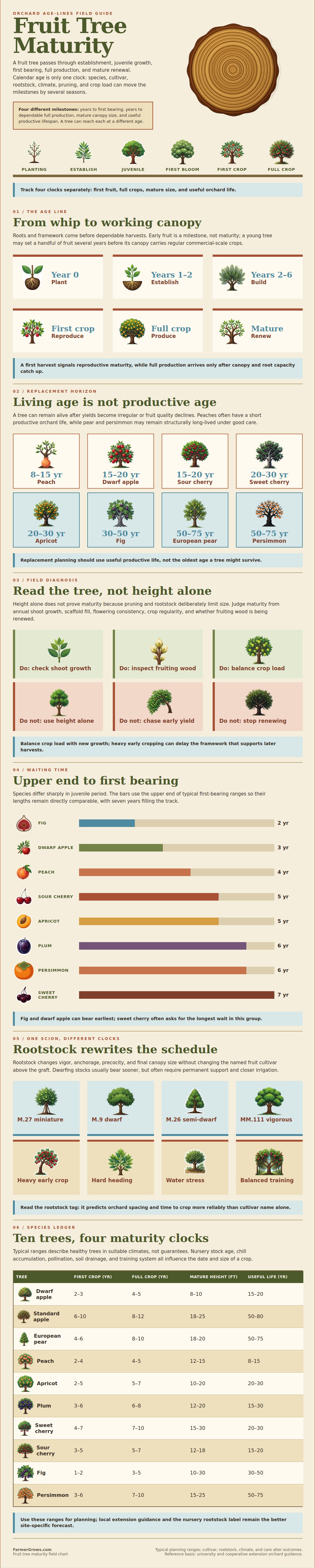
Don’t think of a tree as something that grows and fruits at any given speed. Each phase of its cycle is different than the next, and requires something slightly differnt. Knowing those phases alters your expectations. And your care. A fruit tree has four different stages. There is when it reaches a mature size, when it begins producing full crops, when it produces its first fruit, and how long it lasts before it becomes unproductive.
Why You Must Be Patient With Fruit Trees
After that first fruit, most fruit growers throw up their hands. The tree produce an apple or peach, so it’s productive, right? Wrong. Seeing some fruit means the tree is old enough to bear fruit, but canopy and the root system aren’t prepared to produce heavily. By allowing the tree to bear heavy crops too early, you deny it the energy to create its canopy and roots. Short-term snacking lead to long-term weakness.
Now: “You don’t want the tree spending all of its energy producing fruit; you want the tree to establish good branches and roots.” That’s where rootstock comes in: Depending on the rootstock, the very same variety of apple act differently. Grafted onto a dwarfing rootstock (like M.9), a tree gets pushed to bear fruit earlier (in two to three years or so). Smaller overall, it is also easier to tend. And while it may need permanent stakes, it has a limited life span because roots are shallow.
On a strong rootstock such as MM.111, the tree doesn’t get to bearing as soon, maybe not until four to six years. Eventually, though, that tree will yield more per season, grow to be bigger, and live longer. Do you want your fruit now, or later?
Another important consideration is the length of its useful life. For example, peach trees has a short useful life, perhaps eight to fifteen years of good production until disease pressure mounts. In contrast, European pear trees and persimmon tree can be productive for 50-75 years. That will determine how you plant. Not all trees are meant to be treated as permanent fixtures in the landscape. Some are short-term investors; others is heirlooms.
Not only does a tree’s height mislead you, pruning affects that, as do rootstocks, but also how fast a tree grow, or even its physiological stage (which is called its “phase”). Observe the annual shoot growth. Do they produces long, strong shoots each year? It is still building. Growth is slower, with well-developed spurs. It is in production mode. Examine how consistent the flowers are, too. How good is wood for fruit? The tree will show you its age, not necessarily its calendar age.
GROWING A fruit tree is A patience test. It’s also a test of restraint: Plant one, and then don’t pick fruit too soon because it will compromise the tree’s structure. Don’t be tempted. Let the tree grow…slowly. The tree knows best; all that’s required from you is patience, and soil and water.
Wait some more. The initial crop is a small reward. And then you get the full-grown canopy and the deeply planted roots (the real reward). That’s when timelines line up.