
Have you ever been standing in the grocery aisle with an orange in your left hand and a bag of spinach in your right, questioning whether or not you’re truly nourishing yourself? It’s usually assumed that any brightly colored fruit or vegetable represents some kind of nutritional win. A good start, yes, but there’s more to it than meets the eye.
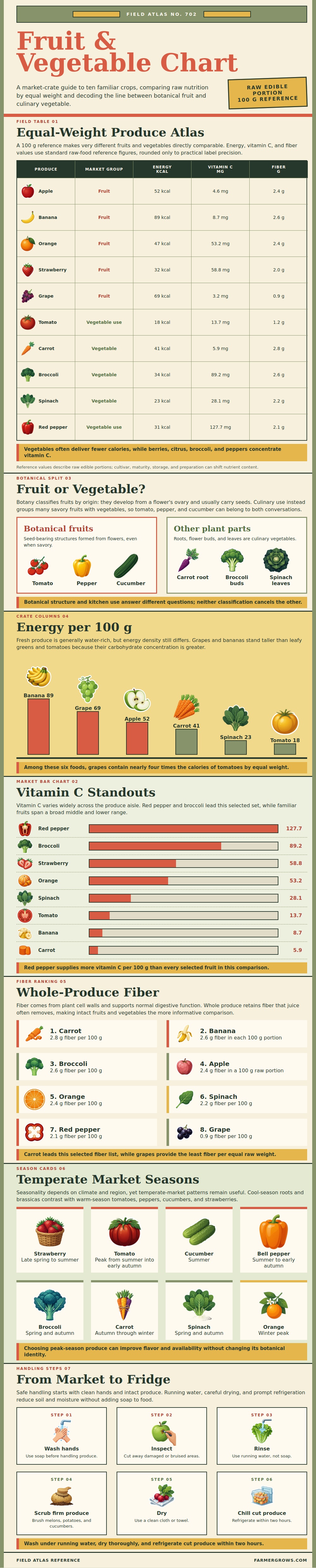
Dive deeper into the contents of these bags, and you’ll find that not all plants are alike; some are calorie-bombs in disguise, others pack almost no calories yet is vitamin powerhouses. Knowing the distinction shifts both your cooking approach and your shopping habits. I break this out into a comparison of raw nutrition by equal weight (see the chart above). This lets us take portion sizes out of the equation and just look at the nutrient density. It really helps us reveal what’s going on behind the scenes with our foods.
Why Knowing the Numbers Helps You Eat Better
Bananas is loaded with more concentrated carbohydrates than tomatoes or even leafy greens. That’s not good or bad (it’s just different). A banana makes perfect sense if you’re looking for fast fuel before a run. Spinach would be the winner if you’re trying to get full on volume but don’t want to raise your energy intake. Knowing this lets you match your food to what you need in the moment, instead of assuming all vegetable are the same.
And then there’s vitamin C, which comes as a surprise to many; they think citrus is the champion of immune-boosters. But when we compare oranges with broccoli and red bell peppers, we find that broccoli and red bell peppers has more vitamin C (per 100g) than oranges. About twice as much in fact, in the case of the red pepper. So keep that in mind next time you’re making dinner plans. Maybe tonight’s stir-fry will be just as good at delivering an antioxidant punch as your morning OJ, without the acidity.
The habit of reaching for fruits over veggies is based off the idea that fruit is automatically the healthy choice. The numbers suggest otherwise: Certain nutrients are better found in certain non-sweet plants. I think it’s also worth clearing up which are vegetables and which are fruits to avoid confusion.
A fruit botanically speaking is anything with seeds that came from a flower. So all of those “vegetables” we grow, like peppers and tomatoes and even cucumbers, are technicaly fruits. But then our cooking culture classifies based off flavor profile: Sweet, tart things belong in the fruit bowl; savory ones go in the vegetable bin. Both categories is correct; they just answer different questions. How do I cook it? How does it fit into the plant kingdom? Letting ourselves have both answers prevents us from getting tripped up when we see a tomato in a salad recipe.
Here’s another category where you might not trust your instincts: Fiber. As it turns out, grapes contain the smallest amount of fiber; carrots top that list. Eating more foods rich in fiber, such as broccoli or carrots. As opposed to low-fiber fruits may help support your digestive health. Juices lack this form of fiber. Which is why consuming the real thing (a.k.a. Eating the whole vegetable tends to be better than sipping on juice.
Season matters too: broccoli and other cool-season crops are tastiest in fall, while strawberries and other warm-season crops is best in summer. In general, fresh foods are freshest (and cheapest) when you buy them in season. That saves money, and it saves the environment from extra shipping.
Last, but never least: Handle with care. To avoid getting sick, wash fruits and vegetables with plain water, then refrigerate cut ones within two hours. No need for fancy cleaners… Or even soap, here.
In the end, though, it’s not so much about hard-and-fast rules when cooking with produce as it is about knowing how each ingredient contribute something to the table, whether that’s vitamins in peppers or fiber in carrots. Knowing the why of what you’re choosing adds purpose to every meal; it transforms a dull grocery outing into a planned one.
You should of looked at the numbers first.