
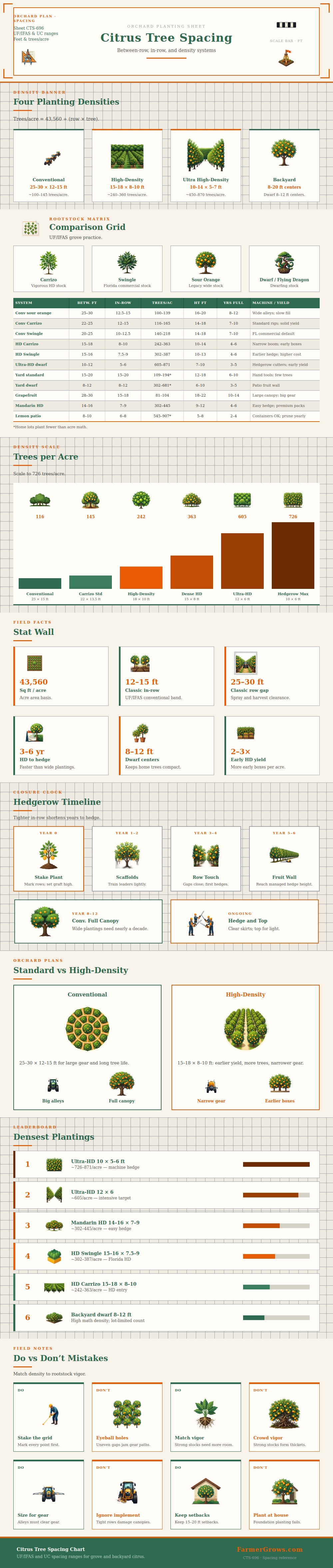
The way a citrus grove is planted, in particular, require some planning. How far apart are the trees? Will this orchard make money, or turn into a jumbled mess?
Besides getting as much fruit as possible from each acre, there is the matter of equipment. Can it move through the rows, and can sunlight reach the tree canopy? There’s also the question of pruning: Just what kind of time are you willing to invest preharvest year one? Rootstock vigor is matched to planting distance in chart (above).
How to Space Your Citrus Trees
In a conventional setup, those trees would be planted on sour orange rootstock. They would be spaced across an alley about twenty to thirty feet wide because they reaches full size at heights of twenty feet or more. Big harvester equipment must move through the orchard without injuring tree trunks; that’s why wider alleys is needed.
By contrast, ultra-high-density systems use dwarfing rootstock; trees are planted just five or six feet from one another. Speed is the objective. Such systems develops a continuous row of fruit-bearing wood fast. After three or five years you’re able to pick substantial amounts. A traditional orchard might take a decade before it reach maturity.
That’s the primary benefit to high-density planting: time. While amateur gardeners tend to think in terms of yield per tree, commercial growers thinks in terms of yield per acre. With high density, you’re thinking about land efficiency different than individual tree performance.
Closer-planted trees compete with one another for sunlight. That competition cause them to bear fruit sooner (and more reliably). The fruit isn’t just at the tips of branches but throughout the whole tree. It’s a short-term gain (you sacrifice your trees’ long-term longevity) but instant cashflow. And it works. Provided you hedge carefuly.
Don’t cut the sides and tops of the trees regular enough, and the rows will blur into each other. Next thing you know, you have a wall of shade, which mean increased risk of disease. The right distance depends on your equipment options, as well. Small pieces of machinery is appropriate for narrow rows. Wide machines suits big row widths and accommodate standard tractors and large harvesting rigs.
If you eyeball the spacing and plant too close, your future labor costs will grow. The result could of manual pruning rather than machine work. Unevenly spaced trees can cause problems in gear paths, and they form shady spots where pests lurk. An innocent error at planting day becomes a big bill down the road.
For the backyard enthusiast, it’s different mathematics. No combine harvester is required. Looks and access come first. For small yards (or patios), consider dwarf varieties, which remain compact and bear fruit early on. Plant them with eight to twelve feet of clearance, or grow them in containers. This prevents roots from choking your lawn and keeps the tree at a manageable height.
Before breaking ground, be sure to match the tree’s mature size to the area where it will live. When spacing your citrus trees, you are balancing the amount of space you want to manage against the size of the tree that will produce fruit first.
The low-maintenance strategy is wide spacing. They’ll take more abuse, and bigger trees handles more wind than small ones do. A high-reward strategy is planting densely, but it means you must constantly pay attention.
Mark out the grid ahead of time, no matter if you have one lemon tree or 100 acres of mandarin oranges. That way, the plan will make it through first frost. Not the shovel. Lay it out before you dig in.