
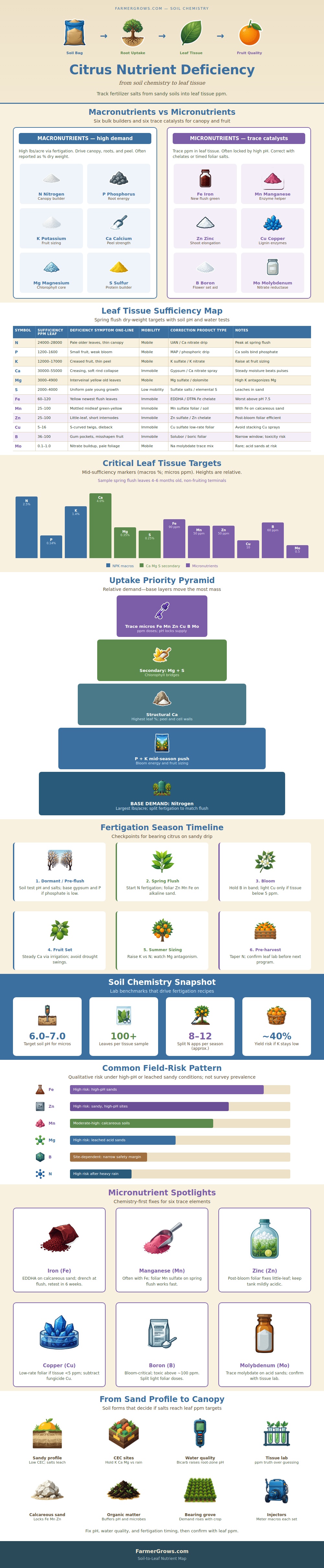
Your plant shows yellow leaves and your initial response is: Feed me Nitrogen! That seems to be the right solution. After all, you desire green leaves. So you give tree the main building block of nutrients.
But citrus plants are complicated living systems, and giving them more of one nutrient that is causing a reaction because another is out-of-balance doesn’t work. It may appear as though something is being done, but it won’t correct the issue. In fact, the true effort take place down under. It’s happening in sandy soil where nutrients leach away faster then you can inject them.
Stop Guessing: Fix Your Citrus Plant’s Nutrients
As you can see on the chart above, for example, there are clear signs that distinguishes an iron deficiency from a lack of nitrogen. Why does this matter? This matters because the cure for each might be the exact opposite of the other.
Nitrogen is a mobile plant nutrient: As the tree sends fresh food to growing parts, it pulls nitrogen from older foliage to newer growth; resulting in bottom leaves going pale with darker-colored tips.
Iron is an immobile plant nutrient: It doesn’t get carried around by the tree; it just sits where it landed, and newest foliage goes bright yellow while rest of canopy stays green. Get two confused and you’ll waste time (and money) as well as stressing out your trees.
The visual hierarchy show that wide base of the uptake pyramid consist of macronutrients: nitrogen, phosphorus, and potassium, which go into fruit size and canopy growth. But before any of that happens, there’s a soil issue to contend with: pH locks out many of these nutrients from the tree’s ability to get at them. Heavy rain also carries them off, especially in sandy soils (which also has a low ability to hold nutrients). So it isn’t so much adding, as keeping what you do add in the root zone long enough to be taken up.
The total amount applied annually counts less then whether it was applied in stages. One huge dose mostly goes straight to ground water.
Trickier are micronutrients such as boron. There’s not much margin for error with micronutrients. Too little is bad. Too much is toxic real fast. The graphic illustrates this tight line, showing how boron is necessary for fruit shape and flower set, but can absorbs at high levels.
A lot of people who grow things makes the mistake of thinking of trace elements as macronutrients and therefore think that “more is better.” That is simply untrue. Often manganese and zinc gets locked up in calcareous soils, typical in citrus areas. If the pH rises to seven or higher, these micronutrients fall out of solution and are no longer available for uptake, even when added to soil.
Here is where foliar chelates come into play. They are only means of delivery that avoids blockage of soil chemistry.
The second part of that equation is timing. A fall application will not remedy a spring flush deficiency. The tree must has the nutrient when it makes it. When new leaves are expanding, it needs iron. When fruit is growing, it needs potassium. The chart’s seasonal timeline help you navigate those checkpoints. It tells you when to add more calcium and when to dial back on the nitrogen. It is a waste of resources if you ignore it.
The bottom line: Citrus nutrition management is more of a matter of verification than guesswork. You have potential through soil tests. But you would of had truth through leaf tissue analysis. Get your water quality right. Get your soil pH under control. Time your fertilizers to match the tree’s biological needs, and let canopy tell you it’s all working out. Know what to look for in leaves, and the tree will tell you if you goofed.