
Citrus seems simple on the supermarket shelf, but it isn’t. Those clear-cut fruits? They’re products of careful selection, and also of long-ago accidents. There’s no tidy citrus family tree. Think of it as a genetic tangle; each branch is linked to all others, whether we realize it or not.
Few of us stop to think about such origins, yet each fruit in your shopping basket is a patchwork of just a handful of ancestral species. That’s why the supermarket will never go out of business.
The Mixed Family of Citrus Fruits
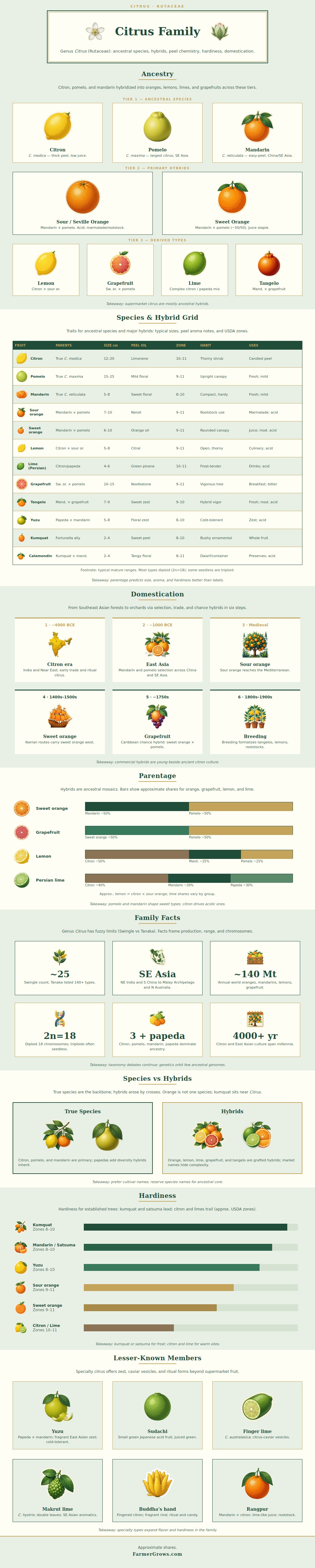
There were three primary ancestors in the story of the moddern orange. They’re the base layer of the infographic. First: the citron. Hailing from ancient times, it’s used for scent and ritual rather than consumption; think very thick-skinned. Next: C. Grandis, or pomelos (also known as pummelos). A giant of the Southeast Asian fruit kingdom, this brings some mild sweetness and size to the party. And finally, there is a compact, peely, and brightly floral-sweet mandarin (C. Reticulata). The mandarin (C. Reticulata) had DNA that donated everything else in the mix. In fact, a real orange is half pomelo and half mandarin. People tend to think oranges is their own unique species, but they are actualy a 50-50 blend and more like a recipe.
So that’s where it gets interesting: Why is some citrus sour, and others sweet? How do you know which way to cook with any given type of fruit? It’s all about blending. Once you get the picture of the derived types, you’ll find the pattern. Citrus varieties (mostly) have citron, pomelo, and mandarin in their DNA. That accounts for the sharp, aromatic punch of lemons, those are the flavors from the ancient citron line. And grapefruit (a combination of pomelo and sweet orange) gets its bitter twist from one parent and its size from the other.
Regarding the peel, the genetics are followed by the chemistry. Lemon zest holds its own bag of essential oils. The inherited traits. Those come from certain crosses. Knowing that let you predict what will happen in the kitchen with any given fruit. For example, if you want something for your baking, you’re looking for those traits from the mandarin lineage. If you want acid for preserving purposes, citron hybrids is the ticket.
How it all came together genetically is an interesting story. Here is a brief history: The trip from the tree to the supermarket wasn’t a straight shot. From India, it traveled slowly along trade routes over the span of several thousands of years. That is what the chart shows. Starting approximately 4,000 years ago there were citrons in India. Next came pomelos and mandarins throughout East Asia. In the Middle Ages, the sour orange landed in the Mediterranean. They was used as a rootstock to graft onto and to make marmalade, among other things. Around the fourteenth century, sweet oranges made their way into the West thanks to Iberian traders. And then, by the middle of the seventeenth century, grapefruits first showed up in the Caribbean. It happened by accident.
So that’s how citrus feels at once so old and so varied: you’re tasting the outcome of hundreds of years of unintentionally trying things out.
Know thy ancestors. Want to grow a tree? Find out which ancestor is dominant to know how hardy it will be. “Satsumas and kumquats tend to be cold-hardy,” says the infographic, explaining why they may thrive in zones eight through ten (and often do). Limes and citrons prefers zones 10 and 11. They like it hot: zone ten and up. So seek out those with some kumquat or mandarin influence if your climate is cooler. And don’t try forcing a Persian lime into a chilly place; you’ll just be disappointed.
It’s not just the variety but also the rootstock. The roots of sour oranges make the whole tree stronger and less prone to diseases. Sure, you can push the tree to grow, but you could of pushed its genetics to forget the weather. A lesson from the citrus world: Humility is good for all of us. Nature doesn’t do boxes. She does mixes and she does gradients.
Next time you peel a mandarin or squeeze a lemon, remind yourself that it’s a slice of history, formed by the hand of farmers’ skill, and the trade winds. That’s what makes it complex. That’s why we get such a range of flavors, from the most pithy of limes (useful in the kitchen) to the sugariest of dessert oranges (perfect at dessert). Without them, we’d have no morning juice…and no holiday treats. The tree is messy, but the fruit is tasty.