
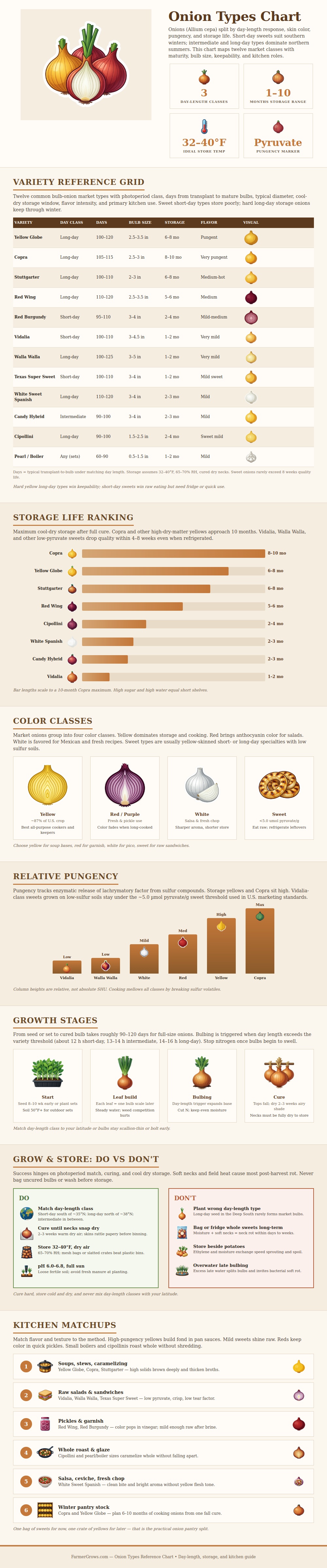
Onions are complex. They react very differently based off their growing environment, such as soil chemistry and sun exposure, and to how they are stored after harvest. To understand onions a little better, have a look at the chart (above) comparing 12 typical market varieties. It compare them by storage time, pungency level, and response to day length.
Knowing where your onion fits into this picture will affect not only what you prepare it for but also when you buy it and how you store it. It will prevent you from slicing a pungent storage type into a tender salad, and then again from storing a sweet onion for three months.
How to Choose, Store, and Cook Onions
The most important factor is day length. Onions are day-length plants, meaning they require a certain number of daylight hours to tell them to start making bulbs. Planting a long-day type when days remain short (as they do in the deep south) never gives the plant the signal to do anything but keep on going, producing more foliage; it doesn’t swell and you wind up with a bunch of scallions rather than bulbs. Up north, growing short-day types tends to cause them to bolt and produce seed before they has time to really form a good bulb.
The infographic maps out those classes neatly, with long-day dominating summer northerly latitudes, and short-day sweets working for winter in the south. Match your variety to your latitude or your harvest will be one of disappointment.
Then what? How do we store those bulbs once they form? Sweet onions are delicious, but oh-so-fragile. Their high water and sugar content means they is perfect for eating raw (hello, salads!), but they are terrible at staying fresh for long (they don’t even last a couple of weeks in good shape).
Hard yellow long-day varieties such as Yellow Globe or Copra (high-dry matter content; thick-skinned) are completely different: they are reliable kitchen staples that can absorbs in a dry, cool spot for up to 10 months. One will get you through the winter; the other will have to be used up before it goes bad. They are quite different than how useful they are!
There’s a third dimension: Pungency. The chart measures this as pyruvate, which shows how much sulfur compounds breaks down into tear-inducing factors. It is all about those high-pungency yellows. They make an ideal base for building up a richly flavored stew or soup through deep-caramelizing flavors that thicken the broth.
The mellow types (such as Walla Walla or Vidalia) won’t cross the sweet line, keeping their crispness and low level of tear factor; these are great eaten raw in salads and sandwiches. The reds, with their anthocyanins and color on the table, really pop in garnish and pickles but cook down over time. And don’t forget: White onions is also more of a mainstay than yellows, with a cleaner bite and sharper aroma. Their whiter flesh won’t tinge your dish yellow, making them the go-to for fresh chopping and salsa.
A little thing, yes… But presentation counts.
The number-one storage mistake is storing onions near potatoes. They give off moisture and ethylene gas that cause both to go bad fast, which makes the onion sprout. The ideal spot for onions? Store them in a dry location with good air circulation, like a bin with holes or a mesh bag kept cool and dark. Do not store moist onions. Snap the necks off at harvest time to dry them thoroughly, and cure them first before storing. Wet neck equals rot invitation.
Once you get the idea, it’s easy with onions in the kitchen: Cook the high-solids yellows a long time; serve them raw as the low-pyruvates of choice. Roast the little cippolini whole; pickle the reds so they don’t lose their color. Match the strength of the onion to its application.
Imagine it is like a double-tiered pantry. You have a bag of the sweeter ones for instant use, which is a practical split that is less wasteful and more economical. You also have a crate of the harder yellows for long-term keeping as your insurance policy if the shelves go bare. You stop guessing, you cook with intent, and you begin to respect the biology of the plant. It turns a simple vegetable into a solid building block for any meal.
This, my friend, is how you cook.